Issue 78
· Keeping it in the family
With the season in full flow Fantasy Bob has managed to compile another bumper edition of the Arrow in between his regular net sessions and range-hitting practice. In this issue there is a feature on Drumpellier, the Arrows opponents in the next round of the Scottish Cup, as well as look back at the storied history of the big house that overlooks the ground. There is also a look back at the various tied matches that the club has been involved in over the years and also news about the Pitchero Club Lottery which can provide the club with much needed funds as well as cash prizes for those taking part, and much, much more.
Text of this page
The Newsletter of Carlton Cricket Club
May 2025 Issue 78
FOLLOW CARLTON
FOLLOW CARLTON
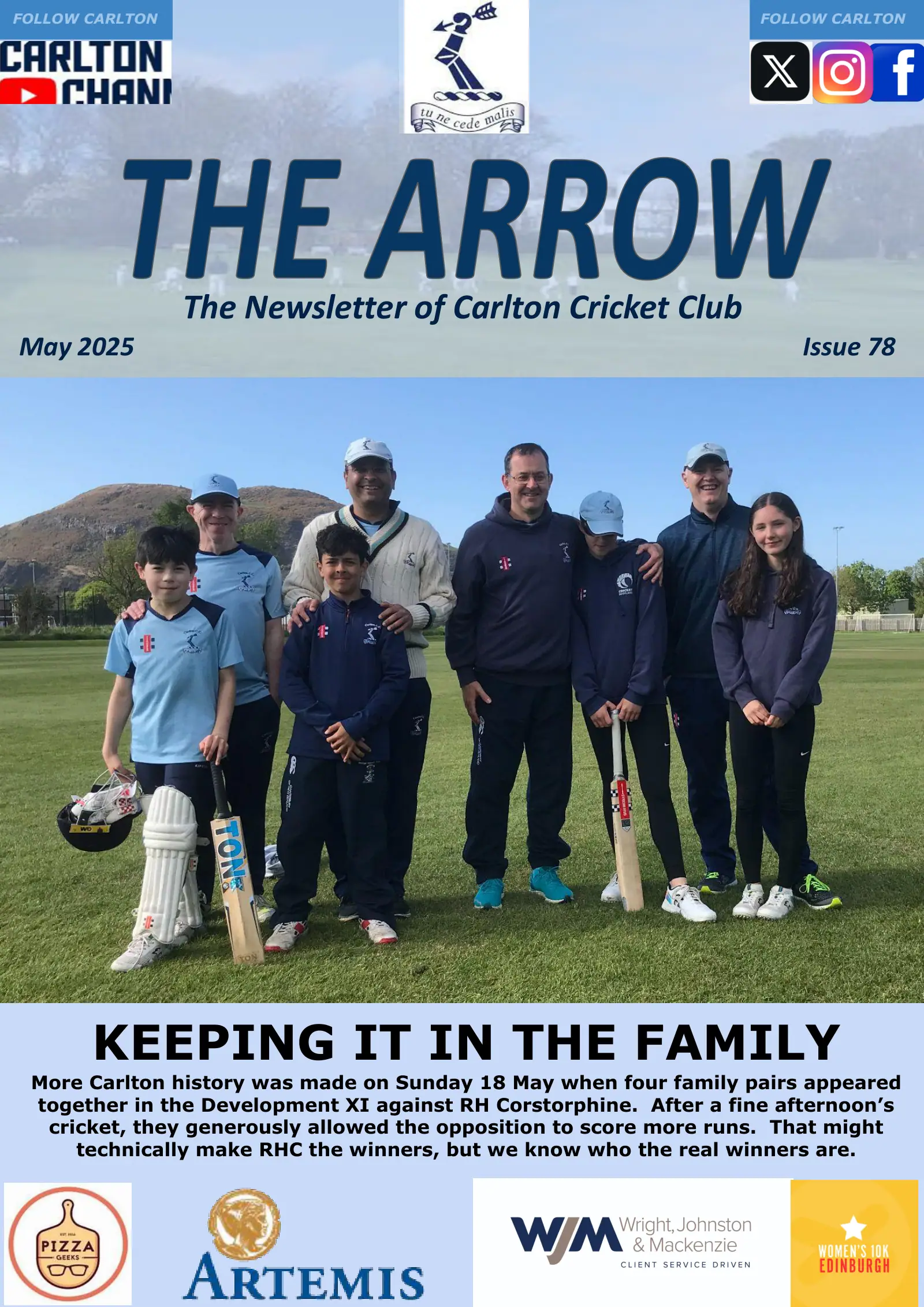
KEEPING IT IN THE FAMILY
More Carlton history was made on Sunday 18 May when four family pairs appeared
together in the Development XI against RH Corstorphine. After a fine afternoon’s
cricket, they generously allowed the opposition to score more runs. That might
technically make RHC the winners, but we know who the real winners are.
Text of this page
CARLTON V DRUMPELLIER
Following their exciting first round victory over Stenhousemuir, Carlton will face Shimla Cottage
Drumpellier at Grange Loan on Sunday 25 May in the second round of the Scottish Cup.
Drumpellier CC celebrates its 175th Anniversary this year and it is 150 years since Carlton and
Drumpellier first met. The club was established in 1850 when landowner Sir David Carrick
Buchanan, himself a keen cricketer, made a field in his estate at Coatbridge available to
enthusiastic local cricketers. While the ground is called Langloan, he insisted that the cricket
club is called Drumpellier, after his estate and mansion. Many of the original players were
workers on his estate.
Reflecting its origins, the motto of the club Audaces Juvo (I aid the brave) is the motto of the
Buchanan clan.
Drumpellier have won 10 WDCU Championships, the most recent being in 1992. They have
won the Scottish Cup 4 times, most recently in 1995, and they have won the Rowan Cup 5
times, the last being in 2019.
Drumpellier currently play in Premier 1 of the WDCU where they finished fifth in 2024.
Langloan from the
air
Text of this page
CARLTON V DRUMPELLIER
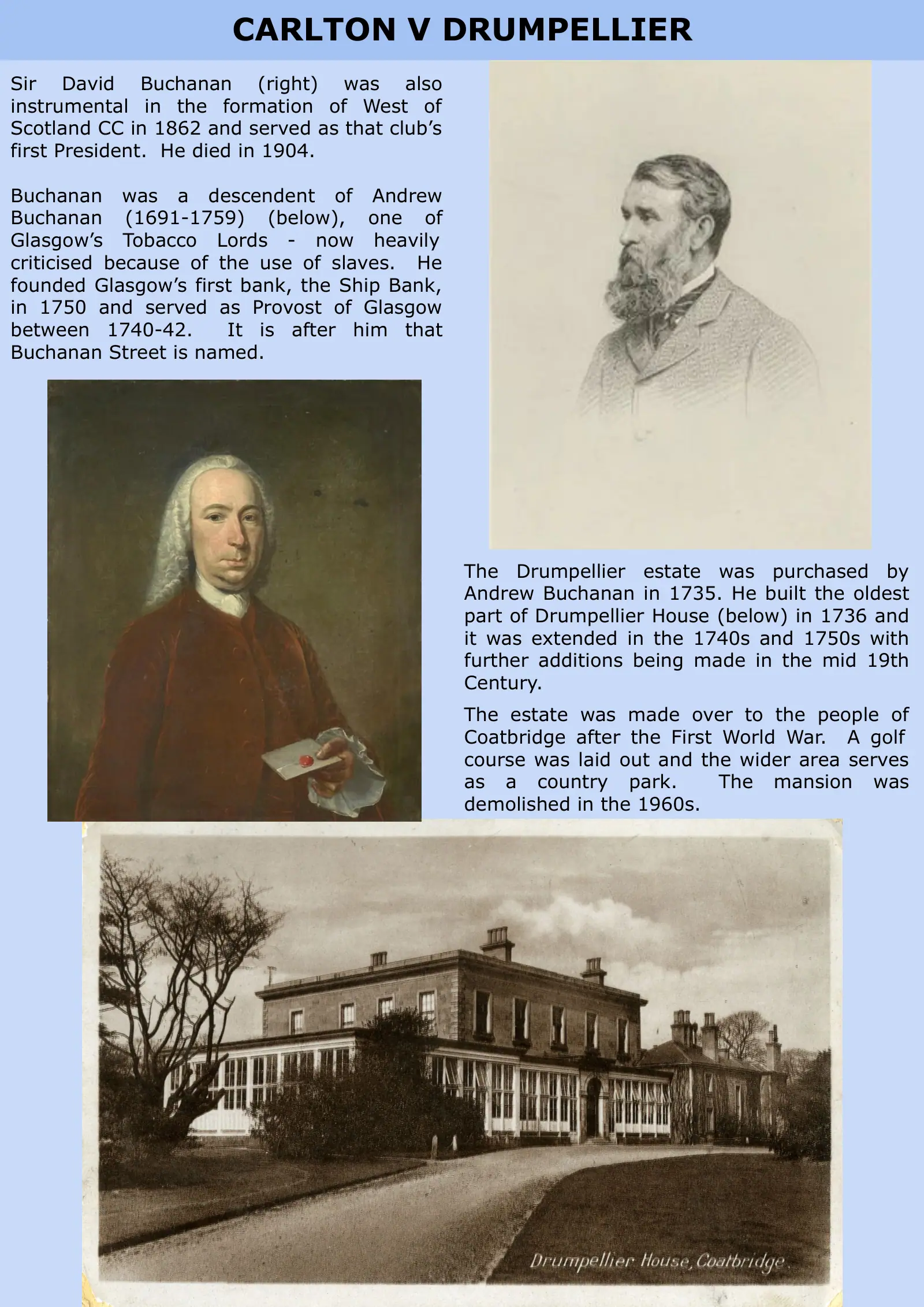
Sir
David
Buchanan
(right)
was
also
instrumental in the formation of West of
Scotland CC in 1862 and served as that club’s
first President. He died in 1904.
Buchanan was a descendent of Andrew
Buchanan
(1691-1759)
(below),
one
of
Glasgow’s Tobacco Lords - now heavily
criticised because of the use of slaves. He
founded Glasgow’s first bank, the Ship Bank,
in 1750 and served as Provost of Glasgow
between 1740-42. It is after him that
Buchanan Street is named.
The Drumpellier estate was purchased by
Andrew Buchanan in 1735. He built the oldest
part of Drumpellier House (below) in 1736 and
it was extended in the 1740s and 1750s with
further additions being made in the mid 19th
Century.
The estate was made over to the people of
Coatbridge after the First World War. A golf
course was laid out and the wider area serves
as a country park. The mansion was
demolished in the 1960s.
Text of this page
The ground at Langloan was laid out by the
same man who had curated Hamilton Crescent
for
West
of
Scotland
CC,
John
Sands.
Drumpellier soon became a force in West of
Scotland cricket and Langloan one of the best
grounds.
In 1860 Colonel Buchanan’s Scotland Team (of
16) took on Ireland (team of 11) at Langloan
losing by an innings and 44 runs. The
following year, Buchanan’s team, this time
numbering 14, managed a noble draw against
the Irish XI.
In 1877 WG Grace’s United South of England
XI took on the 22 of Drumpellier and lost,
despite Grace’s 57 in the first innings. In the
second innings he was run out for 0.
It is now 150 years since the first meeting
between Carlton and Drumpellier in July 1875.
Carlton travelled to Langloan - a gruelling two
train journey and had considerably the worse
of the draw for their pains. The home side
batted for 5 hours to accumulate 206. The
Airdrie and Coatbridge Advertiser summed up
Carlton’s response, ‘Carlton next went in, but
made no stand and when time was called they
had only made 51 with one wicket to fall.’
Regular encounters followed. In August 1877
Carlton visited Langloan again. The Airdrie and
Coatbridge Advertiser reported that, ‘The
visitors did not arrive until 2 o’clock, just a
couple of hours beyond the time fixed for
commencement of the match and then only
with eight men. Players were lent, one of
whom, disguised in newspaper reports as
‘Turnbull’, was significant in Carlton’s victory
scoring
59
and
taking
3
wickets
-
Drumpellier’s first defeat of the season.
CARLTON V DRUMPELLIER
In 1885, Carlton’s efforts over 2 innings failed
to reach half of Drumpellier’s first innings
total. This was one of only two losses Carlton
sustained that season.
In 1904, Carlton were ‘brilliant in the field’
restricting Drumpellier to 57. With rain
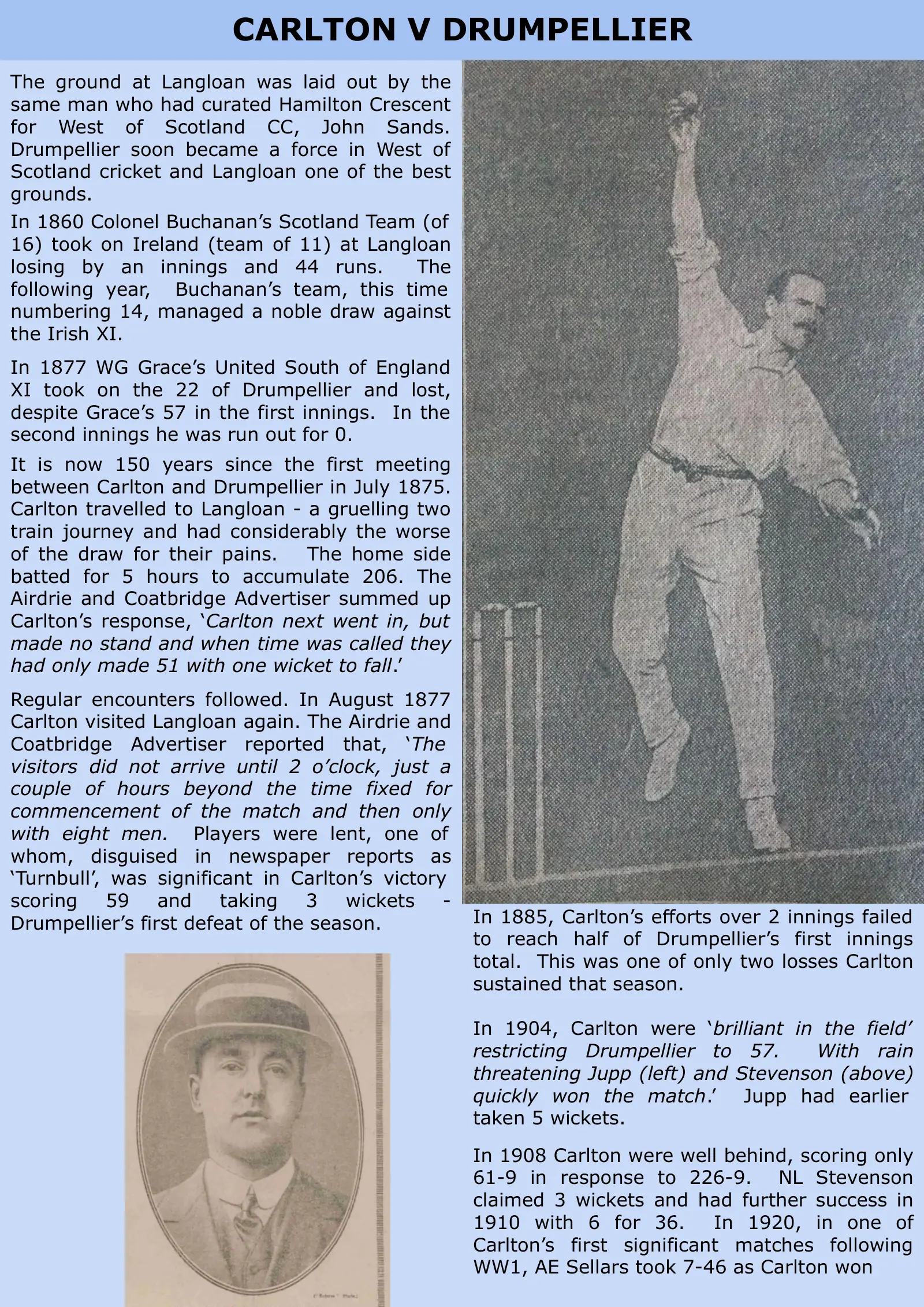
threatening Jupp (left) and Stevenson (above)
quickly won the match.’ Jupp had earlier
taken 5 wickets.
In 1908 Carlton were well behind, scoring only
61-9 in response to 226-9. NL Stevenson
claimed 3 wickets and had further success in
1910 with 6 for 36. In 1920, in one of
Carlton’s first significant matches following
WW1, AE Sellars took 7-46 as Carlton won
Text of this page
With the development of the Western Union,
matches became less frequent and Carlton
and
Drumpellier
did
not
encounter
one
another on league business during the SNCL.
Meetings were restricted to cup ties, of which
there have been 8 since 1972, 4 at each
ground. Carlton have won 6 of these.
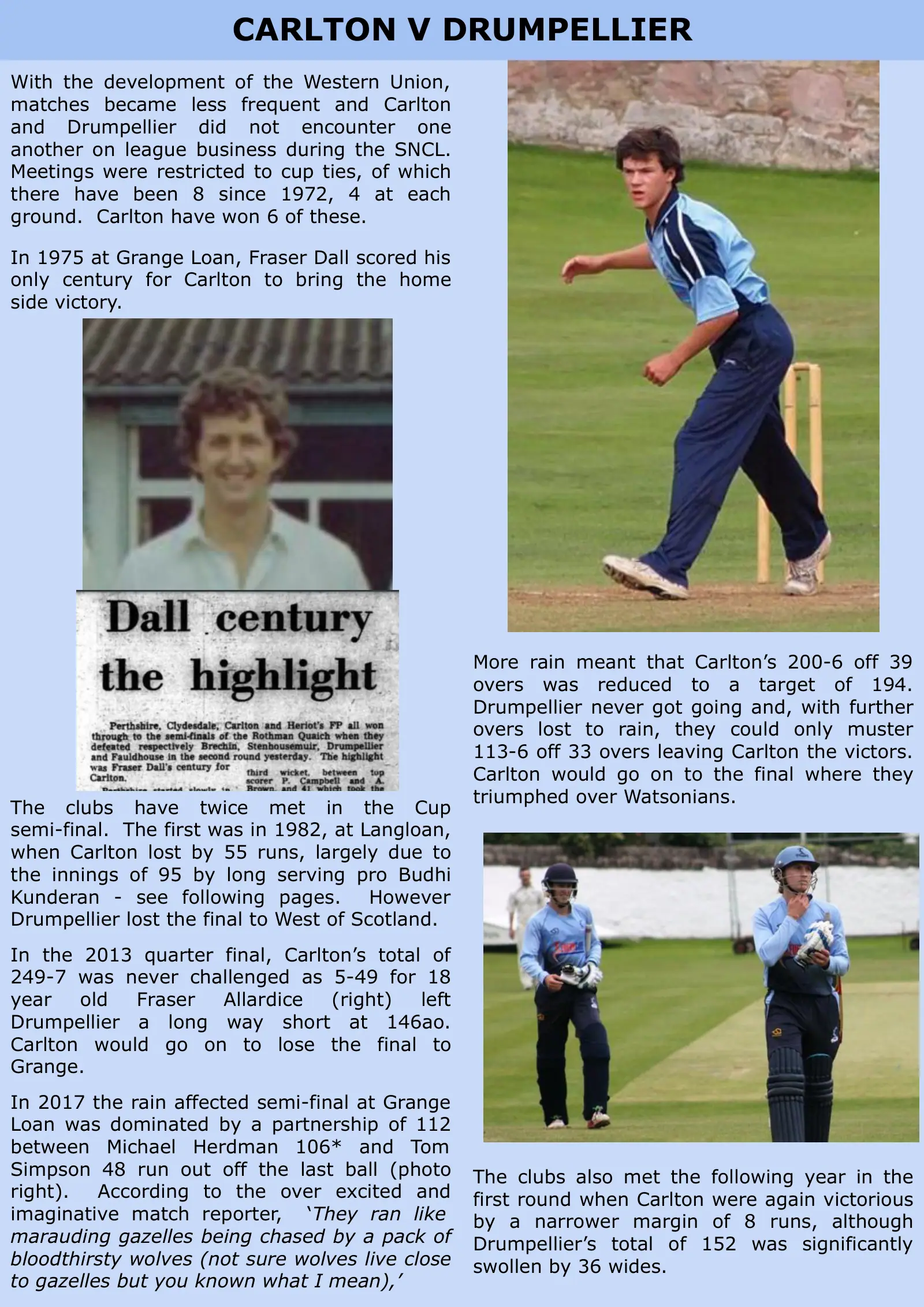
In 1975 at Grange Loan, Fraser Dall scored his
only century for Carlton to bring the home
side victory.
The clubs have twice met in the Cup
semi-final. The first was in 1982, at Langloan,
when Carlton lost by 55 runs, largely due to
the innings of 95 by long serving pro Budhi
Kunderan - see following pages. However
Drumpellier lost the final to West of Scotland.
In the 2013 quarter final, Carlton’s total of
249-7 was never challenged as 5-49 for 18
year
old
Fraser
Allardice
(right)
left
Drumpellier a long way short at 146ao.
Carlton would go on to lose the final to
Grange.
In 2017 the rain affected semi-final at Grange
Loan was dominated by a partnership of 112
between Michael Herdman 106* and Tom
Simpson 48 run out off the last ball (photo
right). According to the over excited and
imaginative match reporter, ‘They ran like
marauding gazelles being chased by a pack of
bloodthirsty wolves (not sure wolves live close
to gazelles but you known what I mean),’
CARLTON V DRUMPELLIER
More rain meant that Carlton’s 200-6 off 39
overs was reduced to a target of 194.
Drumpellier never got going and, with further
overs lost to rain, they could only muster
113-6 off 33 overs leaving Carlton the victors.
Carlton would go on to the final where they
triumphed over Watsonians.
The clubs also met the following year in the
first round when Carlton were again victorious
by a narrower margin of 8 runs, although
Drumpellier’s total of 152 was significantly
swollen by 36 wides.
Text of this page
Drumpellier will mark their 175th Anniversary with
a match against an Indian Select XI on 10 August.
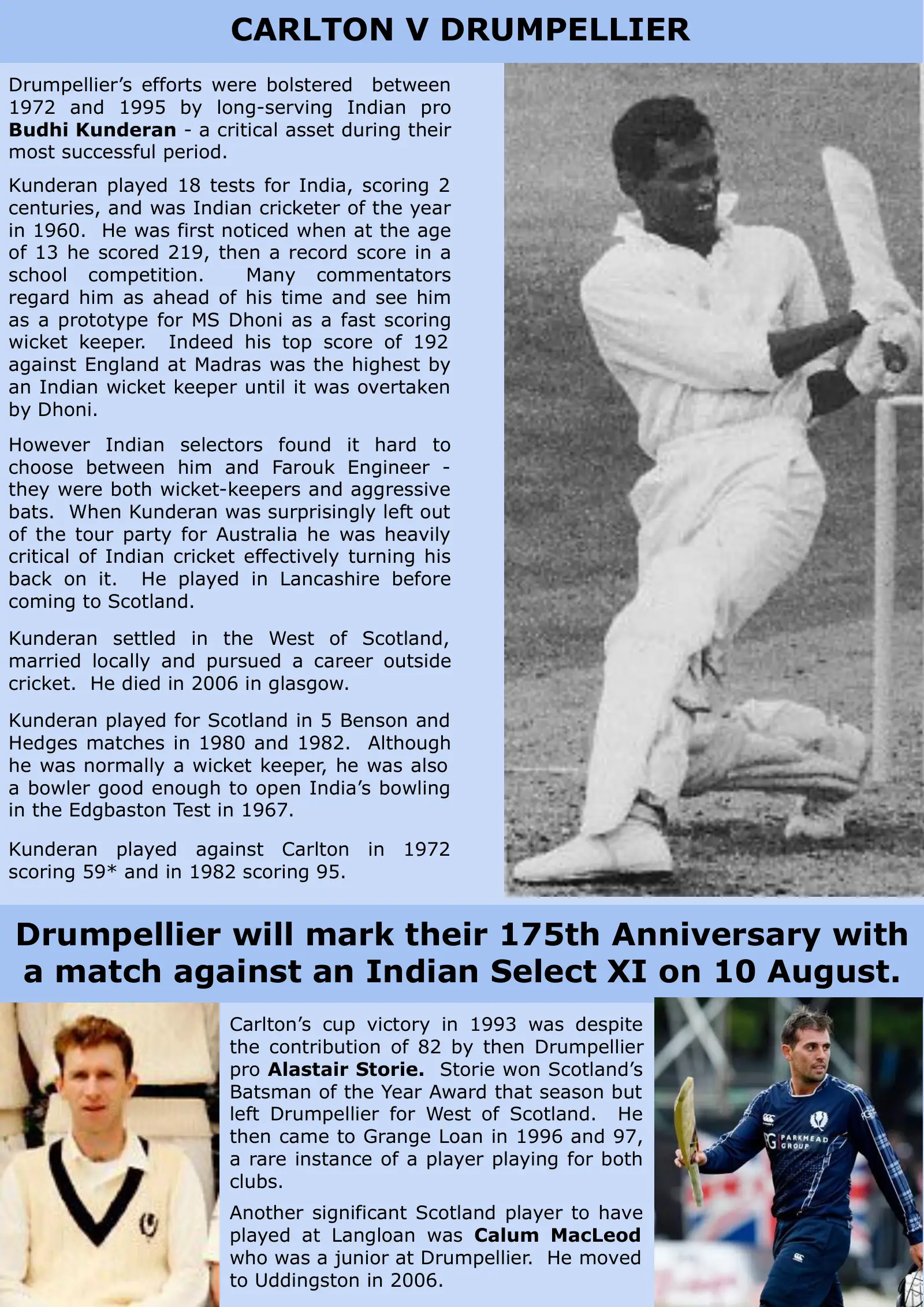
Drumpellier’s efforts were bolstered between
1972 and 1995 by long-serving Indian pro
Budhi Kunderan - a critical asset during their
most successful period.
Kunderan played 18 tests for India, scoring 2
centuries, and was Indian cricketer of the year
in 1960. He was first noticed when at the age
of 13 he scored 219, then a record score in a
school competition. Many commentators
regard him as ahead of his time and see him
as a prototype for MS Dhoni as a fast scoring
wicket keeper. Indeed his top score of 192
against England at Madras was the highest by
an Indian wicket keeper until it was overtaken
by Dhoni.
However Indian selectors found it hard to
choose between him and Farouk Engineer -
they were both wicket-keepers and aggressive
bats. When Kunderan was surprisingly left out
of the tour party for Australia he was heavily
critical of Indian cricket effectively turning his
back on it. He played in Lancashire before
coming to Scotland.
Kunderan settled in the West of Scotland,
married locally and pursued a career outside
cricket. He died in 2006 in glasgow.
Kunderan played for Scotland in 5 Benson and
Hedges matches in 1980 and 1982. Although
he was normally a wicket keeper, he was also
a bowler good enough to open India’s bowling
in the Edgbaston Test in 1967.
Kunderan played against Carlton in 1972
scoring 59* and in 1982 scoring 95.
Carlton’s cup victory in 1993 was despite
the contribution of 82 by then Drumpellier
pro Alastair Storie. Storie won Scotland’s
Batsman of the Year Award that season but
left Drumpellier for West of Scotland. He
then came to Grange Loan in 1996 and 97,
a rare instance of a player playing for both
clubs.
Another significant Scotland player to have
played at Langloan was Calum MacLeod
who was a junior at Drumpellier. He moved
to Uddingston in 2006.
CARLTON V DRUMPELLIER
Text of this page
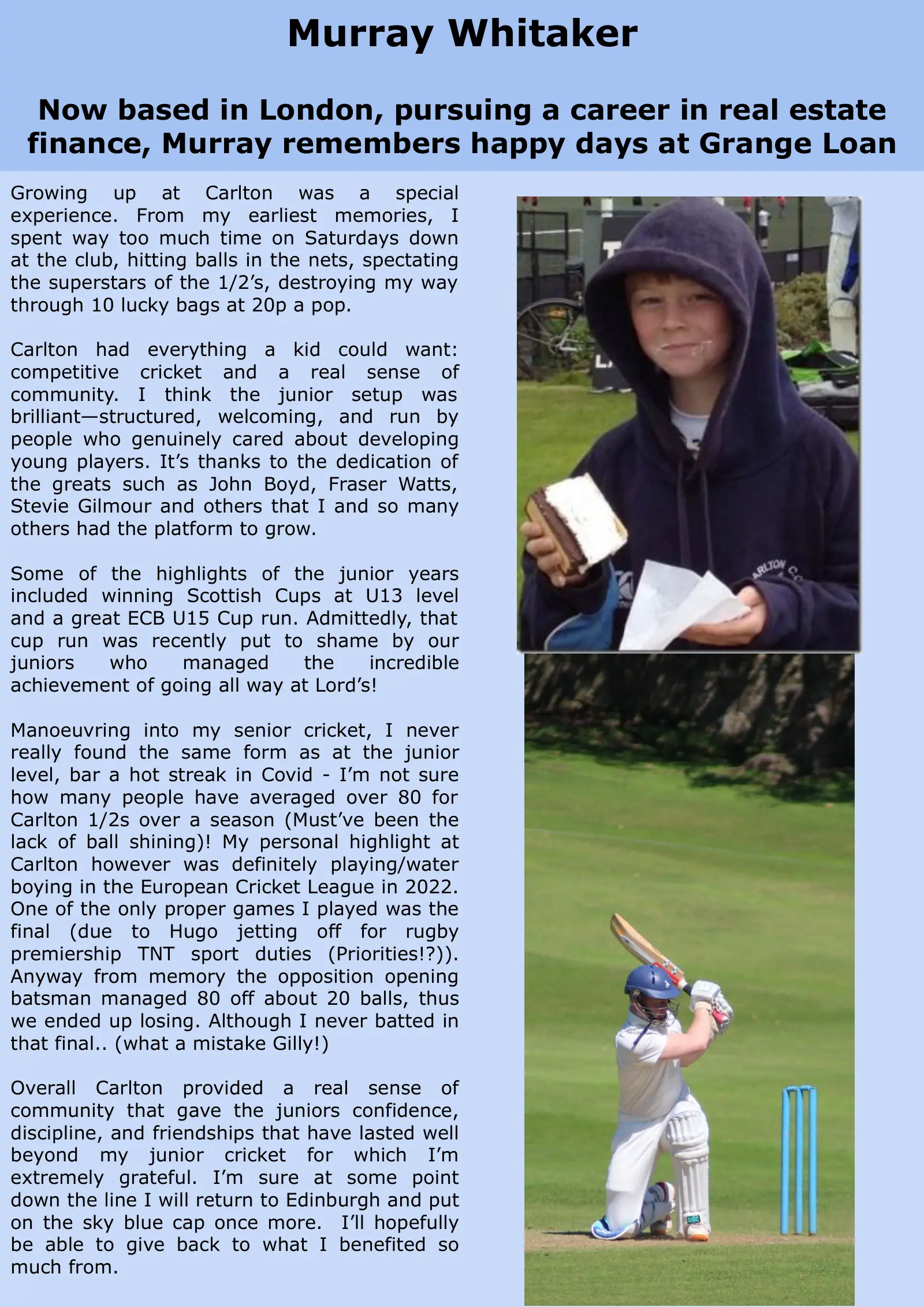
Growing
up
at
Carlton
was
a
special
experience. From my earliest memories, I
spent way too much time on Saturdays down
at the club, hitting balls in the nets, spectating
the superstars of the 1/2’s, destroying my way
through 10 lucky bags at 20p a pop.
Carlton had everything a kid could want:
competitive cricket and a real sense of
community. I think the junior setup was
brilliant—structured, welcoming, and run by
people who genuinely cared about developing
young players. It’s thanks to the dedication of
the greats such as John Boyd, Fraser Watts,
Stevie Gilmour and others that I and so many
others had the platform to grow.
Some of the highlights of the junior years
included winning Scottish Cups at U13 level
and a great ECB U15 Cup run. Admittedly, that
cup run was recently put to shame by our
juniors
who
managed
the
incredible
achievement of going all way at Lord’s!
Manoeuvring into my senior cricket, I never
really found the same form as at the junior
level, bar a hot streak in Covid - I’m not sure
how many people have averaged over 80 for
Carlton 1/2s over a season (Must’ve been the
lack of ball shining)! My personal highlight at
Carlton however was definitely playing/water
boying in the European Cricket League in 2022.
One of the only proper games I played was the
final (due to Hugo jetting off for rugby
premiership TNT sport duties (Priorities!?)).
Anyway from memory the opposition opening
batsman managed 80 off about 20 balls, thus
we ended up losing. Although I never batted in
that final.. (what a mistake Gilly!)
Overall Carlton provided a real sense of
community that gave the juniors confidence,
discipline, and friendships that have lasted well
beyond my junior cricket for which I’m
extremely grateful. I’m sure at some point
down the line I will return to Edinburgh and put
on the sky blue cap once more. I’ll hopefully
be able to give back to what I benefited so
much from.
Murray Whitaker
Now based in London, pursuing a career in real estate
finance, Murray remembers happy days at Grange Loan
Text of this page
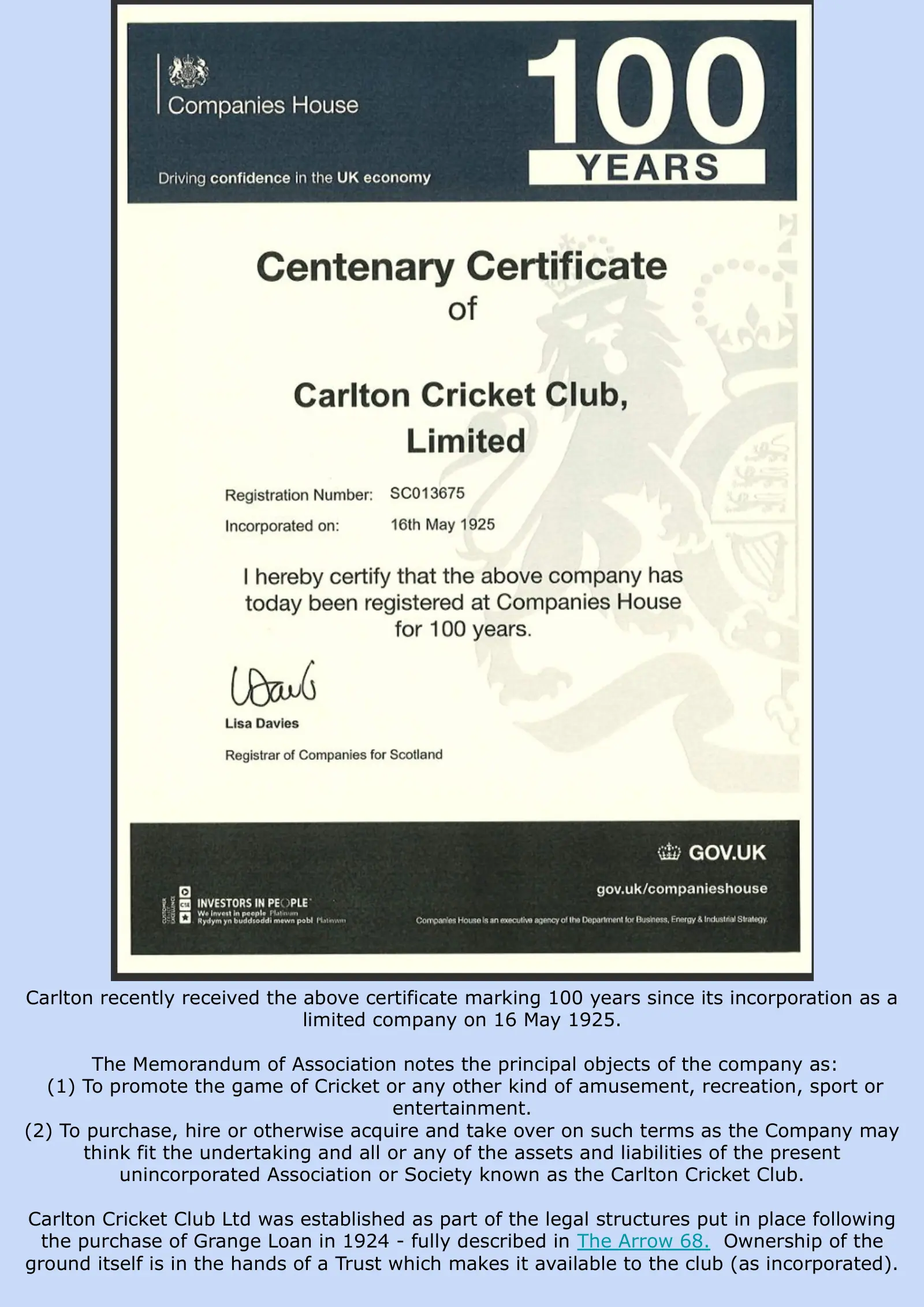
Carlton recently received the above certificate marking 100 years since its incorporation as a
limited company on 16 May 1925.
The Memorandum of Association notes the principal objects of the company as:
(1) To promote the game of Cricket or any other kind of amusement, recreation, sport or
entertainment.
(2) To purchase, hire or otherwise acquire and take over on such terms as the Company may
think fit the undertaking and all or any of the assets and liabilities of the present
unincorporated Association or Society known as the Carlton Cricket Club.
Carlton Cricket Club Ltd was established as part of the legal structures put in place following
the purchase of Grange Loan in 1924 - fully described in The Arrow 68. Ownership of the
ground itself is in the hands of a Trust which makes it available to the club (as incorporated).
Text of this page
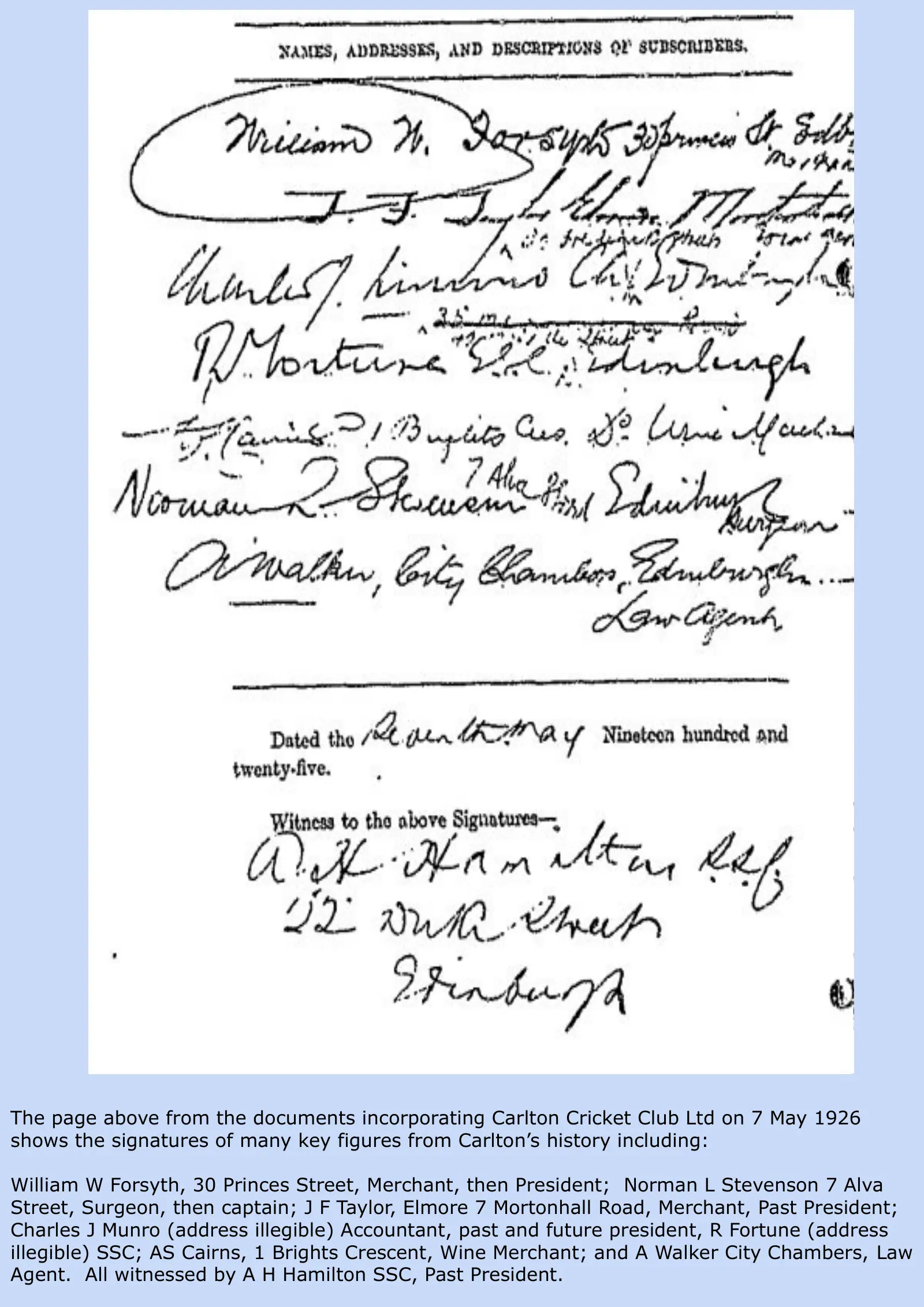
The page above from the documents incorporating Carlton Cricket Club Ltd on 7 May 1926
shows the signatures of many key figures from Carlton’s history including:
William W Forsyth, 30 Princes Street, Merchant, then President; Norman L Stevenson 7 Alva
Street, Surgeon, then captain; J F Taylor, Elmore 7 Mortonhall Road, Merchant, Past President;
Charles J Munro (address illegible) Accountant, past and future president, R Fortune (address
illegible) SSC; AS Cairns, 1 Brights Crescent, Wine Merchant; and A Walker City Chambers, Law
Agent. All witnessed by A H Hamilton SSC, Past President.
Text of this page
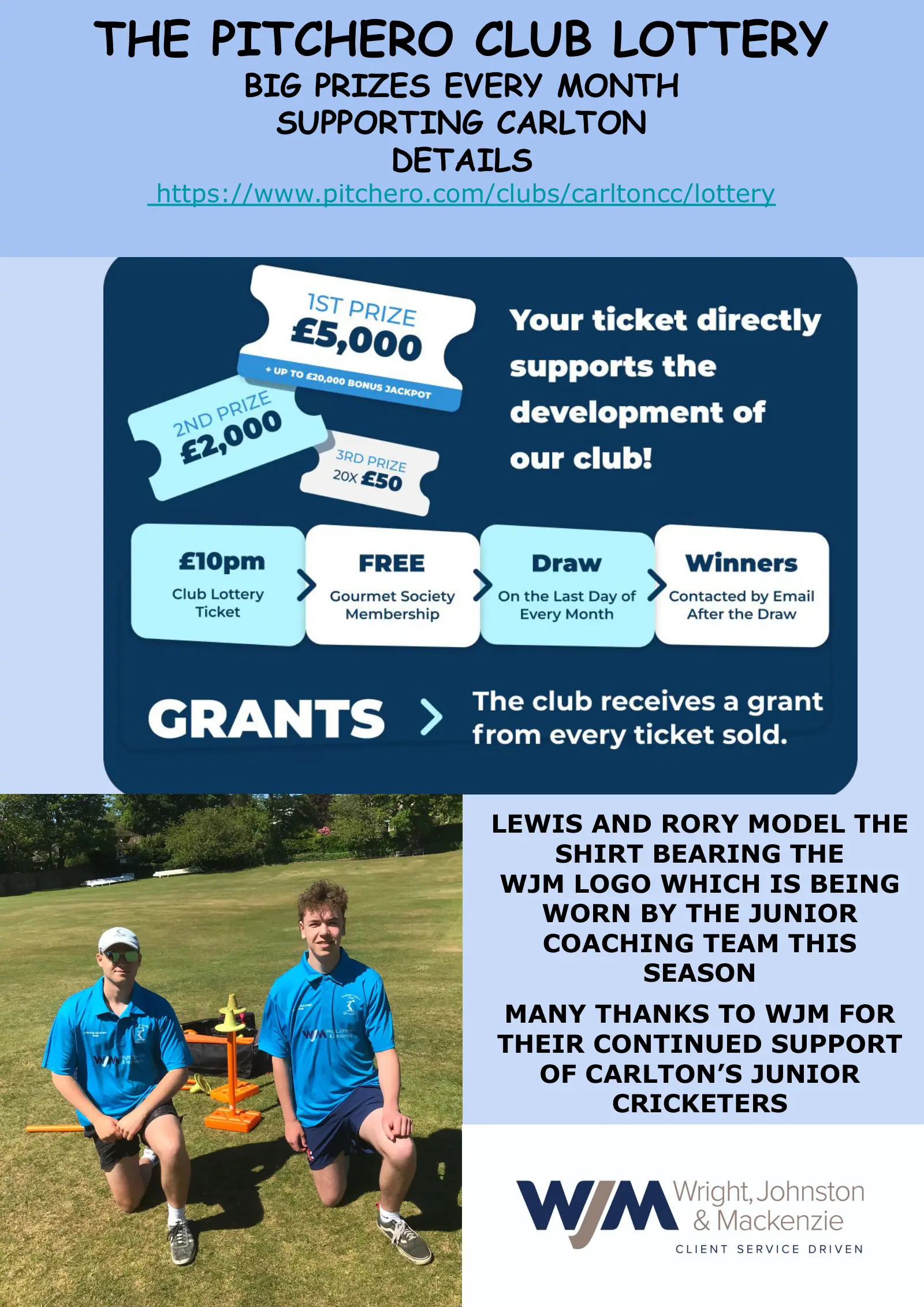
THE PITCHERO CLUB LOTTERY
BIG PRIZES EVERY MONTH
SUPPORTING CARLTON
DETAILS
https://www.pitchero.com/clubs/carltoncc/lottery
LEWIS AND RORY MODEL THE
SHIRT BEARING THE
WJM LOGO WHICH IS BEING
WORN BY THE JUNIOR
COACHING TEAM THIS
SEASON
MANY THANKS TO WJM FOR
THEIR CONTINUED SUPPORT
OF CARLTON’S JUNIOR
CRICKETERS
Text of this page
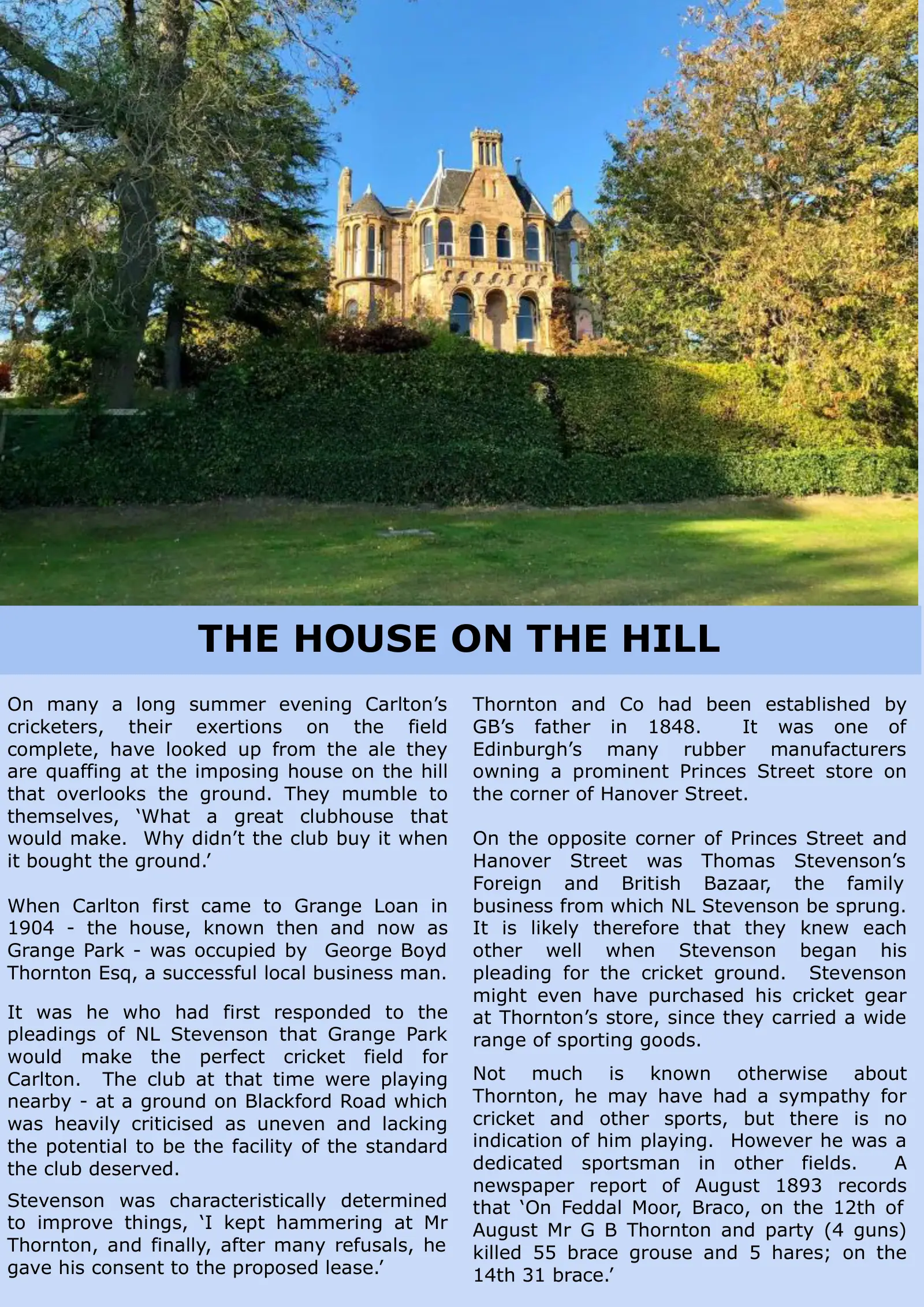
On many a long summer evening Carlton’s
cricketers,
their
exertions
on
the
field
complete, have looked up from the ale they
are quaffing at the imposing house on the hill
that overlooks the ground. They mumble to
themselves, ‘What a great clubhouse that
would make. Why didn’t the club buy it when
it bought the ground.’
When Carlton first came to Grange Loan in
1904 - the house, known then and now as
Grange Park - was occupied by George Boyd
Thornton Esq, a successful local business man.
It was he who had first responded to the
pleadings of NL Stevenson that Grange Park
would make the perfect cricket field for
Carlton. The club at that time were playing
nearby - at a ground on Blackford Road which
was heavily criticised as uneven and lacking
the potential to be the facility of the standard
the club deserved.
Stevenson was characteristically determined
to improve things, ‘I kept hammering at Mr
Thornton, and finally, after many refusals, he
gave his consent to the proposed lease.’
Thornton and Co had been established by
GB’s father in 1848. It was one of
Edinburgh’s
many
rubber
manufacturers
owning a prominent Princes Street store on
the corner of Hanover Street.
On the opposite corner of Princes Street and
Hanover Street was Thomas Stevenson’s
Foreign
and
British
Bazaar,
the
family
business from which NL Stevenson be sprung.
It is likely therefore that they knew each
other
well
when
Stevenson
began
his
pleading for the cricket ground. Stevenson
might even have purchased his cricket gear
at Thornton’s store, since they carried a wide
range of sporting goods.
Not
much
is
known
otherwise
about
Thornton, he may have had a sympathy for
cricket and other sports, but there is no
indication of him playing. However he was a
dedicated sportsman in other fields. A
newspaper report of August 1893 records
that ‘On Feddal Moor, Braco, on the 12th of
August Mr G B Thornton and party (4 guns)
killed 55 brace grouse and 5 hares; on the
14th 31 brace.’
THE HOUSE ON THE HILL
Text of this page
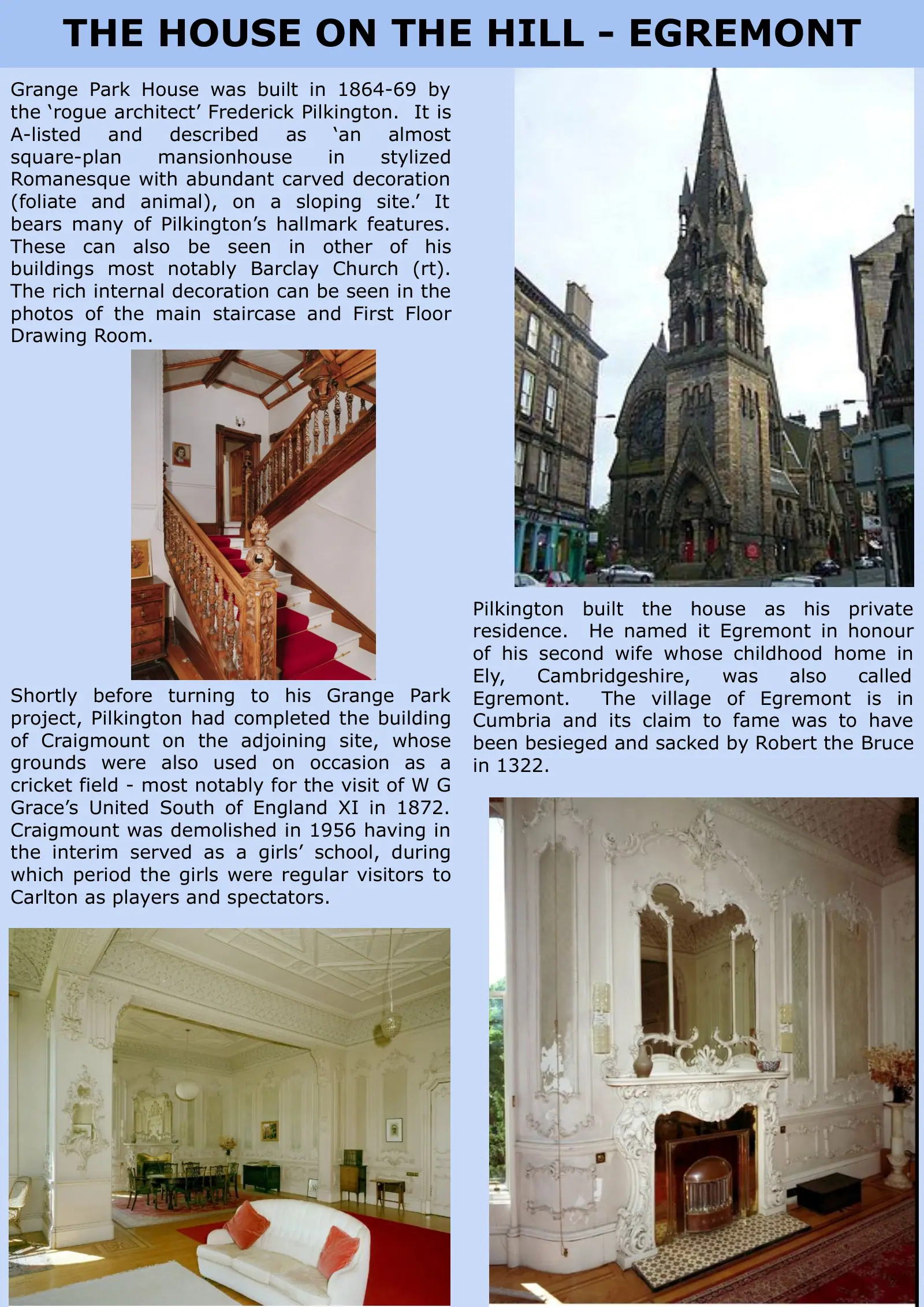
Grange Park House was built in 1864-69 by
the ‘rogue architect’ Frederick Pilkington. It is
A-listed
and
described
as
‘an
almost
square-plan
mansionhouse
in
stylized
Romanesque with abundant carved decoration
(foliate and animal), on a sloping site.’ It
bears many of Pilkington’s hallmark features.
These can also be seen in other of his
buildings most notably Barclay Church (rt).
The rich internal decoration can be seen in the
photos of the main staircase and First Floor
Drawing Room.
Shortly before turning to his Grange Park
project, Pilkington had completed the building
of Craigmount on the adjoining site, whose
grounds were also used on occasion as a
cricket field - most notably for the visit of W G
Grace’s United South of England XI in 1872.
Craigmount was demolished in 1956 having in
the interim served as a girls’ school, during
which period the girls were regular visitors to
Carlton as players and spectators.
THE HOUSE ON THE HILL - EGREMONT
Pilkington built the house as his private
residence. He named it Egremont in honour
of his second wife whose childhood home in
Ely,
Cambridgeshire,
was
also
called
Egremont. The village of Egremont is in
Cumbria and its claim to fame was to have
been besieged and sacked by Robert the Bruce
in 1322.
Text of this page
GB Thornton died in 1908. Nearly twenty years
later, when the field came under threat from
speculative builders, prompting Stevenson to
pursue its purchase, the house was in the
occupation of Mrs Pelham Burn, widow of
Charles Maitland Pelham Burn who had died in
1917. (This is perhaps the origin of the belief
still held by many Carltonites that the house is
occupied by a single old lady). Pelham Burn
came from a very well connected military family
and had himself served in 77th Highlanders. He
had been a Director of the Standard Life
Insurance company and was well known for
extensive philanthropic work on behalf of
military veterans.
Mrs Pelham Burn died in 1929, when Grange
Park was divided into apartments.
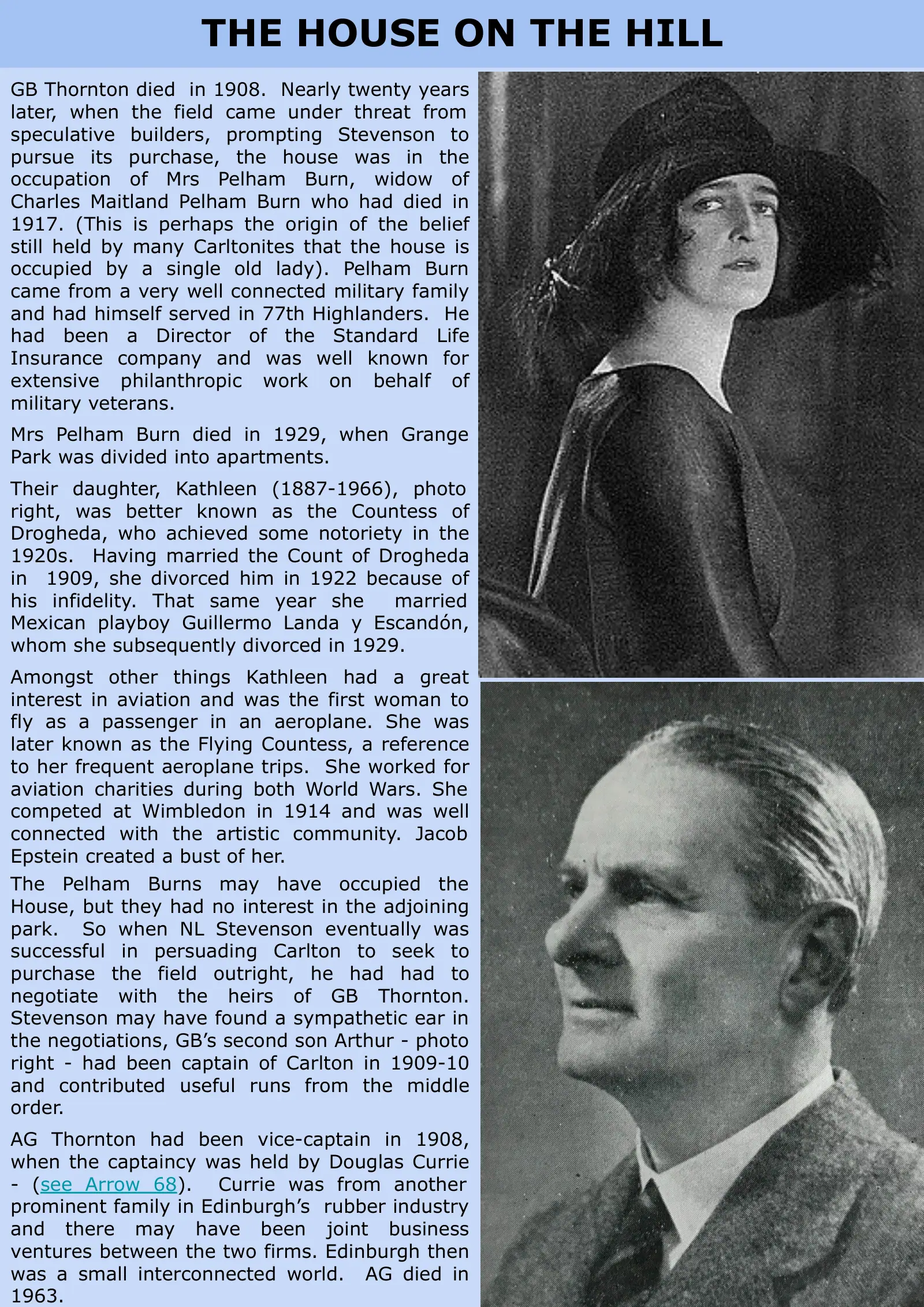
Their daughter, Kathleen (1887-1966), photo
right, was better known as the Countess of
Drogheda, who achieved some notoriety in the
1920s. Having married the Count of Drogheda
in 1909, she divorced him in 1922 because of
his infidelity. That same year she married
Mexican playboy Guillermo Landa y Escandón,
whom she subsequently divorced in 1929.
Amongst other things Kathleen had a great
interest in aviation and was the first woman to
fly as a passenger in an aeroplane. She was
later known as the Flying Countess, a reference
to her frequent aeroplane trips. She worked for
aviation charities during both World Wars. She
competed at Wimbledon in 1914 and was well
connected with the artistic community. Jacob
Epstein created a bust of her.
The Pelham Burns may have occupied the
House, but they had no interest in the adjoining
park. So when NL Stevenson eventually was
successful in persuading Carlton to seek to
purchase the field outright, he had had to
negotiate with the heirs of GB Thornton.
Stevenson may have found a sympathetic ear in
the negotiations, GB’s second son Arthur - photo
right - had been captain of Carlton in 1909-10
and contributed useful runs from the middle
order.
AG Thornton had been vice-captain in 1908,
when the captaincy was held by Douglas Currie
- (see Arrow 68). Currie was from another
prominent family in Edinburgh’s rubber industry
and there may have been joint business
ventures between the two firms. Edinburgh then
was a small interconnected world. AG died in
1963.
THE HOUSE ON THE HILL
Text of this page
THE HOUSE ON THE HILL
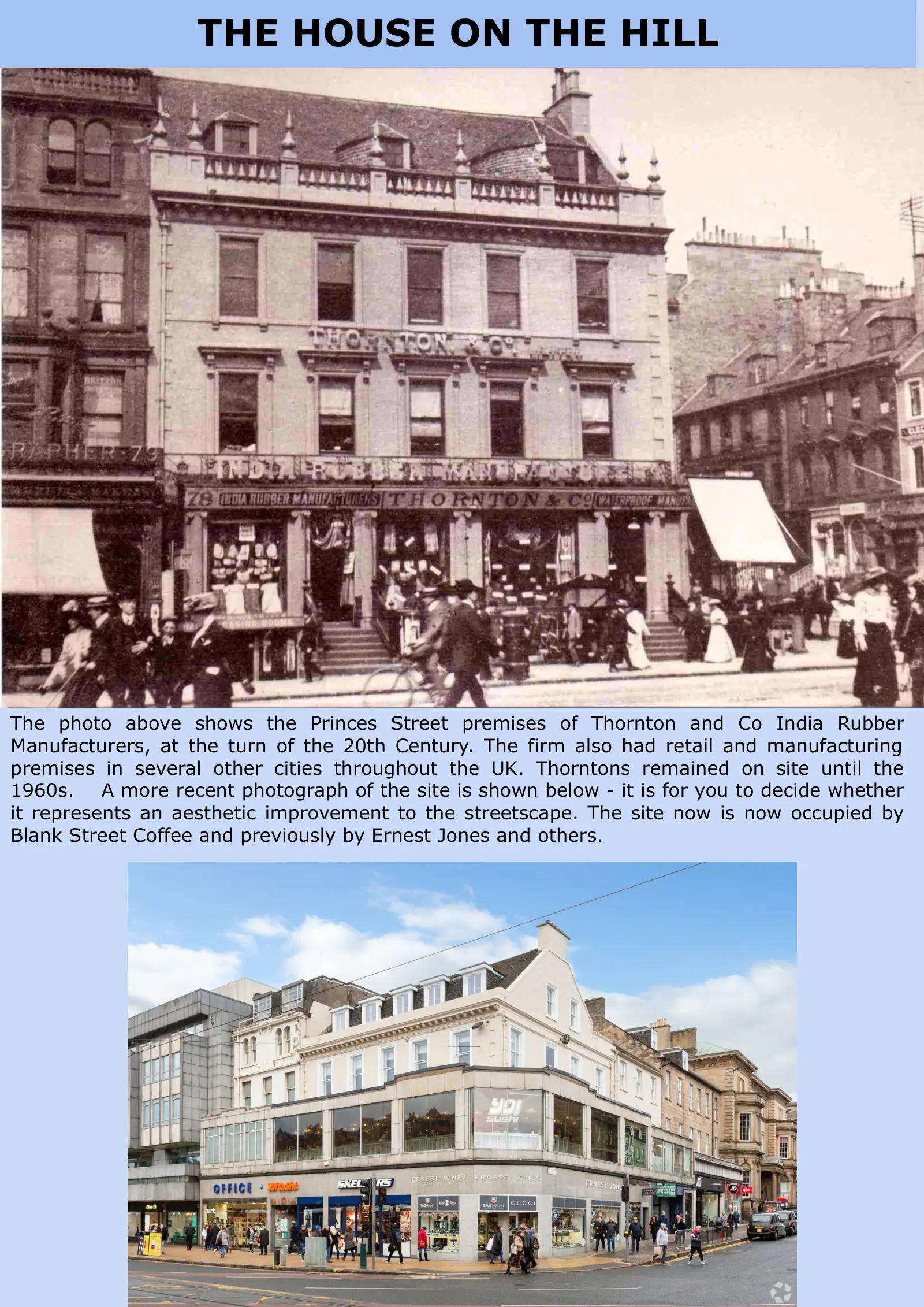
The photo above shows the Princes Street premises of Thornton and Co India Rubber
Manufacturers, at the turn of the 20th Century. The firm also had retail and manufacturing
premises in several other cities throughout the UK. Thorntons remained on site until the
1960s. A more recent photograph of the site is shown below - it is for you to decide whether
it represents an aesthetic improvement to the streetscape. The site now is now occupied by
Blank Street Coffee and previously by Ernest Jones and others.
Text of this page
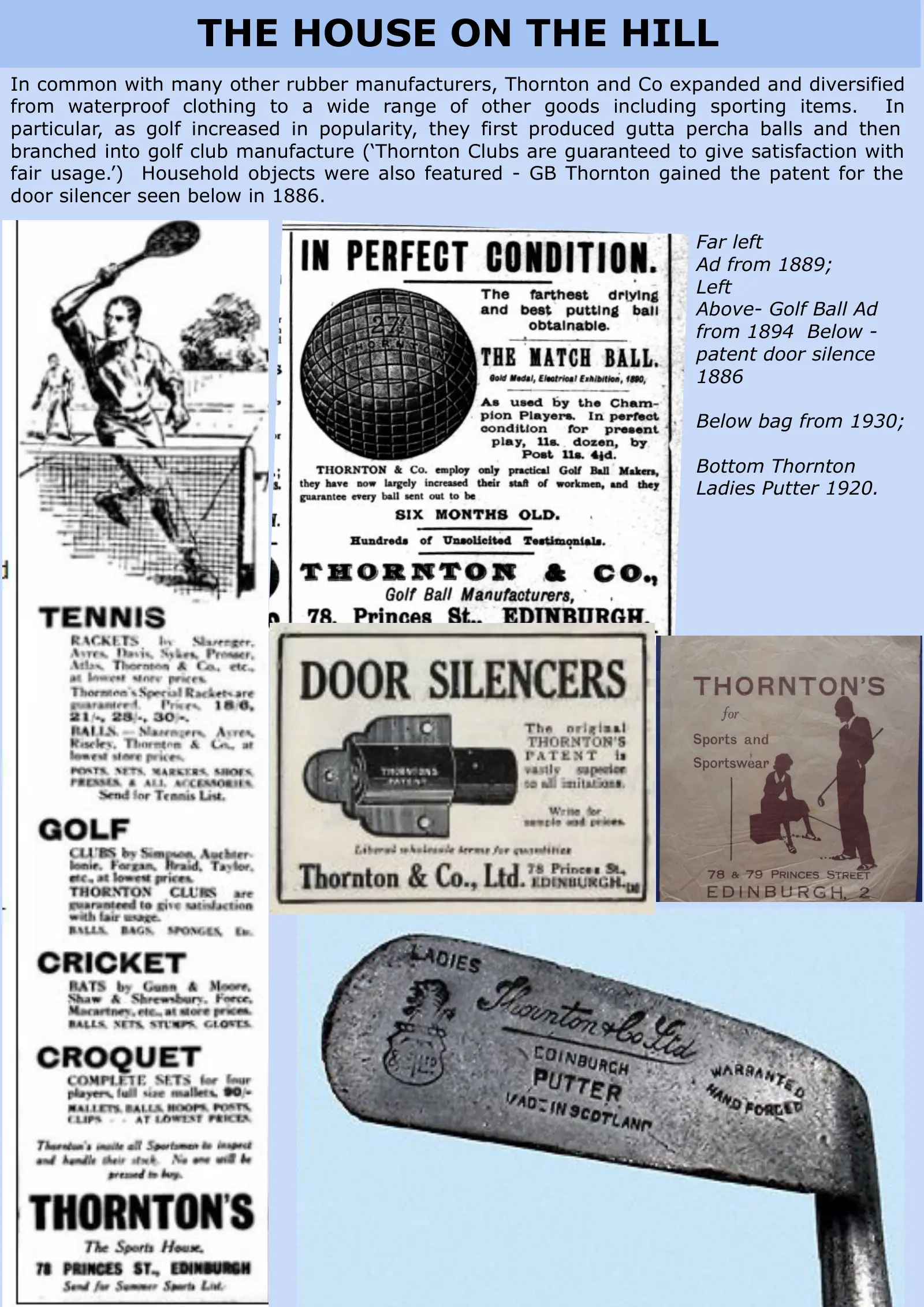
In common with many other rubber manufacturers, Thornton and Co expanded and diversified
from waterproof clothing to a wide range of other goods including sporting items. In
particular, as golf increased in popularity, they first produced gutta percha balls and then
branched into golf club manufacture (‘Thornton Clubs are guaranteed to give satisfaction with
fair usage.’) Household objects were also featured - GB Thornton gained the patent for the
door silencer seen below in 1886.
THE HOUSE ON THE HILL
Far left
Ad from 1889;
Left
Above- Golf Ball Ad
from 1894 Below -
patent door silence
1886
Below bag from 1930;
Bottom Thornton
Ladies Putter 1920.
Text of this page
In Memoriam John Bain
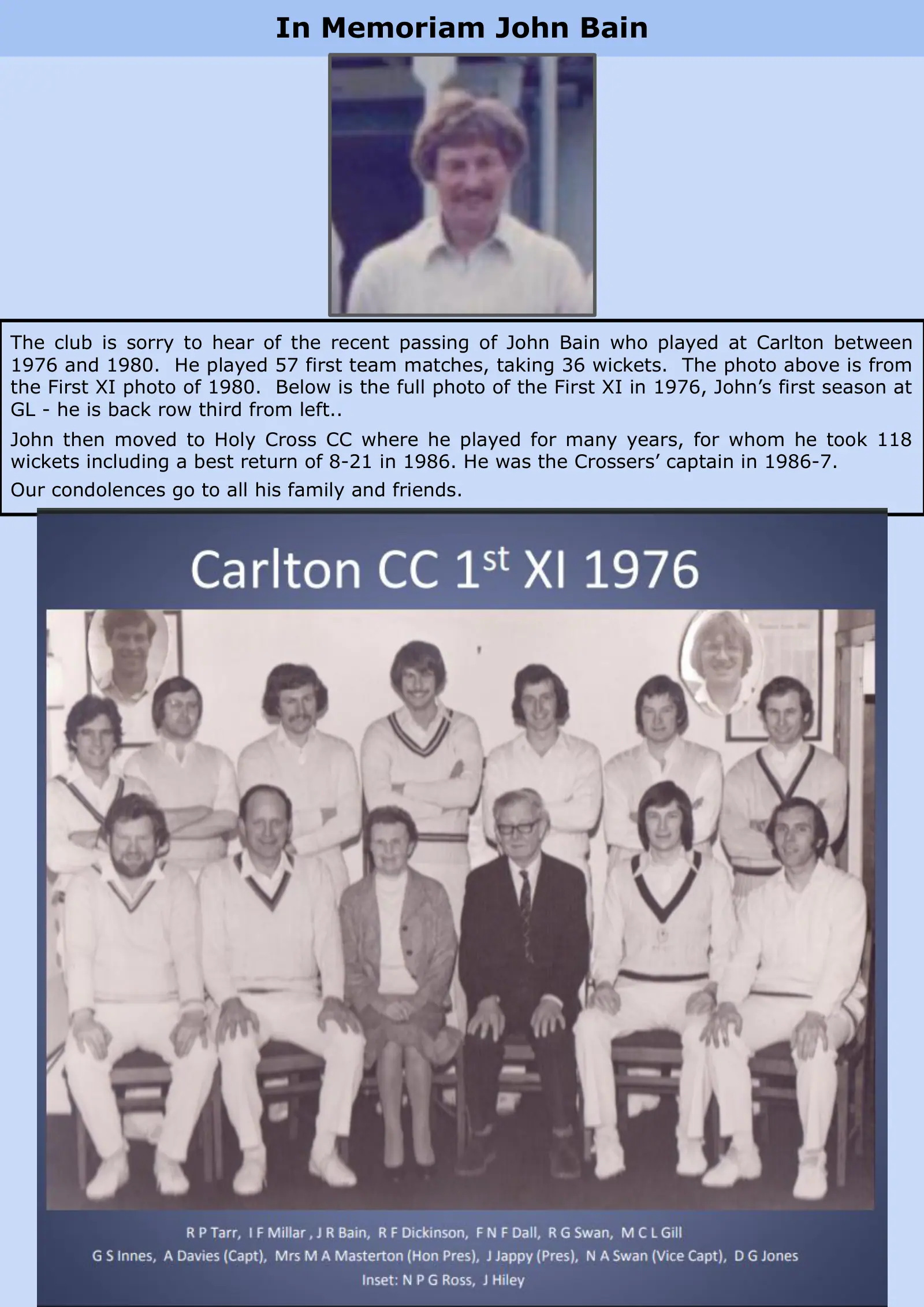
The club is sorry to hear of the recent passing of John Bain who played at Carlton between
1976 and 1980. He played 57 first team matches, taking 36 wickets. The photo above is from
the First XI photo of 1980. Below is the full photo of the First XI in 1976, John’s first season at
GL - he is back row third from left..
John then moved to Holy Cross CC where he played for many years, for whom he took 118
wickets including a best return of 8-21 in 1986. He was the Crossers’ captain in 1986-7.
Our condolences go to all his family and friends.
Text of this page
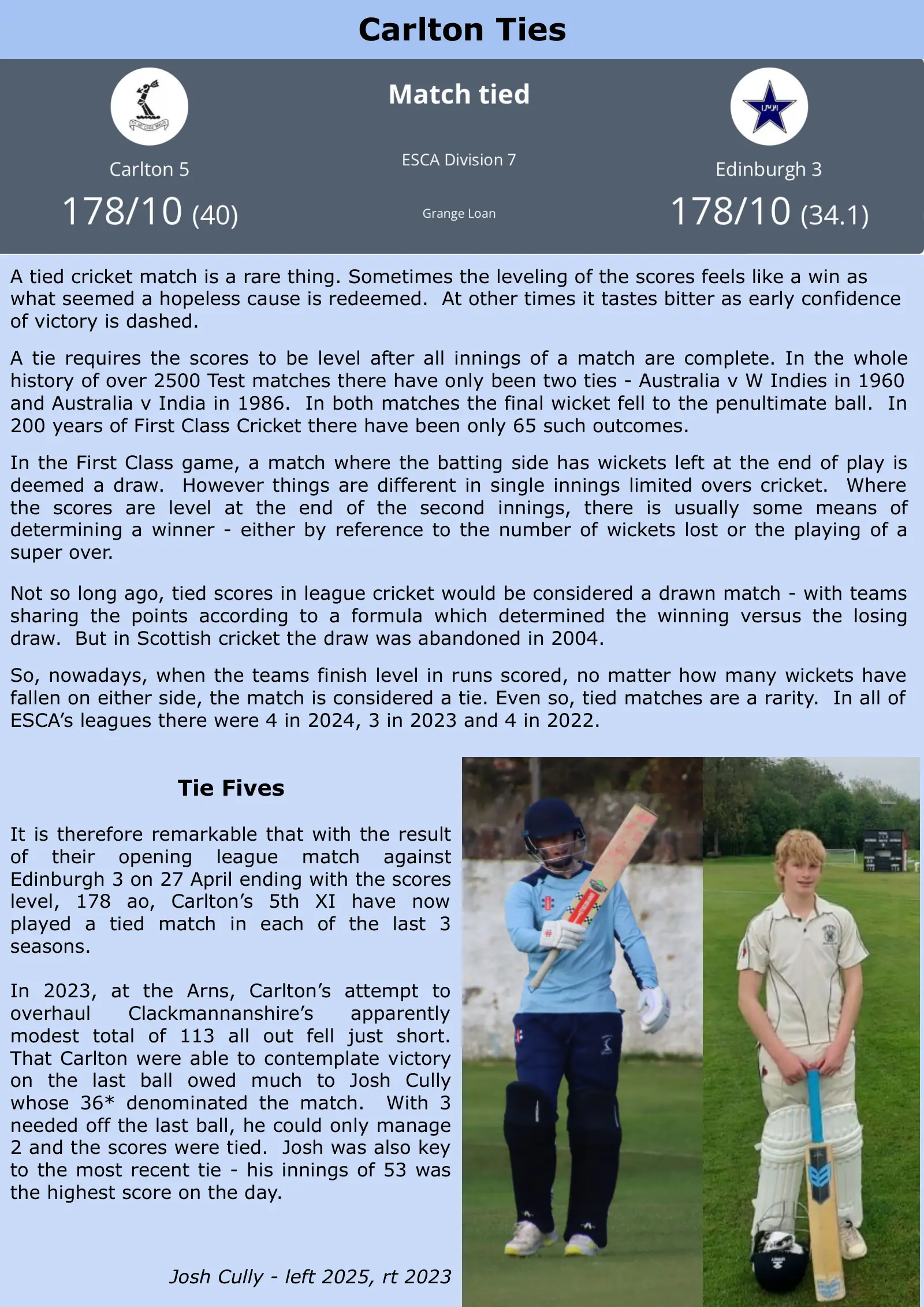
A tied cricket match is a rare thing. Sometimes the leveling of the scores feels like a win as
what seemed a hopeless cause is redeemed. At other times it tastes bitter as early confidence
of victory is dashed.
A tie requires the scores to be level after all innings of a match are complete. In the whole
history of over 2500 Test matches there have only been two ties - Australia v W Indies in 1960
and Australia v India in 1986. In both matches the final wicket fell to the penultimate ball. In
200 years of First Class Cricket there have been only 65 such outcomes.
In the First Class game, a match where the batting side has wickets left at the end of play is
deemed a draw. However things are different in single innings limited overs cricket. Where
the scores are level at the end of the second innings, there is usually some means of
determining a winner - either by reference to the number of wickets lost or the playing of a
super over.
Not so long ago, tied scores in league cricket would be considered a drawn match - with teams
sharing the points according to a formula which determined the winning versus the losing
draw. But in Scottish cricket the draw was abandoned in 2004.
So, nowadays, when the teams finish level in runs scored, no matter how many wickets have
fallen on either side, the match is considered a tie. Even so, tied matches are a rarity. In all of
ESCA’s leagues there were 4 in 2024, 3 in 2023 and 4 in 2022.
Tie Fives
It is therefore remarkable that with the result
of
their
opening
league
match
against
Edinburgh 3 on 27 April ending with the scores
level, 178 ao, Carlton’s 5th XI have now
played a tied match in each of the last 3
seasons.
In 2023, at the Arns, Carlton’s attempt to
overhaul
Clackmannanshire’s
apparently
modest total of 113 all out fell just short.
That Carlton were able to contemplate victory
on the last ball owed much to Josh Cully
whose 36* denominated the match. With 3
needed off the last ball, he could only manage
2 and the scores were tied. Josh was also key
to the most recent tie - his innings of 53 was
the highest score on the day.
Josh Cully - left 2025, rt 2023
Carlton Ties
Text of this page
In 2024 at Peebles, Carlton 5’s chase of the home side’s 157 got off to a rocky start, but once
again the innings was salvaged by a major contribution by a junior batter. John Gill (60) batted
brilliantly and in a significant partnership with Angus Turner (27) put Carlton back on track.
They reached the last over with 5 wanted and 2 wickets in hand. A score-leveling 4 off the first
ball was followed by 2 wickets and the match tied.
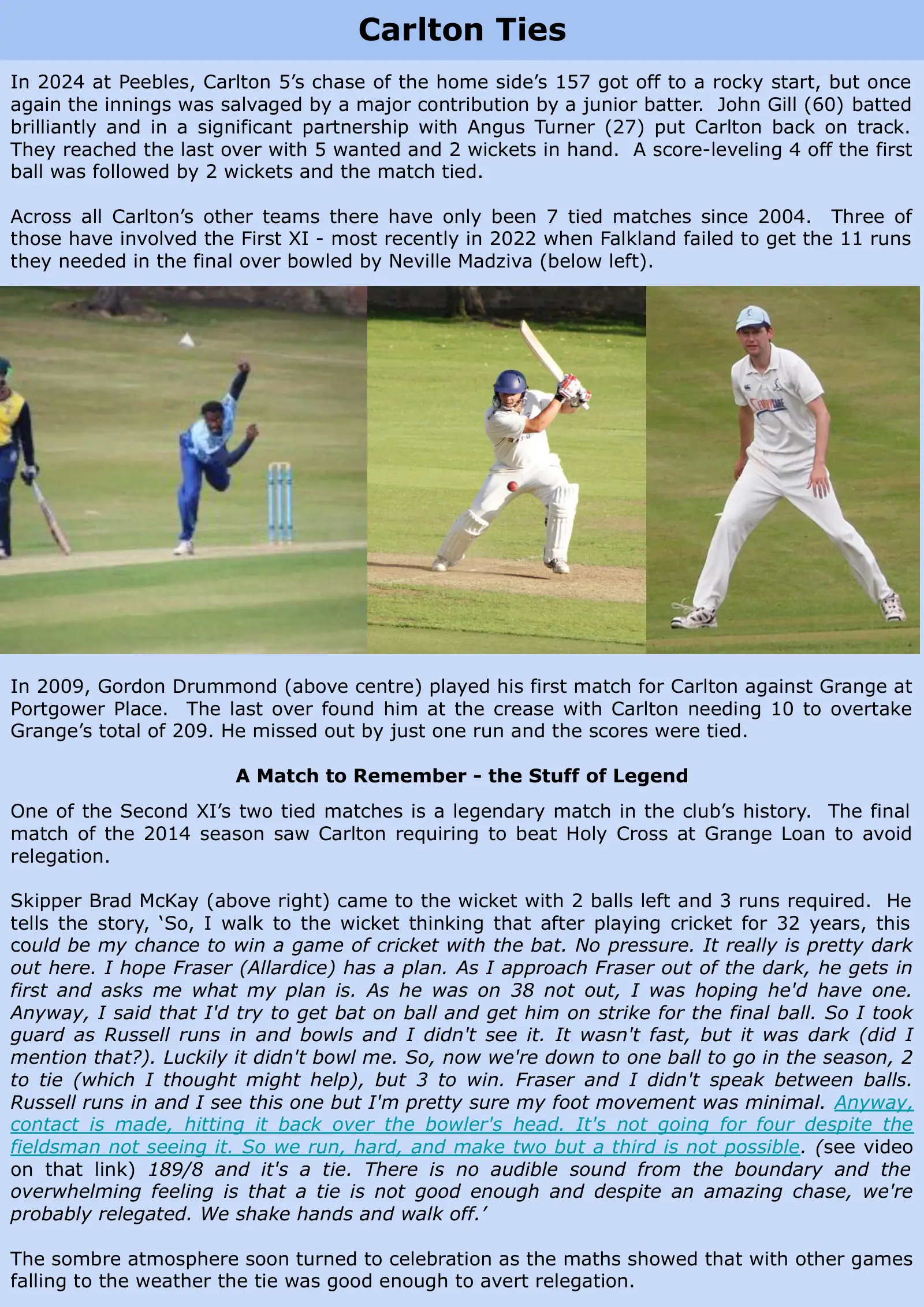
Across all Carlton’s other teams there have only been 7 tied matches since 2004. Three of
those have involved the First XI - most recently in 2022 when Falkland failed to get the 11 runs
they needed in the final over bowled by Neville Madziva (below left).
In 2009, Gordon Drummond (above centre) played his first match for Carlton against Grange at
Portgower Place. The last over found him at the crease with Carlton needing 10 to overtake
Grange’s total of 209. He missed out by just one run and the scores were tied.
A Match to Remember - the Stuff of Legend
One of the Second XI’s two tied matches is a legendary match in the club’s history. The final
match of the 2014 season saw Carlton requiring to beat Holy Cross at Grange Loan to avoid
relegation.
Skipper Brad McKay (above right) came to the wicket with 2 balls left and 3 runs required. He
tells the story, ‘So, I walk to the wicket thinking that after playing cricket for 32 years, this
could be my chance to win a game of cricket with the bat. No pressure. It really is pretty dark
out here. I hope Fraser (Allardice) has a plan. As I approach Fraser out of the dark, he gets in
first and asks me what my plan is. As he was on 38 not out, I was hoping he'd have one.
Anyway, I said that I'd try to get bat on ball and get him on strike for the final ball. So I took
guard as Russell runs in and bowls and I didn't see it. It wasn't fast, but it was dark (did I
mention that?). Luckily it didn't bowl me. So, now we're down to one ball to go in the season, 2
to tie (which I thought might help), but 3 to win. Fraser and I didn't speak between balls.
Russell runs in and I see this one but I'm pretty sure my foot movement was minimal. Anyway,
contact is made, hitting it back over the bowler's head. It's not going for four despite the
fieldsman not seeing it. So we run, hard, and make two but a third is not possible. (see video
on that link) 189/8 and it's a tie. There is no audible sound from the boundary and the
overwhelming feeling is that a tie is not good enough and despite an amazing chase, we're
probably relegated. We shake hands and walk off.’
The sombre atmosphere soon turned to celebration as the maths showed that with other games
falling to the weather the tie was good enough to avert relegation.
Carlton Ties
Text of this page
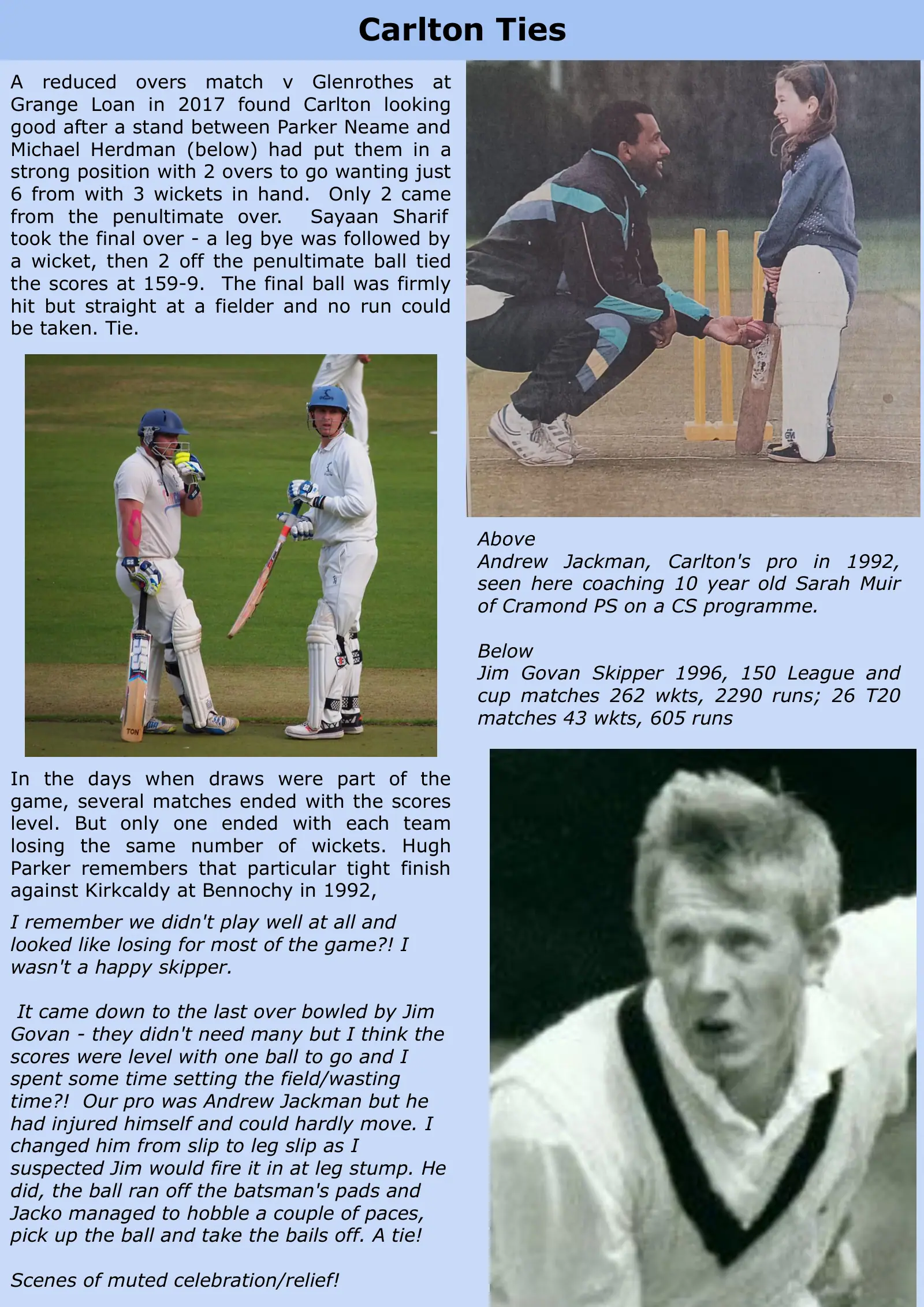
A reduced overs match v Glenrothes at
Grange Loan in 2017 found Carlton looking
good after a stand between Parker Neame and
Michael Herdman (below) had put them in a
strong position with 2 overs to go wanting just
6 from with 3 wickets in hand. Only 2 came
from the penultimate over. Sayaan Sharif
took the final over - a leg bye was followed by
a wicket, then 2 off the penultimate ball tied
the scores at 159-9. The final ball was firmly
hit but straight at a fielder and no run could
be taken. Tie.
In the days when draws were part of the
game, several matches ended with the scores
level. But only one ended with each team
losing the same number of wickets. Hugh
Parker remembers that particular tight finish
against Kirkcaldy at Bennochy in 1992,
I remember we didn't play well at all and
looked like losing for most of the game?! I
wasn't a happy skipper.
It came down to the last over bowled by Jim
Govan - they didn't need many but I think the
scores were level with one ball to go and I
spent some time setting the field/wasting
time?! Our pro was Andrew Jackman but he
had injured himself and could hardly move. I
changed him from slip to leg slip as I
suspected Jim would fire it in at leg stump. He
did, the ball ran off the batsman's pads and
Jacko managed to hobble a couple of paces,
pick up the ball and take the bails off. A tie!
Scenes of muted celebration/relief!
Above
Andrew Jackman, Carlton's pro in 1992,
seen here coaching 10 year old Sarah Muir
of Cramond PS on a CS programme.
Below
Jim Govan Skipper 1996, 150 League and
cup matches 262 wkts, 2290 runs; 26 T20
matches 43 wkts, 605 runs
Carlton Ties
Text of this page
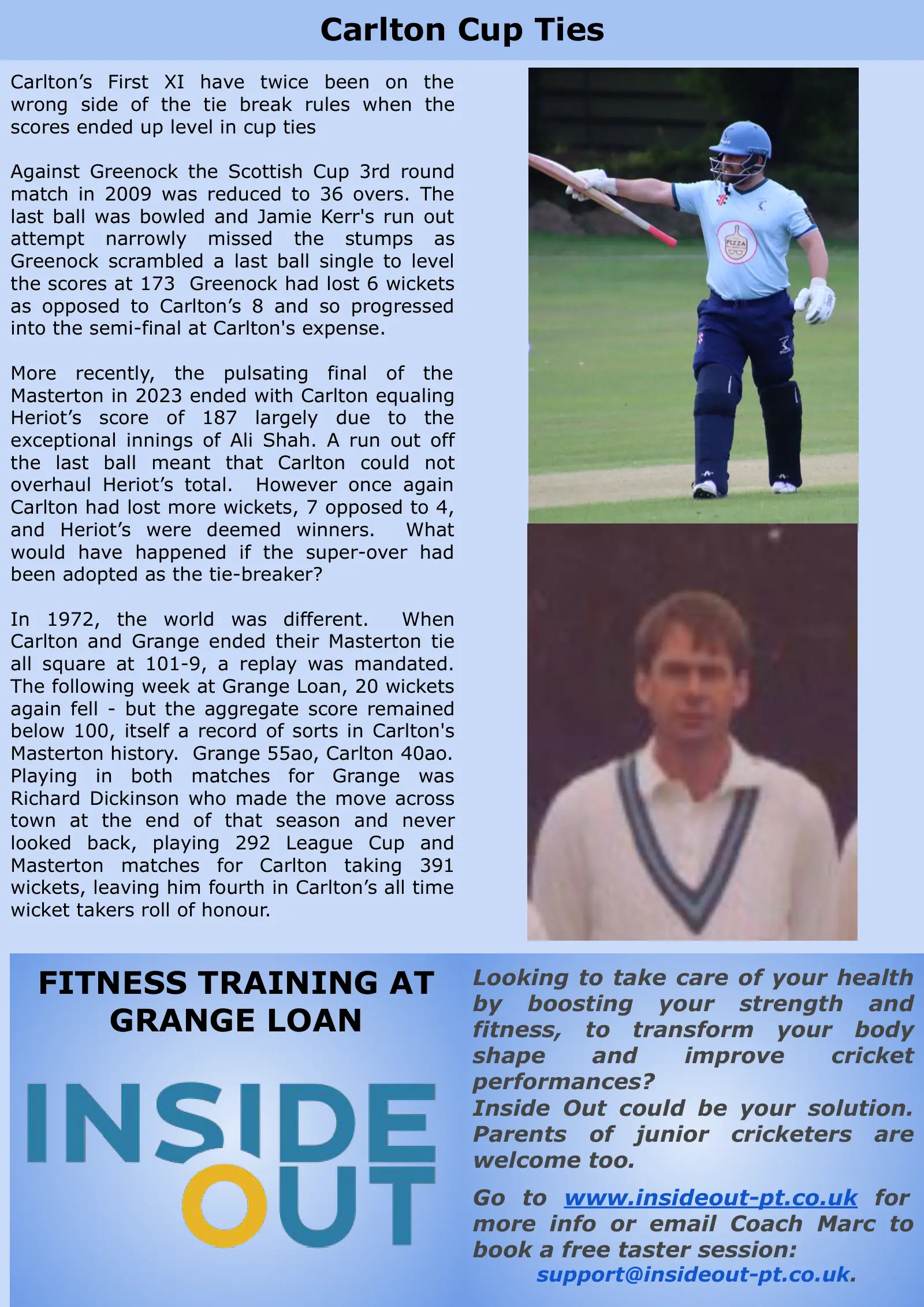
Carlton’s First XI have twice been on the
wrong side of the tie break rules when the
scores ended up level in cup ties
Against Greenock the Scottish Cup 3rd round
match in 2009 was reduced to 36 overs. The
last ball was bowled and Jamie Kerr's run out
attempt narrowly missed the stumps as
Greenock scrambled a last ball single to level
the scores at 173 Greenock had lost 6 wickets
as opposed to Carlton’s 8 and so progressed
into the semi-final at Carlton's expense.
More recently, the pulsating final of the
Masterton in 2023 ended with Carlton equaling
Heriot’s score of 187 largely due to the
exceptional innings of Ali Shah. A run out off
the last ball meant that Carlton could not
overhaul Heriot’s total. However once again
Carlton had lost more wickets, 7 opposed to 4,
and Heriot’s were deemed winners. What
would have happened if the super-over had
been adopted as the tie-breaker?
In 1972, the world was different. When
Carlton and Grange ended their Masterton tie
all square at 101-9, a replay was mandated.
The following week at Grange Loan, 20 wickets
again fell - but the aggregate score remained
below 100, itself a record of sorts in Carlton's
Masterton history. Grange 55ao, Carlton 40ao.
Playing in both matches for Grange was
Richard Dickinson who made the move across
town at the end of that season and never
looked back, playing 292 League Cup and
Masterton matches for Carlton taking 391
wickets, leaving him fourth in Carlton’s all time
wicket takers roll of honour.
Carlton Cup Ties
Looking to take care of your health
by
boosting
your
strength
and
fitness, to transform your body
shape
and
improve
cricket
performances?
Inside Out could be your solution.
Parents of junior cricketers are
welcome too.
Go to www.insideout-pt.co.uk for
more info or email Coach Marc to
book a free taster session:
support@insideout-pt.co.uk.
FITNESS TRAINING AT
GRANGE LOAN

Text of this page
Carlton Neck Ties
From the left, classic striped Carlton tie, then
the 125th Anniversary tie, then two different
2011 SNCL winning ties, and finally the 150th
Anniversary tie.
ALL CARLTON KIT IS NOW AVAILABLE DIRECT
FROM
GRAY NICOLLS

Text of this page
MAKE GRANGE LOAN THE SPECIAL
PLACE FOR YOUR SPECIAL OCCASION
Contact
Kerry_david_simpson@hotmail.com)
Square Cut
Kitchen
Now on
Instagram
Follow to keep
in the know
about all
future events.

Text of this page
Carlton Director of Cricket Stevie Gilmour has launched a
new venture offering Performance and Breath Coaching
Helping athletes and professionals optimise breathing to
perform better physically and mentally, manage stress,
sleep better, boost focus and concentration.
https://www.steviegilmour.com/
Highlights of
Carlton matches
can be seen on the
Carlton Cricket
Club
YouTube Channel
Raise money for Carlton through
EASYFUNDRAISING
website or app
Breathe Less.
Think Less.
Perform Better