Issue 77
· Wedding of the year
Just as the ESCA leagues are about to start, Fantasy Bob has taken time out of his pre-season training regime to compile another action-packed edition of the Arrow. In this issue there is a feature on the wedding of Ally Evans and Sam Haggo as well as other notable unions from the Grange Loan archive. There is also a feature on the latest incarnation of the Grange Loan pavilion as it celebrates its 20th anniversary and a look back at what had gone before. Inspired by the opening round of the Scottish Cup seeing the 1s travel to Stenhousemuir, FB looks back at the very storied history of meetings between the 2 clubs and much, much more.

Text of this page
The Newsletter of Carlton Cricket Club
April 2025 Issue 77
FOLLOW CARLTON
FOLLOW CARLTON
WEDDING OF THE YEAR
A
The newly married Mr and Mrs Evans cross the Brig o’ Doon,
Alloway, 18 April 2025.
Many congratulations to them from Carlton CC.
Everyone at the club wishes them a long and happy innings
together.
Text of this page
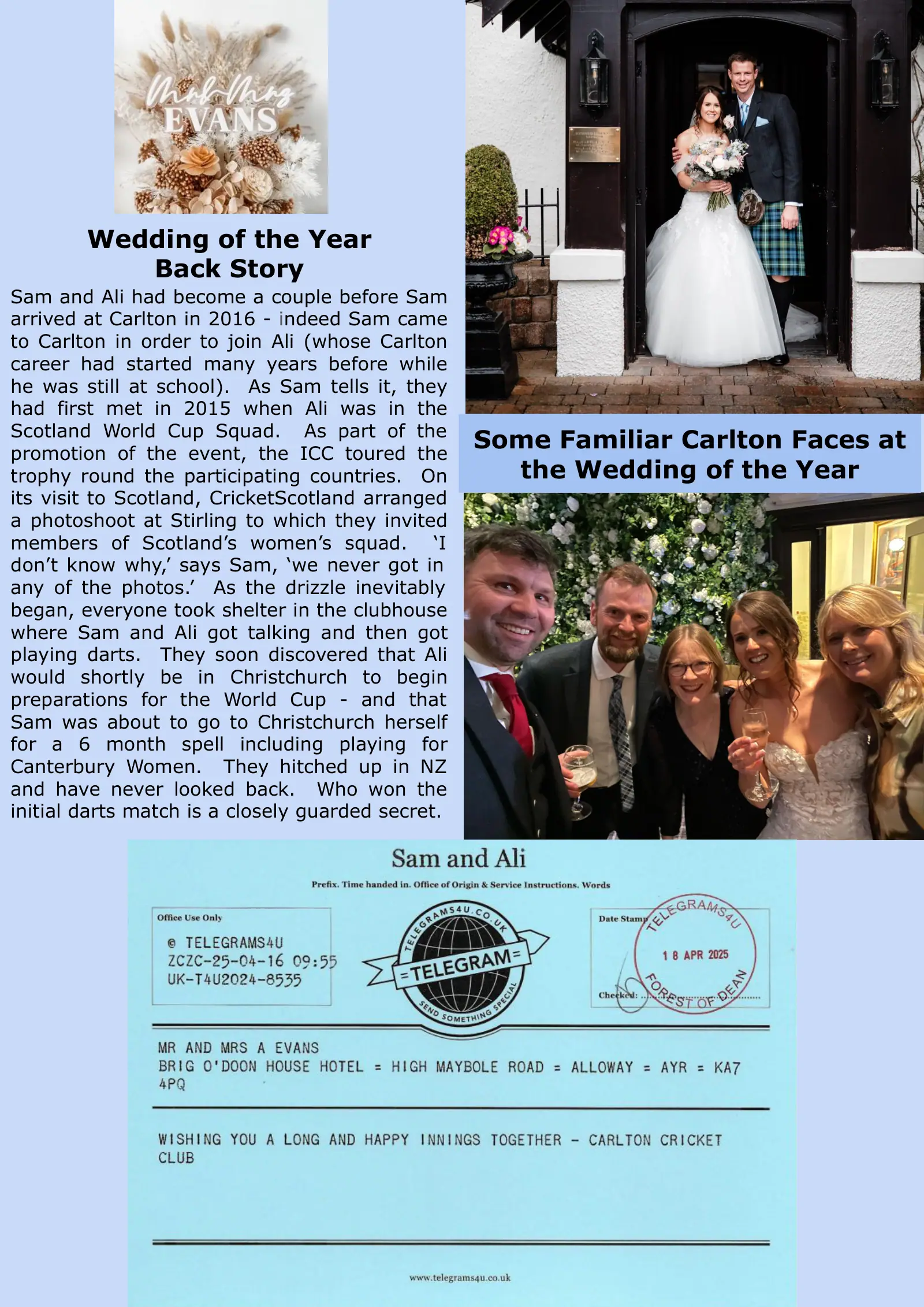
Wedding of the Year
Back Story
Sam and Ali had become a couple before Sam
arrived at Carlton in 2016 - indeed Sam came
to Carlton in order to join Ali (whose Carlton
career had started many years before while
he was still at school). As Sam tells it, they
had first met in 2015 when Ali was in the
Scotland World Cup Squad. As part of the
promotion of the event, the ICC toured the
trophy round the participating countries. On
its visit to Scotland, CricketScotland arranged
a photoshoot at Stirling to which they invited
members of Scotland’s women’s squad. ‘I
don’t know why,’ says Sam, ‘we never got in
any of the photos.’ As the drizzle inevitably
began, everyone took shelter in the clubhouse
where Sam and Ali got talking and then got
playing darts. They soon discovered that Ali
would shortly be in Christchurch to begin
preparations for the World Cup - and that
Sam was about to go to Christchurch herself
for a 6 month spell including playing for
Canterbury Women. They hitched up in NZ
and have never looked back. Who won the
initial darts match is a closely guarded secret.
Some Familiar Carlton Faces at
the Wedding of the Year
Text of this page
Carlton Weddings
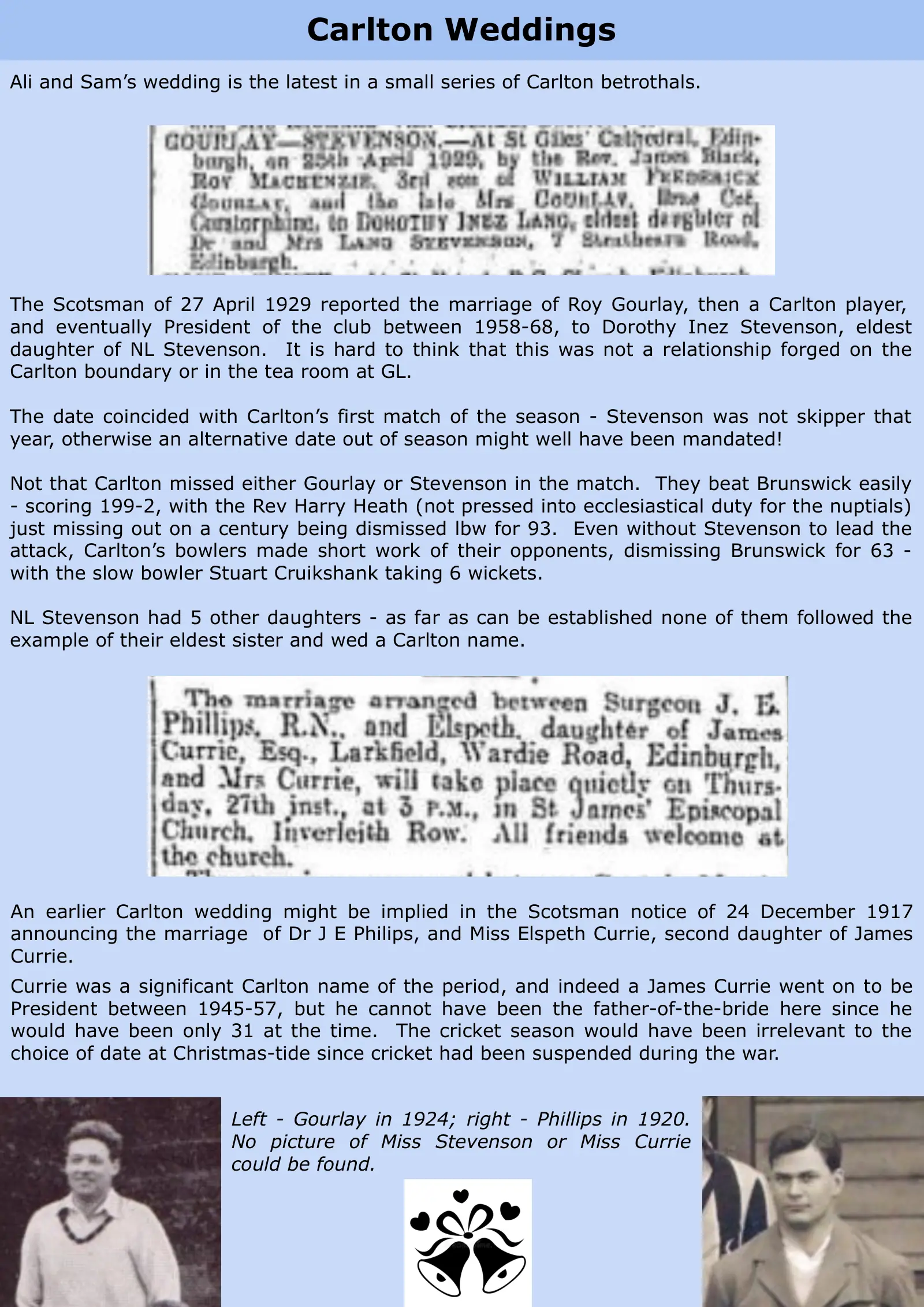
Ali and Sam’s wedding is the latest in a small series of Carlton betrothals.
An earlier Carlton wedding might be implied in the Scotsman notice of 24 December 1917
announcing the marriage of Dr J E Philips, and Miss Elspeth Currie, second daughter of James
Currie.
Currie was a significant Carlton name of the period, and indeed a James Currie went on to be
President between 1945-57, but he cannot have been the father-of-the-bride here since he
would have been only 31 at the time. The cricket season would have been irrelevant to the
choice of date at Christmas-tide since cricket had been suspended during the war.
The Scotsman of 27 April 1929 reported the marriage of Roy Gourlay, then a Carlton player,
and eventually President of the club between 1958-68, to Dorothy Inez Stevenson, eldest
daughter of NL Stevenson. It is hard to think that this was not a relationship forged on the
Carlton boundary or in the tea room at GL.
The date coincided with Carlton’s first match of the season - Stevenson was not skipper that
year, otherwise an alternative date out of season might well have been mandated!
Not that Carlton missed either Gourlay or Stevenson in the match. They beat Brunswick easily
- scoring 199-2, with the Rev Harry Heath (not pressed into ecclesiastical duty for the nuptials)
just missing out on a century being dismissed lbw for 93. Even without Stevenson to lead the
attack, Carlton’s bowlers made short work of their opponents, dismissing Brunswick for 63 -
with the slow bowler Stuart Cruikshank taking 6 wickets.
NL Stevenson had 5 other daughters - as far as can be established none of them followed the
example of their eldest sister and wed a Carlton name.
Left - Gourlay in 1924; right - Phillips in 1920.
No picture of Miss Stevenson or Miss Currie
could be found.
Text of this page
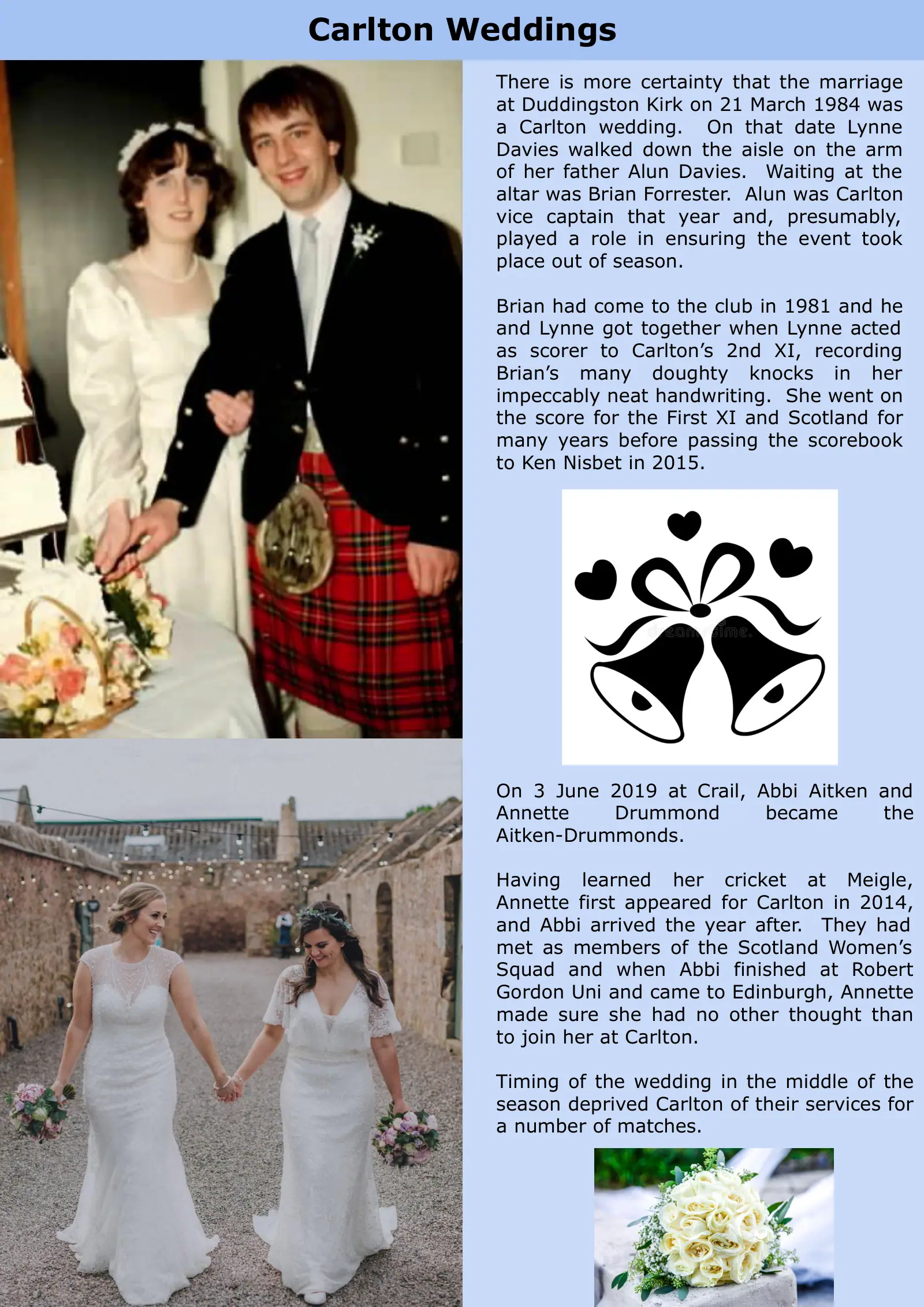
There is more certainty that the marriage
at Duddingston Kirk on 21 March 1984 was
a Carlton wedding. On that date Lynne
Davies walked down the aisle on the arm
of her father Alun Davies. Waiting at the
altar was Brian Forrester. Alun was Carlton
vice captain that year and, presumably,
played a role in ensuring the event took
place out of season.
Brian had come to the club in 1981 and he
and Lynne got together when Lynne acted
as scorer to Carlton’s 2nd XI, recording
Brian’s many doughty knocks in her
impeccably neat handwriting. She went on
the score for the First XI and Scotland for
many years before passing the scorebook
to Ken Nisbet in 2015.
On 3 June 2019 at Crail, Abbi Aitken and
Annette
Drummond
became
the
Aitken-Drummonds.
Having learned her cricket at Meigle,
Annette first appeared for Carlton in 2014,
and Abbi arrived the year after. They had
met as members of the Scotland Women’s
Squad and when Abbi finished at Robert
Gordon Uni and came to Edinburgh, Annette
made sure she had no other thought than
to join her at Carlton.
Timing of the wedding in the middle of the
season deprived Carlton of their services for
a number of matches.
Carlton Weddings

Text of this page
Played over over 100 senior matches
for Carlton?
You can join Carlton Legends.
Complimentary drink when watching
cricket at Grange Loan, tailored
news and updates throughout the
season and recognition on the
website and in the clubhouse and
discounts on Square Cut Supper
Clubs.
This package is available for £100.
For further information please
contact
president@carltoncricket.co.uk
ALL CARLTON KIT IS NOW AVAILABLE DIRECT
FROM
GRAY NICOLLS
Looking to take care of your health by
boosting your strength and fitness, to
transform your body shape and improve
cricket performances?
Inside Out could be your solution.
Parents of junior cricketers are welcome
too.
Go to www.insideout-pt.co.uk for more
info or email Coach Marc to book a free
taster session:
support@insideout-pt.co.uk.
Text of this page
PAVILIONED IN SPLENDOUR
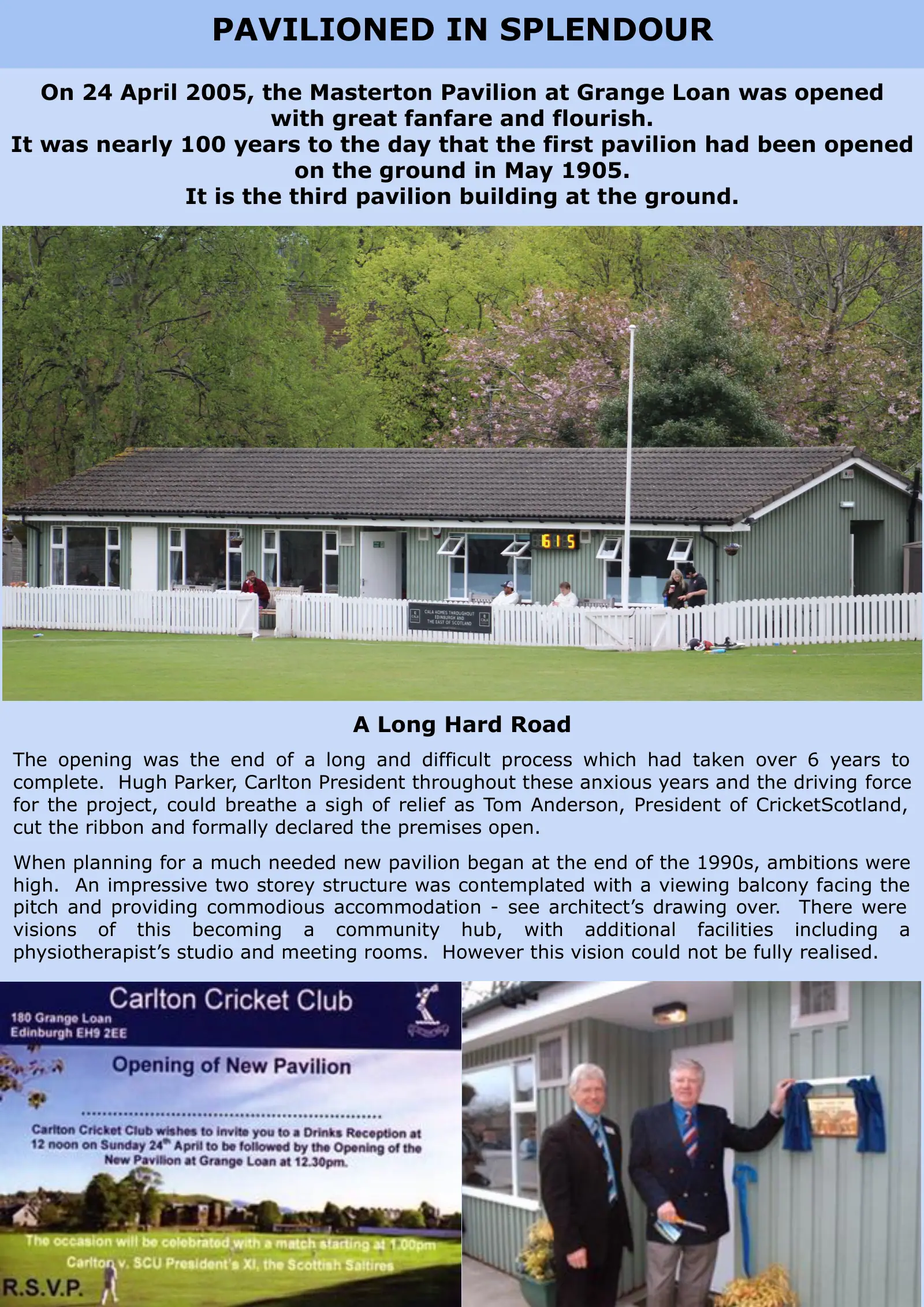
On 24 April 2005, the Masterton Pavilion at Grange Loan was opened
with great fanfare and flourish.
It was nearly 100 years to the day that the first pavilion had been opened
on the ground in May 1905.
It is the third pavilion building at the ground.
A Long Hard Road
The opening was the end of a long and difficult process which had taken over 6 years to
complete. Hugh Parker, Carlton President throughout these anxious years and the driving force
for the project, could breathe a sigh of relief as Tom Anderson, President of CricketScotland,
cut the ribbon and formally declared the premises open.
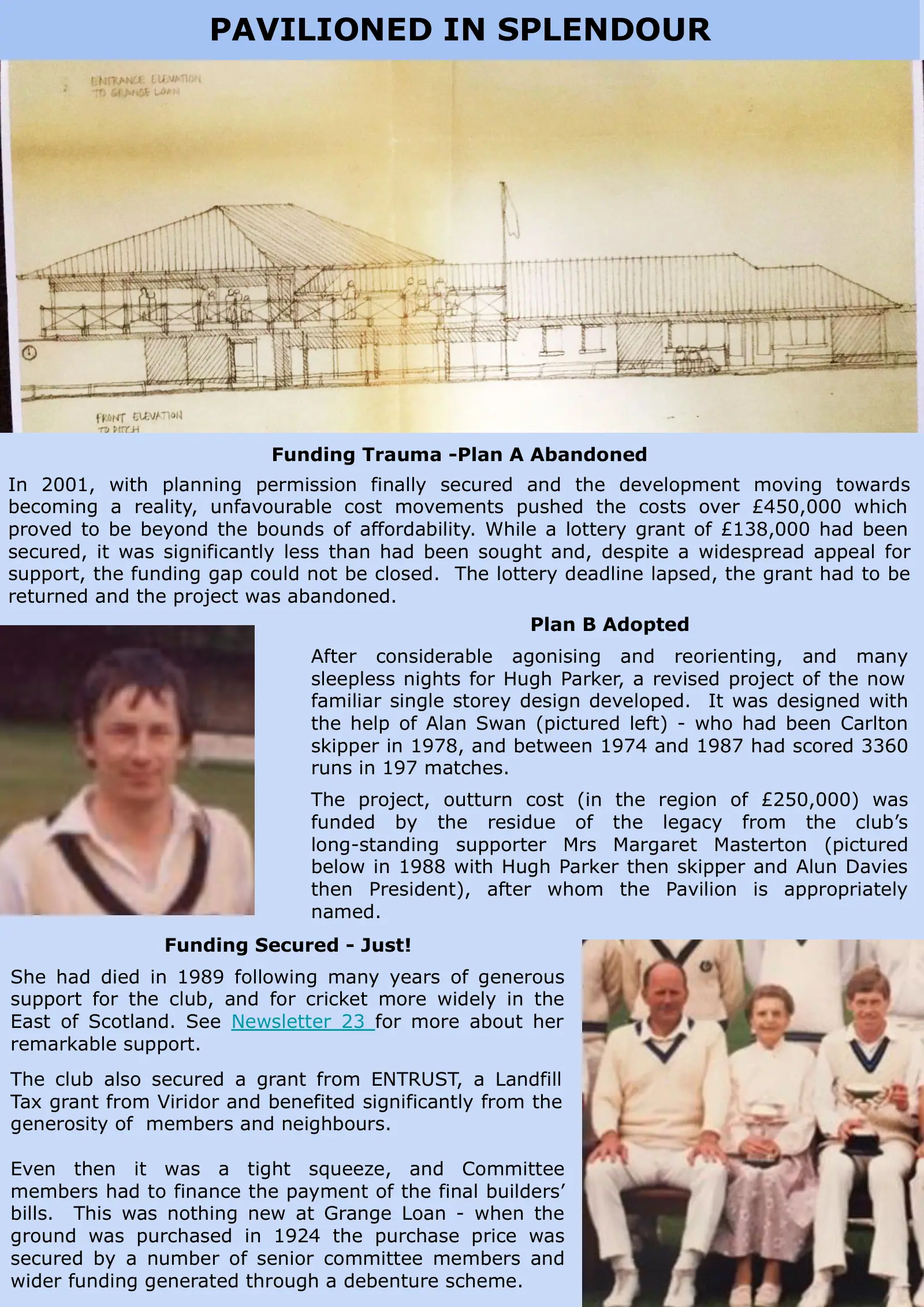
When planning for a much needed new pavilion began at the end of the 1990s, ambitions were
high. An impressive two storey structure was contemplated with a viewing balcony facing the
pitch and providing commodious accommodation - see architect’s drawing over. There were
visions of this becoming a community hub, with additional facilities including a
physiotherapist’s studio and meeting rooms. However this vision could not be fully realised.
Text of this page
PAVILIONED IN SPLENDOUR
Funding Trauma -Plan A Abandoned
In 2001, with planning permission finally secured and the development moving towards
becoming a reality, unfavourable cost movements pushed the costs over £450,000 which
proved to be beyond the bounds of affordability. While a lottery grant of £138,000 had been
secured, it was significantly less than had been sought and, despite a widespread appeal for
support, the funding gap could not be closed. The lottery deadline lapsed, the grant had to be
returned and the project was abandoned.
Funding Secured - Just!
She had died in 1989 following many years of generous
support for the club, and for cricket more widely in the
East of Scotland. See Newsletter 23 for more about her
remarkable support.
The club also secured a grant from ENTRUST, a Landfill
Tax grant from Viridor and benefited significantly from the
generosity of members and neighbours.
Even then it was a tight squeeze, and Committee
members had to finance the payment of the final builders’
bills. This was nothing new at Grange Loan - when the
ground was purchased in 1924 the purchase price was
secured by a number of senior committee members and
wider funding generated through a debenture scheme.
Plan B Adopted
After considerable agonising and reorienting, and many
sleepless nights for Hugh Parker, a revised project of the now
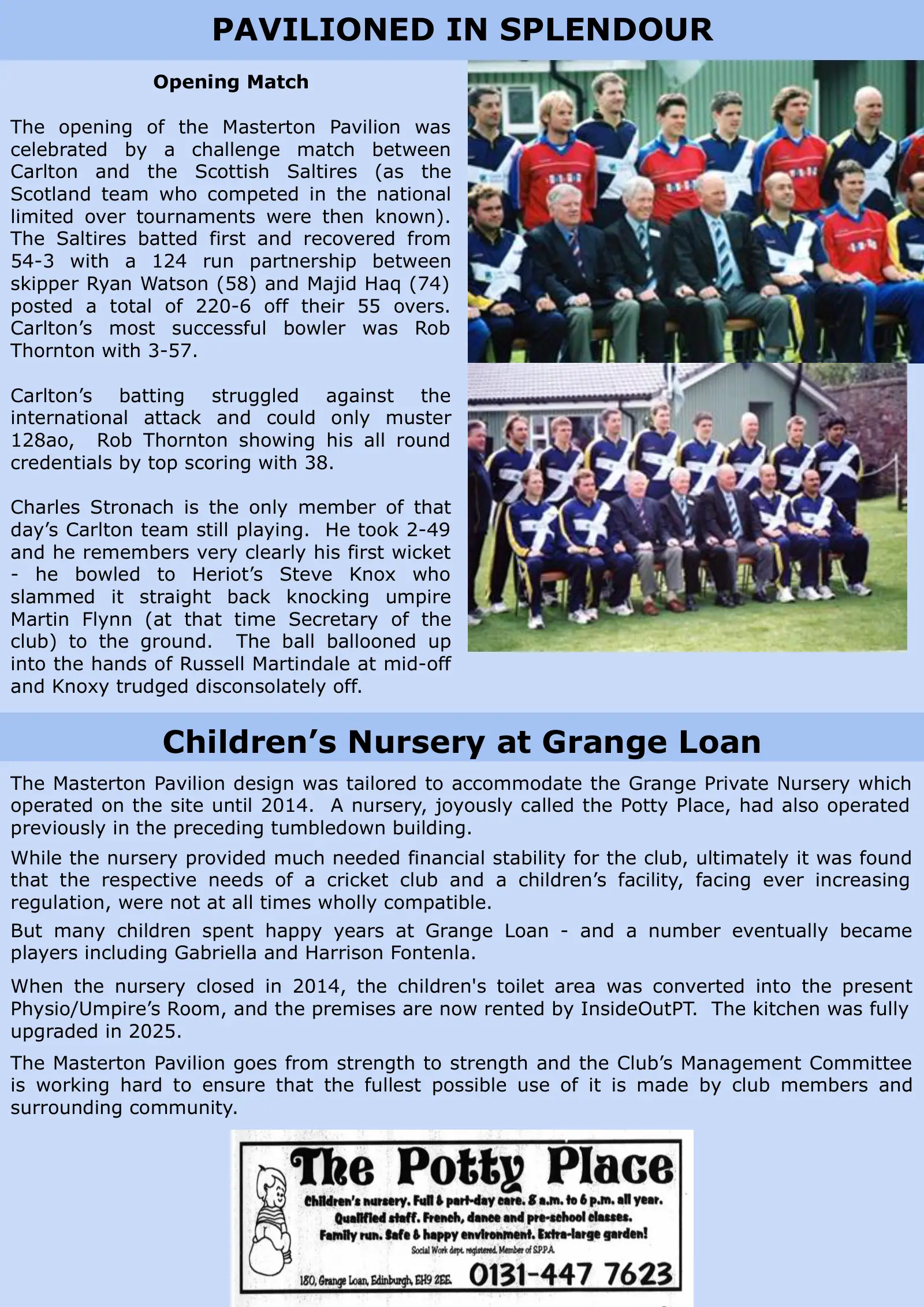
familiar single storey design developed. It was designed with
the help of Alan Swan (pictured left) - who had been Carlton
skipper in 1978, and between 1974 and 1987 had scored 3360
runs in 197 matches.
The project, outturn cost (in the region of £250,000) was
funded by the residue of the legacy from the club’s
long-standing supporter Mrs Margaret Masterton (pictured
below in 1988 with Hugh Parker then skipper and Alun Davies
then President), after whom the Pavilion is appropriately
named.
Text of this page
PAVILIONED IN SPLENDOUR
Opening Match
The opening of the Masterton Pavilion was
celebrated by a challenge match between
Carlton and the Scottish Saltires (as the
Scotland team who competed in the national
limited over tournaments were then known).
The Saltires batted first and recovered from
54-3 with a 124 run partnership between
skipper Ryan Watson (58) and Majid Haq (74)
posted a total of 220-6 off their 55 overs.
Carlton’s most successful bowler was Rob
Thornton with 3-57.
Carlton’s
batting
struggled
against
the
international attack and could only muster
128ao, Rob Thornton showing his all round
credentials by top scoring with 38.
Charles Stronach is the only member of that
day’s Carlton team still playing. He took 2-49
and he remembers very clearly his first wicket
- he bowled to Heriot’s Steve Knox who
slammed it straight back knocking umpire
Martin Flynn (at that time Secretary of the
club) to the ground. The ball ballooned up
into the hands of Russell Martindale at mid-off
and Knoxy trudged disconsolately off.
The Masterton Pavilion design was tailored to accommodate the Grange Private Nursery which
operated on the site until 2014. A nursery, joyously called the Potty Place, had also operated
previously in the preceding tumbledown building.
While the nursery provided much needed financial stability for the club, ultimately it was found
that the respective needs of a cricket club and a children’s facility, facing ever increasing
regulation, were not at all times wholly compatible.
But many children spent happy years at Grange Loan - and a number eventually became
players including Gabriella and Harrison Fontenla.
When the nursery closed in 2014, the children's toilet area was converted into the present
Physio/Umpire’s Room, and the premises are now rented by InsideOutPT. The kitchen was fully
upgraded in 2025.
The Masterton Pavilion goes from strength to strength and the Club’s Management Committee
is working hard to ensure that the fullest possible use of it is made by club members and
surrounding community.
Children’s Nursery at Grange Loan
Text of this page
PAVILIONED IN SPLENDOUR
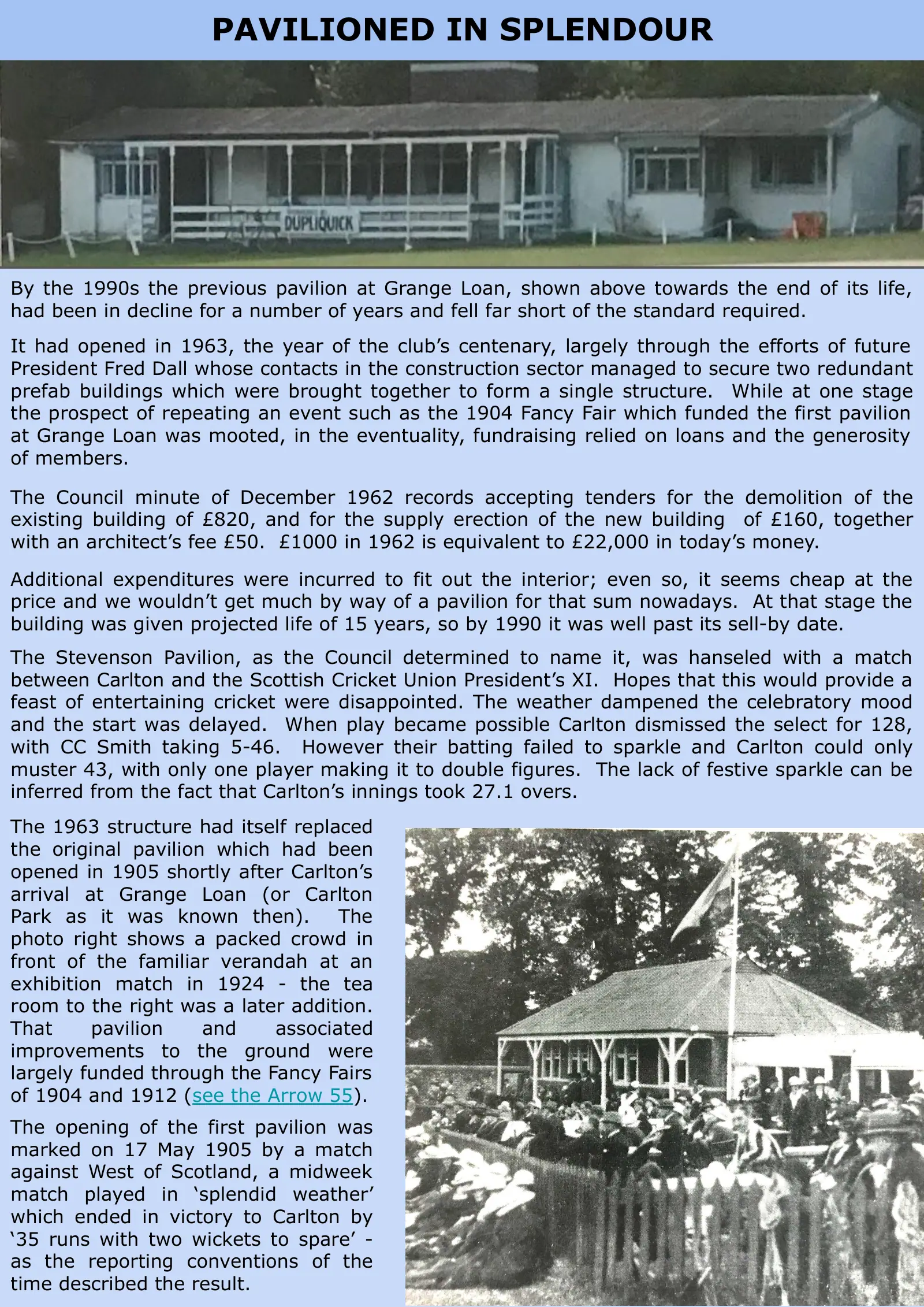
By the 1990s the previous pavilion at Grange Loan, shown above towards the end of its life,
had been in decline for a number of years and fell far short of the standard required.
It had opened in 1963, the year of the club’s centenary, largely through the efforts of future
President Fred Dall whose contacts in the construction sector managed to secure two redundant
prefab buildings which were brought together to form a single structure. While at one stage
the prospect of repeating an event such as the 1904 Fancy Fair which funded the first pavilion
at Grange Loan was mooted, in the eventuality, fundraising relied on loans and the generosity
of members.
The Council minute of December 1962 records accepting tenders for the demolition of the
existing building of £820, and for the supply erection of the new building of £160, together
with an architect’s fee £50. £1000 in 1962 is equivalent to £22,000 in today’s money.
Additional expenditures were incurred to fit out the interior; even so, it seems cheap at the
price and we wouldn’t get much by way of a pavilion for that sum nowadays. At that stage the
building was given projected life of 15 years, so by 1990 it was well past its sell-by date.
The Stevenson Pavilion, as the Council determined to name it, was hanseled with a match
between Carlton and the Scottish Cricket Union President’s XI. Hopes that this would provide a
feast of entertaining cricket were disappointed. The weather dampened the celebratory mood
and the start was delayed. When play became possible Carlton dismissed the select for 128,
with CC Smith taking 5-46. However their batting failed to sparkle and Carlton could only
muster 43, with only one player making it to double figures. The lack of festive sparkle can be
inferred from the fact that Carlton’s innings took 27.1 overs.
The 1963 structure had itself replaced
the original pavilion which had been
opened in 1905 shortly after Carlton’s
arrival at Grange Loan (or Carlton
Park as it was known then). The
photo right shows a packed crowd in
front of the familiar verandah at an
exhibition match in 1924 - the tea
room to the right was a later addition.
That
pavilion
and
associated
improvements to the ground were
largely funded through the Fancy Fairs
of 1904 and 1912 (see the Arrow 55).
The opening of the first pavilion was
marked on 17 May 1905 by a match
against West of Scotland, a midweek
match played in ‘splendid weather’
which ended in victory to Carlton by
‘35 runs with two wickets to spare’ -
as the reporting conventions of the
time described the result.
Text of this page
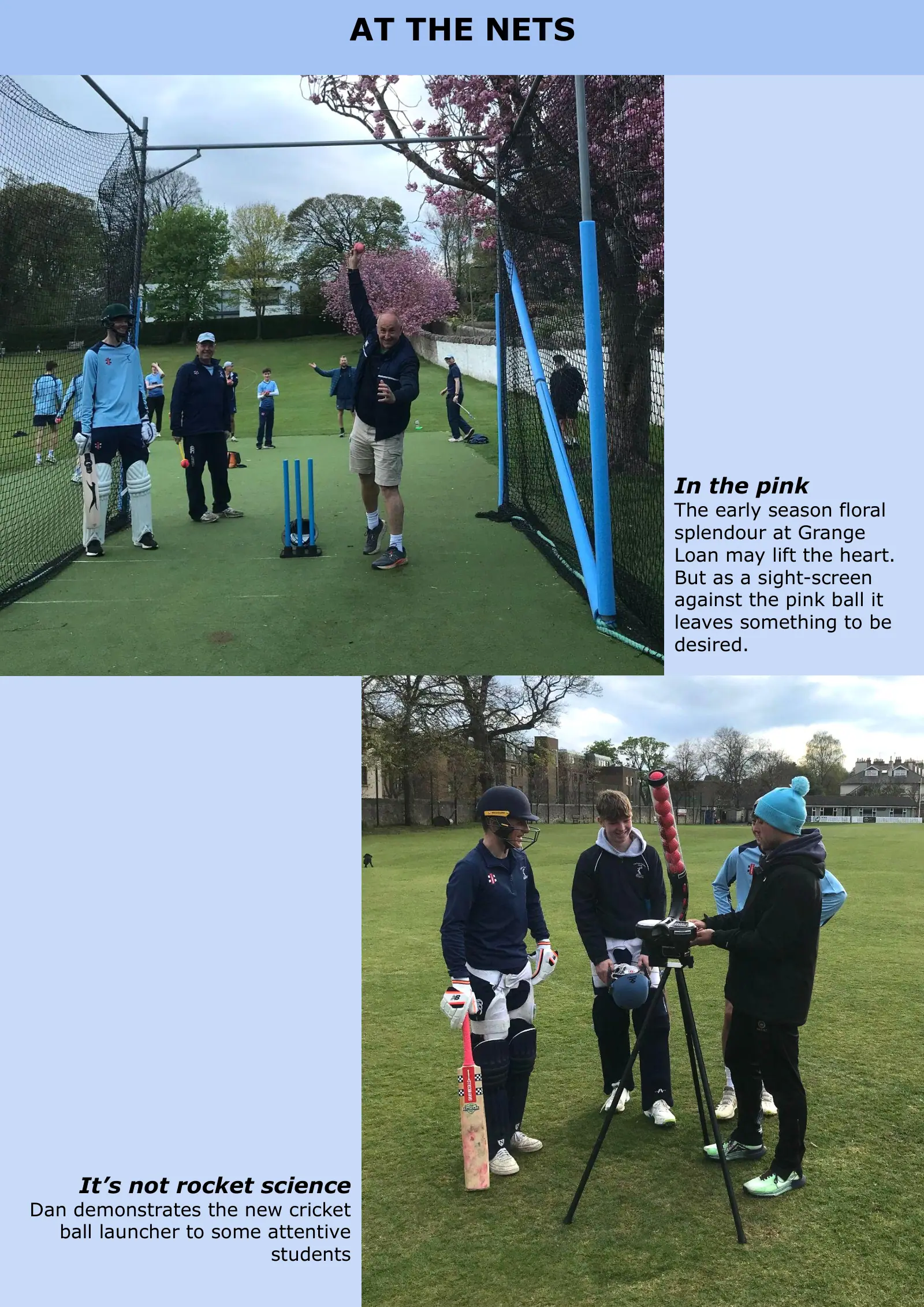
In the pink
The early season floral
splendour at Grange
Loan may lift the heart.
But as a sight-screen
against the pink ball it
leaves something to be
desired.
AT THE NETS
It’s not rocket science
Dan demonstrates the new cricket
ball launcher to some attentive
students
Text of this page
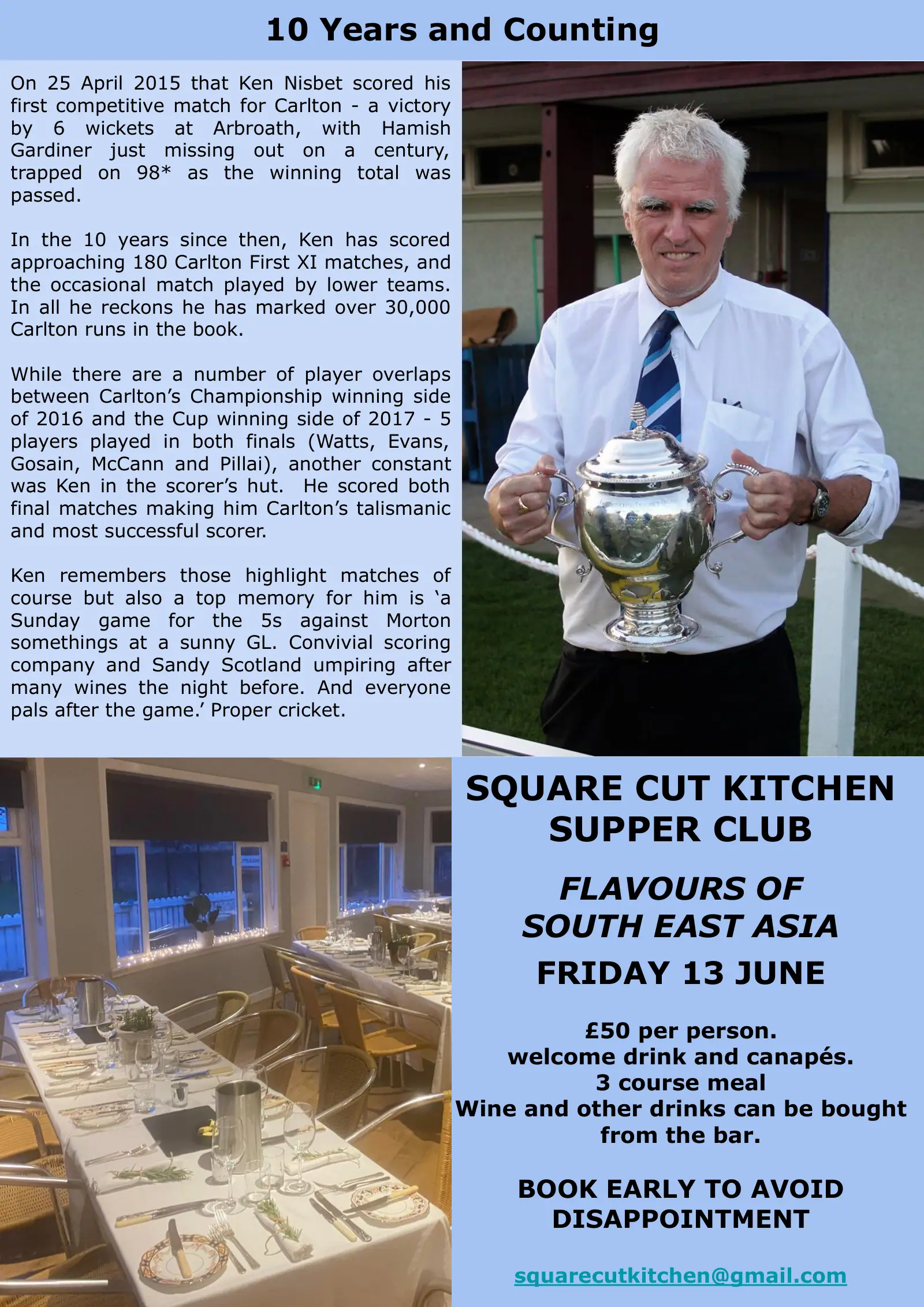
On 25 April 2015 that Ken Nisbet scored his
first competitive match for Carlton - a victory
by 6 wickets at Arbroath, with Hamish
Gardiner just missing out on a century,
trapped on 98* as the winning total was
passed.
In the 10 years since then, Ken has scored
approaching 180 Carlton First XI matches, and
the occasional match played by lower teams.
In all he reckons he has marked over 30,000
Carlton runs in the book.
While there are a number of player overlaps
between Carlton’s Championship winning side
of 2016 and the Cup winning side of 2017 - 5
players played in both finals (Watts, Evans,
Gosain, McCann and Pillai), another constant
was Ken in the scorer’s hut. He scored both
final matches making him Carlton’s talismanic
and most successful scorer.
Ken remembers those highlight matches of
course but also a top memory for him is ‘a
Sunday game for the 5s against Morton
somethings at a sunny GL. Convivial scoring
company and Sandy Scotland umpiring after
many wines the night before. And everyone
pals after the game.’ Proper cricket.
10 Years and Counting
SQUARE CUT KITCHEN
SUPPER CLUB
FLAVOURS OF
SOUTH EAST ASIA
FRIDAY 13 JUNE
£50 per person.
welcome drink and canapés.
3 course meal
Wine and other drinks can be bought
from the bar.
BOOK EARLY TO AVOID
DISAPPOINTMENT
squarecutkitchen@gmail.com
Text of this page
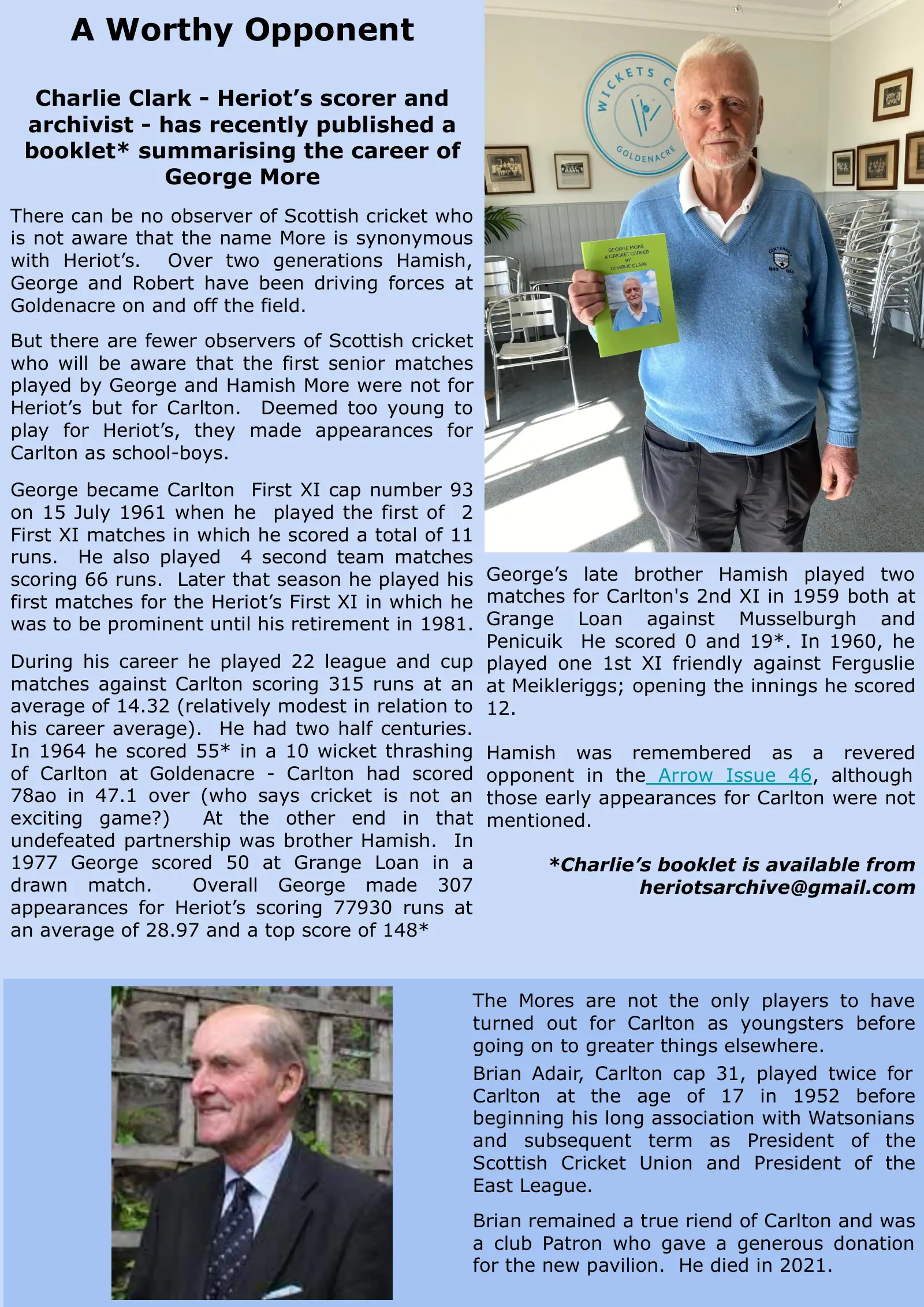
A Worthy Opponent
Charlie Clark - Heriot’s scorer and
archivist - has recently published a
booklet* summarising the career of
George More
There can be no observer of Scottish cricket who
is not aware that the name More is synonymous
with Heriot’s. Over two generations Hamish,
George and Robert have been driving forces at
Goldenacre on and off the field.
But there are fewer observers of Scottish cricket
who will be aware that the first senior matches
played by George and Hamish More were not for
Heriot’s but for Carlton. Deemed too young to
play for Heriot’s, they made appearances for
Carlton as school-boys.
George became Carlton First XI cap number 93
on 15 July 1961 when he played the first of 2
First XI matches in which he scored a total of 11
runs. He also played 4 second team matches
scoring 66 runs. Later that season he played his
first matches for the Heriot’s First XI in which he
was to be prominent until his retirement in 1981.
During his career he played 22 league and cup
matches against Carlton scoring 315 runs at an
average of 14.32 (relatively modest in relation to
his career average). He had two half centuries.
In 1964 he scored 55* in a 10 wicket thrashing
of Carlton at Goldenacre - Carlton had scored
78ao in 47.1 over (who says cricket is not an
exciting game?) At the other end in that
undefeated partnership was brother Hamish. In
1977 George scored 50 at Grange Loan in a
drawn match. Overall George made 307
appearances for Heriot’s scoring 77930 runs at
an average of 28.97 and a top score of 148*
George’s late brother Hamish played two
matches for Carlton's 2nd XI in 1959 both at
Grange
Loan
against
Musselburgh
and
Penicuik He scored 0 and 19*. In 1960, he
played one 1st XI friendly against Ferguslie
at Meikleriggs; opening the innings he scored
12.
Hamish was remembered as a revered
opponent in the Arrow Issue 46, although
those early appearances for Carlton were not
mentioned.
*Charlie’s booklet is available from
heriotsarchive@gmail.com
The Mores are not the only players to have
turned out for Carlton as youngsters before
going on to greater things elsewhere.
Brian Adair, Carlton cap 31, played twice for
Carlton at the age of 17 in 1952 before
beginning his long association with Watsonians
and subsequent term as President of the
Scottish Cricket Union and President of the
East League.
Brian remained a true riend of Carlton and was
a club Patron who gave a generous donation
for the new pavilion. He died in 2021.
Text of this page
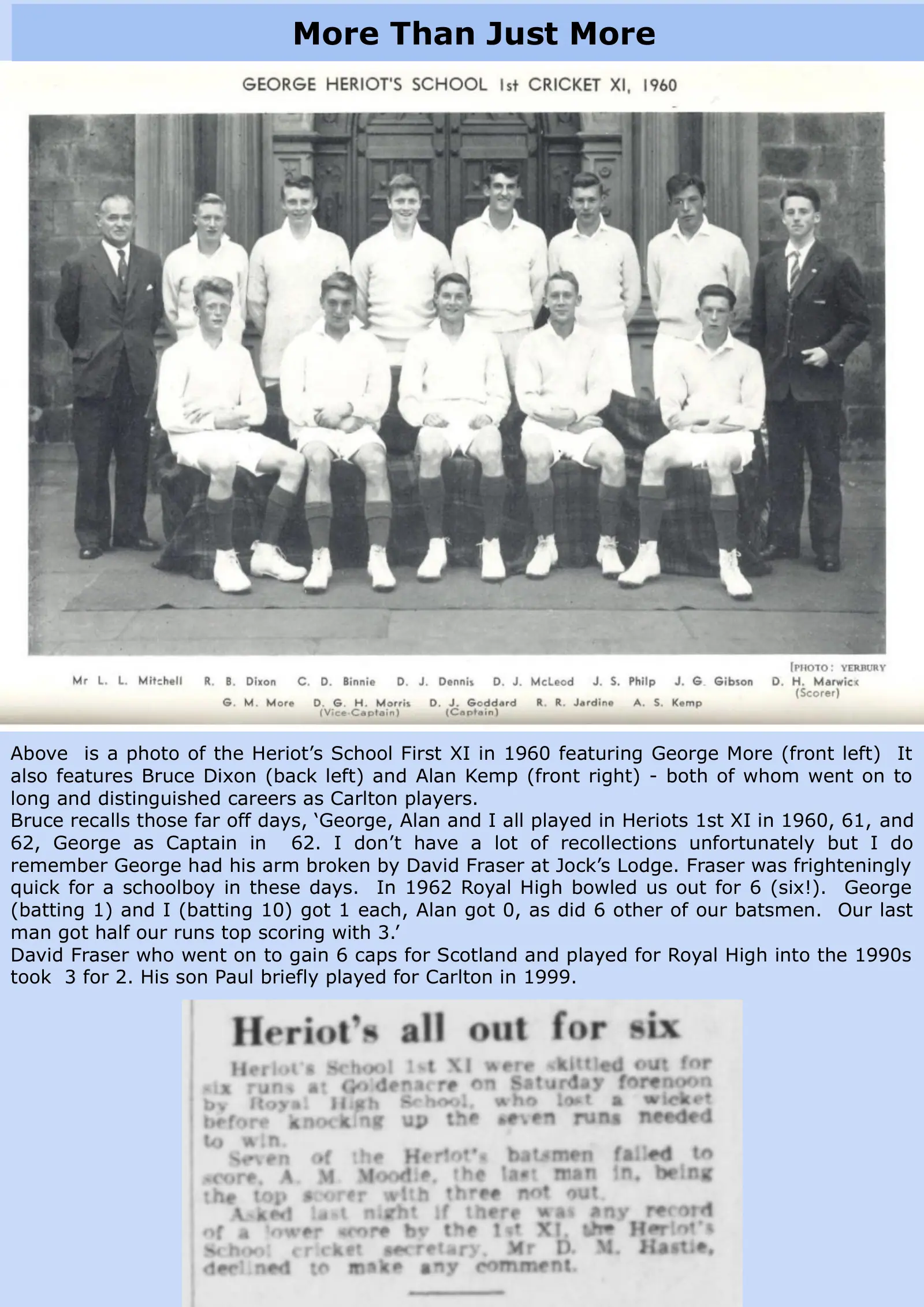
Above is a photo of the Heriot’s School First XI in 1960 featuring George More (front left) It
also features Bruce Dixon (back left) and Alan Kemp (front right) - both of whom went on to
long and distinguished careers as Carlton players.
Bruce recalls those far off days, ‘George, Alan and I all played in Heriots 1st XI in 1960, 61, and
62, George as Captain in 62. I don’t have a lot of recollections unfortunately but I do
remember George had his arm broken by David Fraser at Jock’s Lodge. Fraser was frighteningly
quick for a schoolboy in these days. In 1962 Royal High bowled us out for 6 (six!). George
(batting 1) and I (batting 10) got 1 each, Alan got 0, as did 6 other of our batsmen. Our last
man got half our runs top scoring with 3.’
David Fraser who went on to gain 6 caps for Scotland and played for Royal High into the 1990s
took 3 for 2. His son Paul briefly played for Carlton in 1999.
More Than Just More
Text of this page
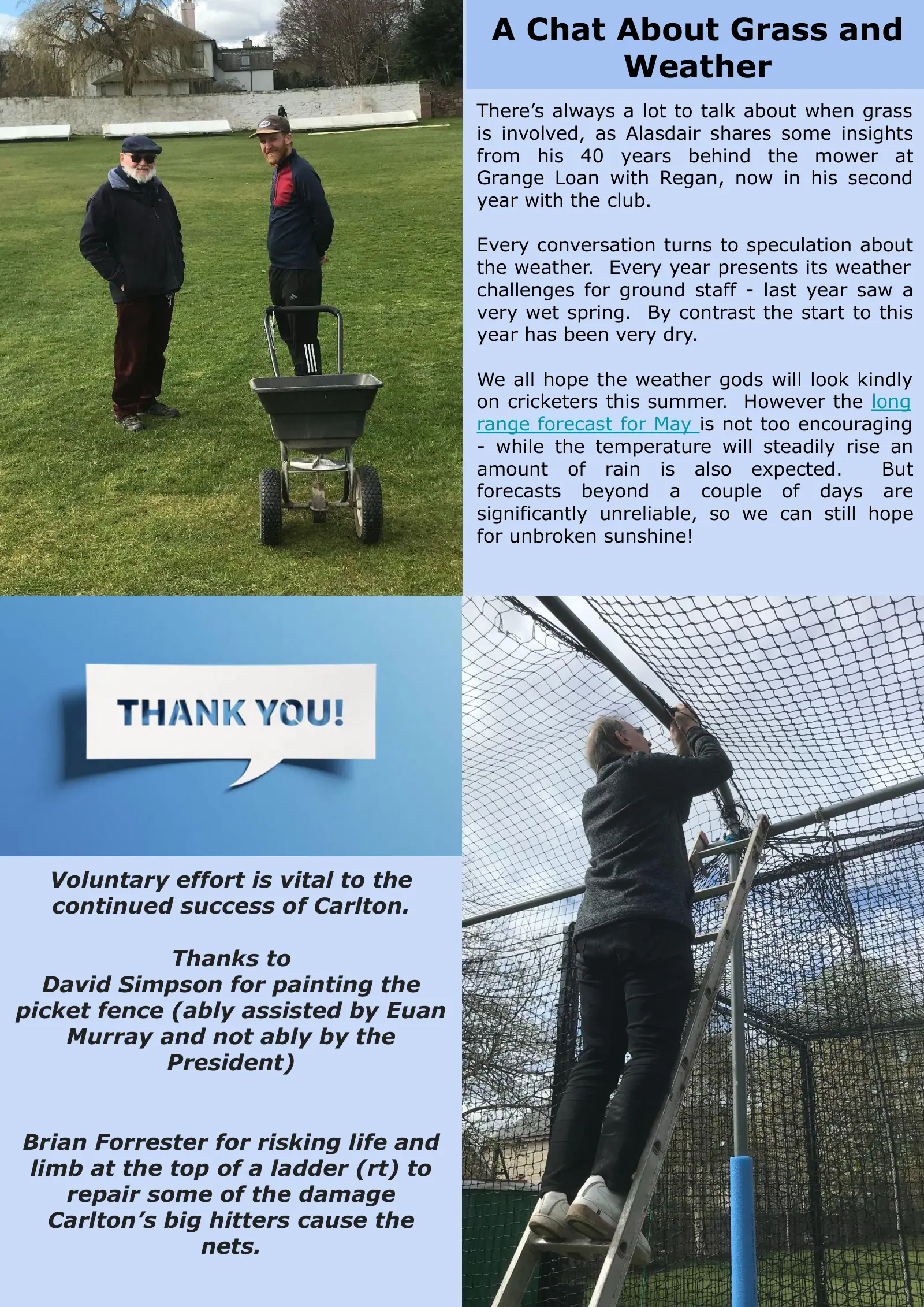
There’s always a lot to talk about when grass
is involved, as Alasdair shares some insights
from his 40 years behind the mower at
Grange Loan with Regan, now in his second
year with the club.
Every conversation turns to speculation about
the weather. Every year presents its weather
challenges for ground staff - last year saw a
very wet spring. By contrast the start to this
year has been very dry.
We all hope the weather gods will look kindly
on cricketers this summer. However the long
range forecast for May is not too encouraging
- while the temperature will steadily rise an
amount of rain is also expected. But
forecasts beyond a couple of days are
significantly unreliable, so we can still hope
for unbroken sunshine!
A Chat About Grass and
Weather
Voluntary effort is vital to the
continued success of Carlton.
Thanks to
David Simpson for painting the
picket fence (ably assisted by Euan
Murray and not ably by the
President)
Brian Forrester for risking life and
limb at the top of a ladder (rt) to
repair some of the damage
Carlton’s big hitters cause the
nets.
Text of this page
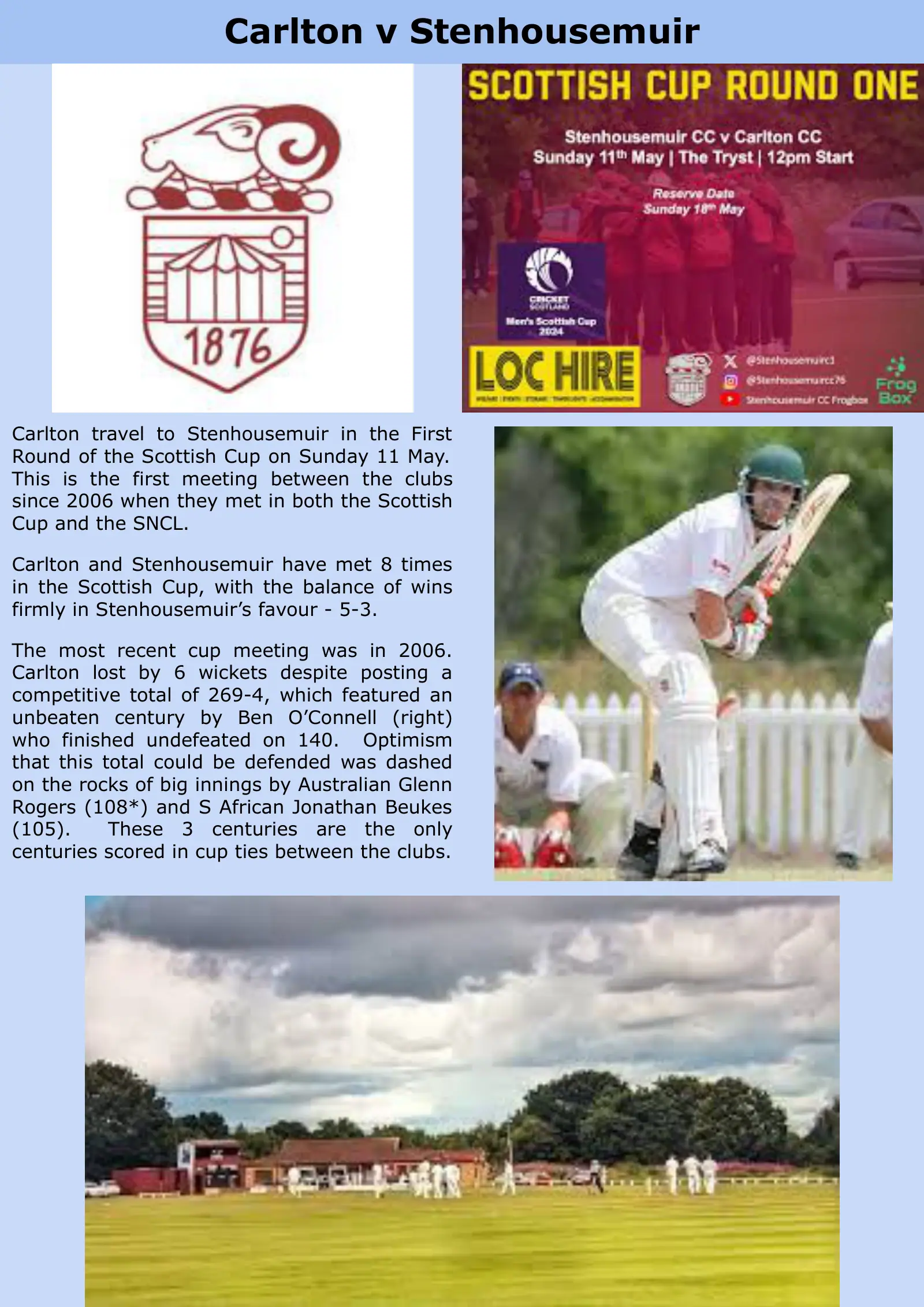
Carlton travel to Stenhousemuir in the First
Round of the Scottish Cup on Sunday 11 May.
This is the first meeting between the clubs
since 2006 when they met in both the Scottish
Cup and the SNCL.
Carlton and Stenhousemuir have met 8 times
in the Scottish Cup, with the balance of wins
firmly in Stenhousemuir’s favour - 5-3.
The most recent cup meeting was in 2006.
Carlton lost by 6 wickets despite posting a
competitive total of 269-4, which featured an
unbeaten century by Ben O’Connell (right)
who finished undefeated on 140. Optimism
that this total could be defended was dashed
on the rocks of big innings by Australian Glenn
Rogers (108*) and S African Jonathan Beukes
(105). These 3 centuries are the only
centuries scored in cup ties between the clubs.
Carlton v Stenhousemuir
Text of this page
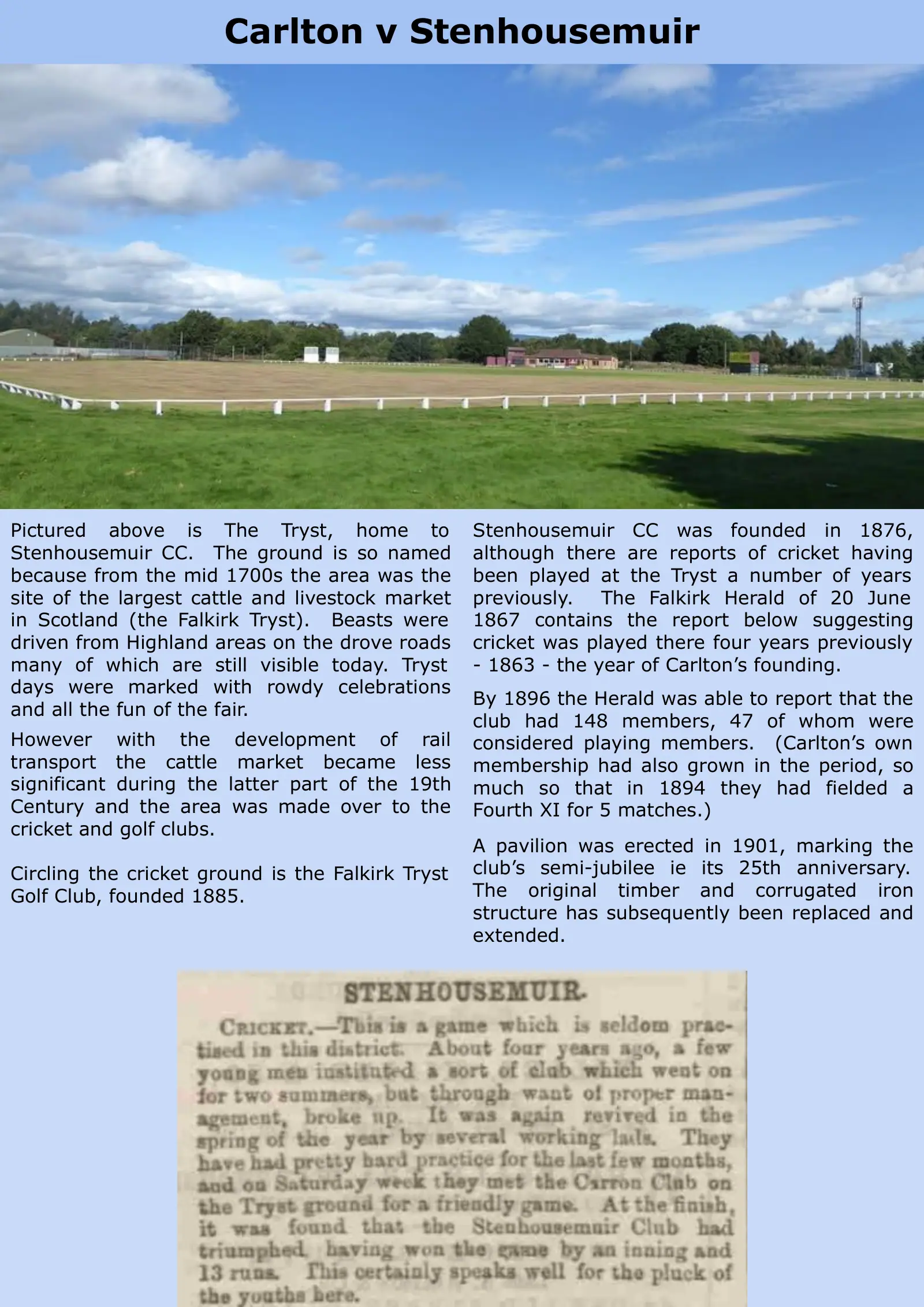
Pictured
above
is
The
Tryst,
home
to
Stenhousemuir CC. The ground is so named
because from the mid 1700s the area was the
site of the largest cattle and livestock market
in Scotland (the Falkirk Tryst). Beasts were
driven from Highland areas on the drove roads
many of which are still visible today. Tryst
days were marked with rowdy celebrations
and all the fun of the fair.
However
with
the
development
of
rail
transport the cattle market became less
significant during the latter part of the 19th
Century and the area was made over to the
cricket and golf clubs.
Circling the cricket ground is the Falkirk Tryst
Golf Club, founded 1885.
Stenhousemuir CC was founded in 1876,
although there are reports of cricket having
been played at the Tryst a number of years
previously. The Falkirk Herald of 20 June
1867 contains the report below suggesting
cricket was played there four years previously
- 1863 - the year of Carlton’s founding.
By 1896 the Herald was able to report that the
club had 148 members, 47 of whom were
considered playing members. (Carlton’s own
membership had also grown in the period, so
much so that in 1894 they had fielded a
Fourth XI for 5 matches.)
A pavilion was erected in 1901, marking the
club’s semi-jubilee ie its 25th anniversary.
The original timber and corrugated iron
structure has subsequently been replaced and
extended.
Carlton v Stenhousemuir
Text of this page
The Falkirk Herald reported in 1886 that the
Stenhousemuir Cricket Club had had its most
successful season with 7 wins out of 16
matches. Its opposition was largely locally
based teams and the 2nd XI’s of larger clubs
such
as
Drumpellier
and
Clydesdale.
Gradually the club became more competitive
and its fixture card began to include more
challenging opposition.
However it was not until August of 1920 that
the first recorded match with Carlton took
place - Stenhousemuir going down to a 5
wicket defeat at Grange Loan. Having batted
first their total of 109 didn’t look particularly
challenging, but their bowlers soon had the
home side in a bit of trouble at 24-4. A stand
of
77
between
CS
Paterson
and
GD
Cunningham saved the home team’s blushes.
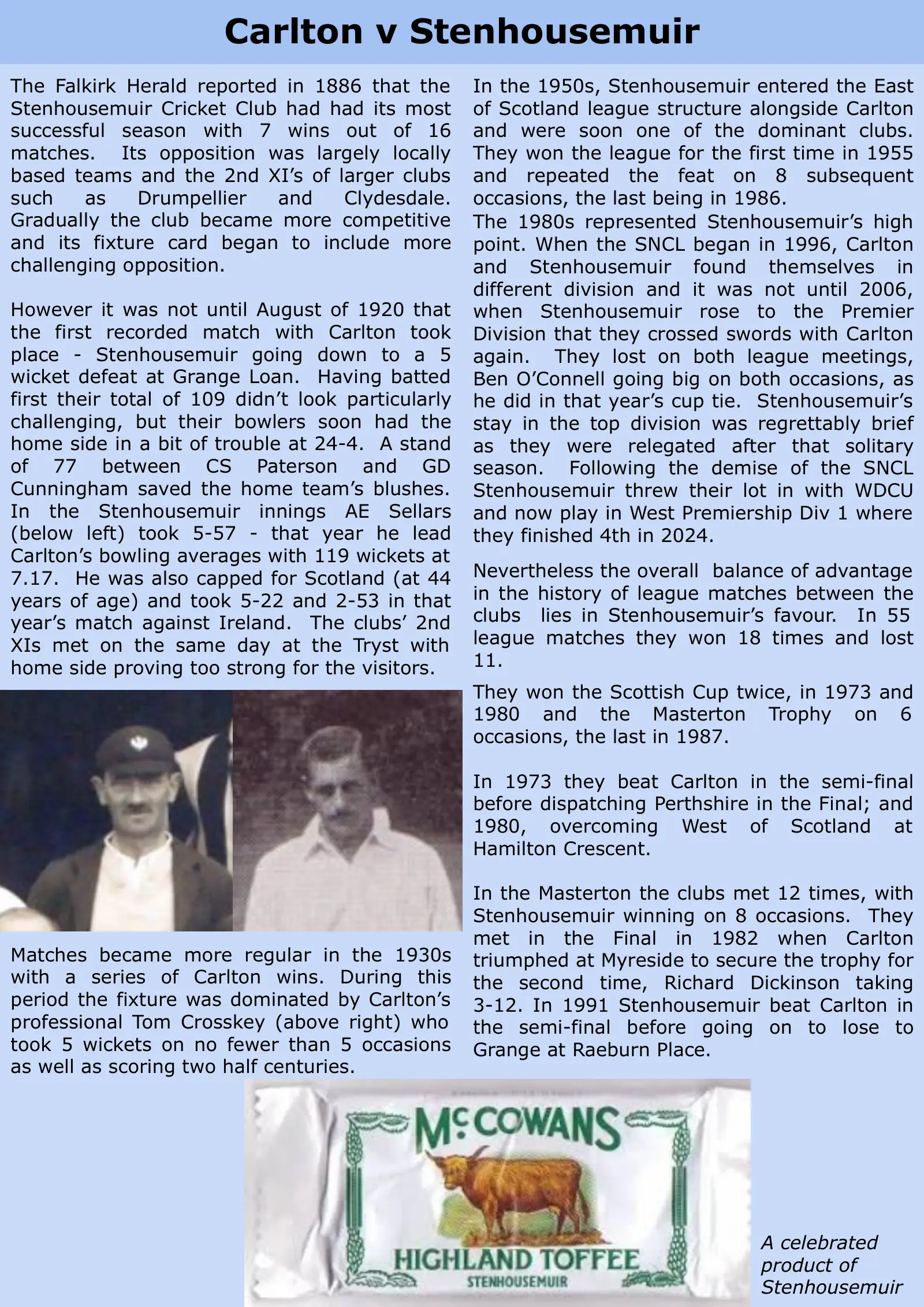
In the Stenhousemuir innings AE Sellars
(below left) took 5-57 - that year he lead
Carlton’s bowling averages with 119 wickets at
7.17. He was also capped for Scotland (at 44
years of age) and took 5-22 and 2-53 in that
year’s match against Ireland. The clubs’ 2nd
XIs met on the same day at the Tryst with
home side proving too strong for the visitors.
Matches became more regular in the 1930s
with a series of Carlton wins. During this
period the fixture was dominated by Carlton’s
professional Tom Crosskey (above right) who
took 5 wickets on no fewer than 5 occasions
as well as scoring two half centuries.
A celebrated
product of
Stenhousemuir
Carlton v Stenhousemuir
In the 1950s, Stenhousemuir entered the East
of Scotland league structure alongside Carlton
and were soon one of the dominant clubs.
They won the league for the first time in 1955
and repeated the feat on 8 subsequent
occasions, the last being in 1986.
The 1980s represented Stenhousemuir’s high
point. When the SNCL began in 1996, Carlton
and
Stenhousemuir
found
themselves
in
different division and it was not until 2006,
when Stenhousemuir rose to the Premier
Division that they crossed swords with Carlton
again. They lost on both league meetings,
Ben O’Connell going big on both occasions, as
he did in that year’s cup tie. Stenhousemuir’s
stay in the top division was regrettably brief
as they were relegated after that solitary
season. Following the demise of the SNCL
Stenhousemuir threw their lot in with WDCU
and now play in West Premiership Div 1 where
they finished 4th in 2024.
Nevertheless the overall balance of advantage
in the history of league matches between the
clubs lies in Stenhousemuir’s favour. In 55
league matches they won 18 times and lost
11.
They won the Scottish Cup twice, in 1973 and
1980
and
the
Masterton
Trophy
on
6
occasions, the last in 1987.
In 1973 they beat Carlton in the semi-final
before dispatching Perthshire in the Final; and
1980,
overcoming
West
of
Scotland
at
Hamilton Crescent.
In the Masterton the clubs met 12 times, with
Stenhousemuir winning on 8 occasions. They
met in the Final in 1982 when Carlton
triumphed at Myreside to secure the trophy for
the second time, Richard Dickinson taking
3-12. In 1991 Stenhousemuir beat Carlton in
the semi-final before going on to lose to
Grange at Raeburn Place.
Text of this page
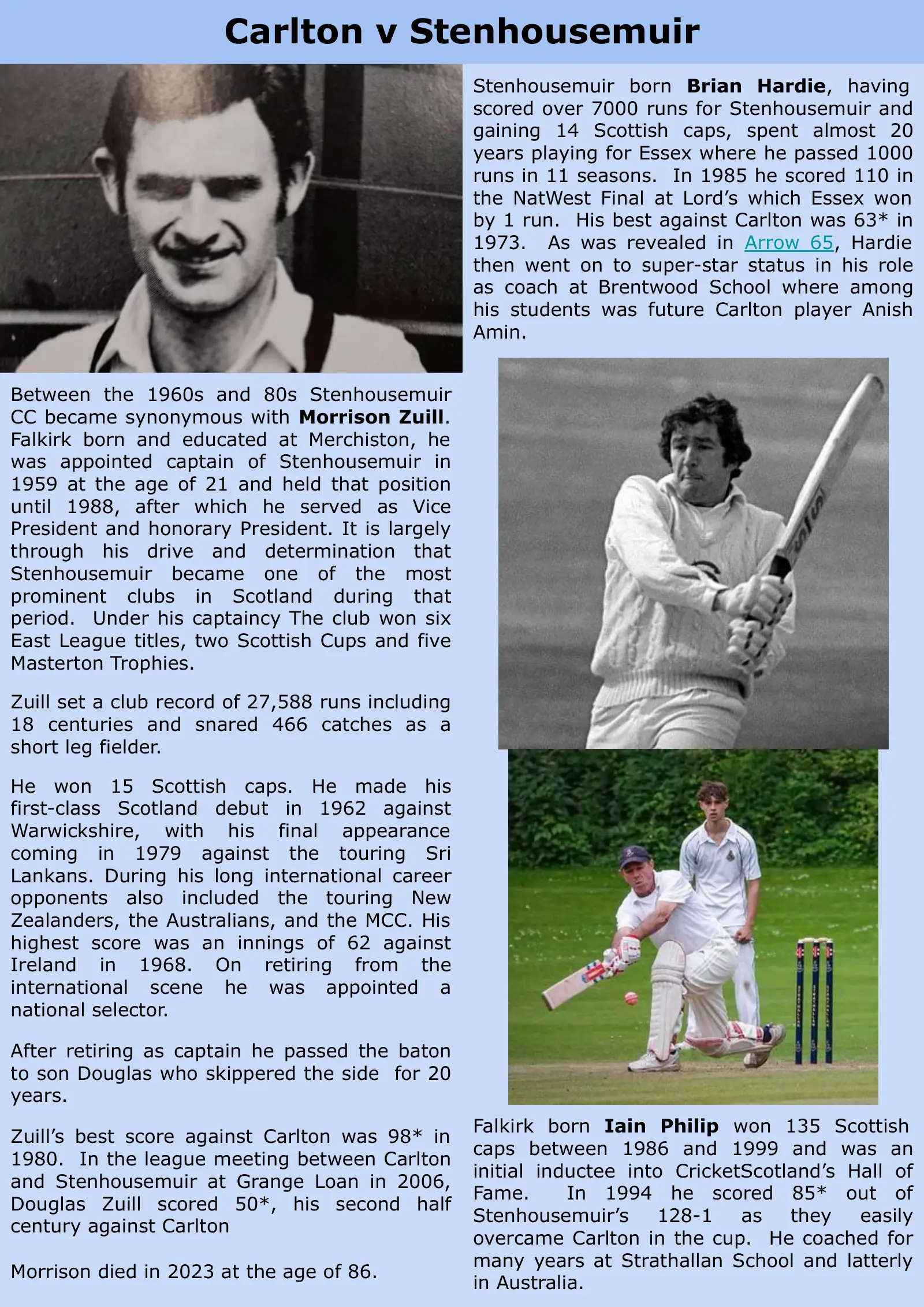
Between the 1960s and 80s Stenhousemuir
CC became synonymous with Morrison Zuill.
Falkirk born and educated at Merchiston, he
was appointed captain of Stenhousemuir in
1959 at the age of 21 and held that position
until 1988, after which he served as Vice
President and honorary President. It is largely
through his drive and determination that
Stenhousemuir became one of the most
prominent clubs in Scotland during that
period. Under his captaincy The club won six
East League titles, two Scottish Cups and five
Masterton Trophies.
Zuill set a club record of 27,588 runs including
18 centuries and snared 466 catches as a
short leg fielder.
He won 15 Scottish caps. He made his
first-class Scotland debut in 1962 against
Warwickshire,
with
his
final
appearance
coming in 1979 against the touring Sri
Lankans. During his long international career
opponents also included the touring New
Zealanders, the Australians, and the MCC. His
highest score was an innings of 62 against
Ireland
in
1968.
On
retiring
from
the
international scene he was appointed a
national selector.
After retiring as captain he passed the baton
to son Douglas who skippered the side for 20
years.
Zuill’s best score against Carlton was 98* in
1980. In the league meeting between Carlton
and Stenhousemuir at Grange Loan in 2006,
Douglas Zuill scored 50*, his second half
century against Carlton
Morrison died in 2023 at the age of 86.
Carlton v Stenhousemuir
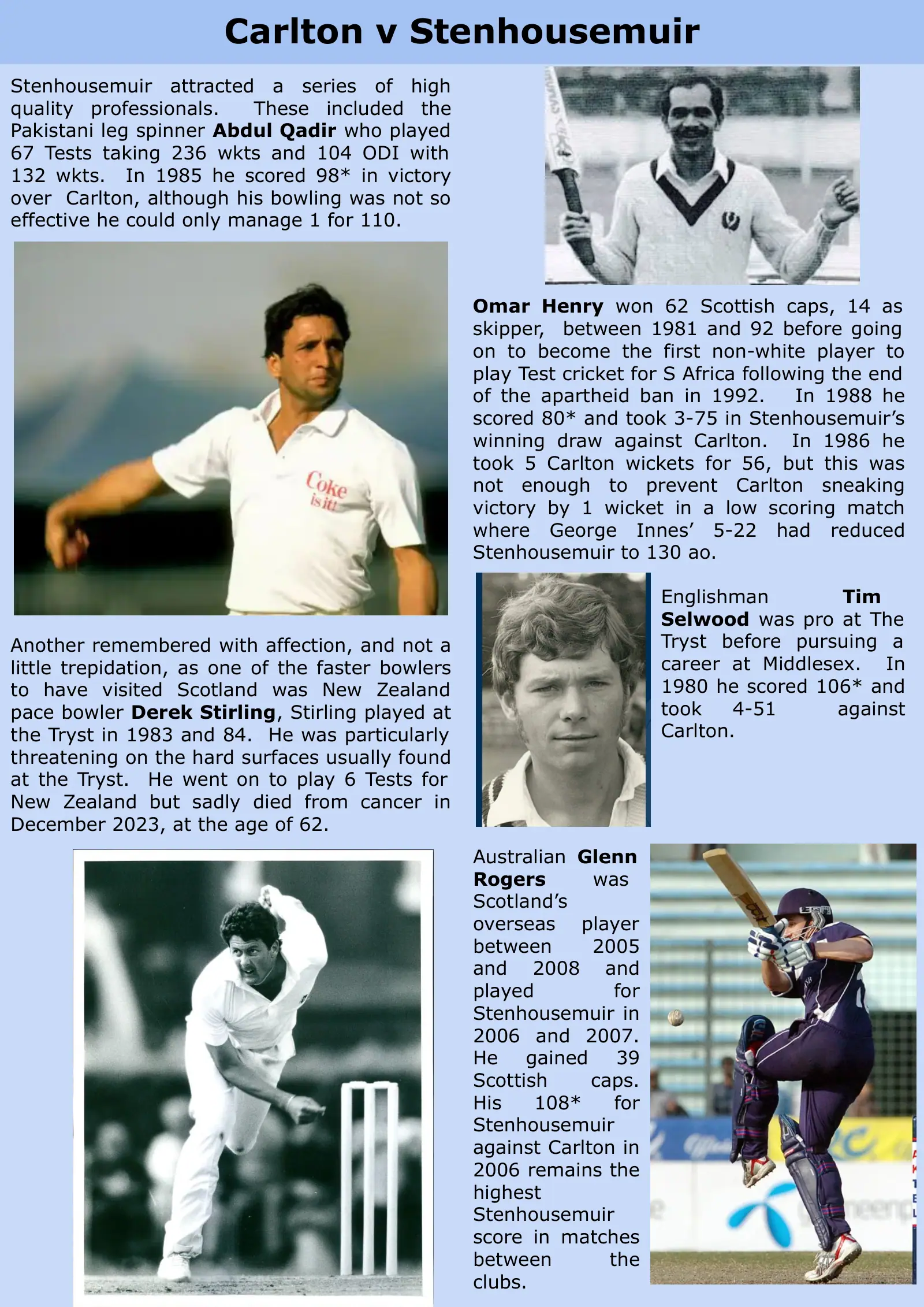
Stenhousemuir born Brian Hardie, having
scored over 7000 runs for Stenhousemuir and
gaining 14 Scottish caps, spent almost 20
years playing for Essex where he passed 1000
runs in 11 seasons. In 1985 he scored 110 in
the NatWest Final at Lord’s which Essex won
by 1 run. His best against Carlton was 63* in
1973. As was revealed in Arrow 65, Hardie
then went on to super-star status in his role
as coach at Brentwood School where among
his students was future Carlton player Anish
Amin.
Falkirk born Iain Philip won 135 Scottish
caps between 1986 and 1999 and was an
initial inductee into CricketScotland’s Hall of
Fame. In 1994 he scored 85* out of
Stenhousemuir’s
128-1
as
they
easily
overcame Carlton in the cup. He coached for
many years at Strathallan School and latterly
in Australia.
Text of this page
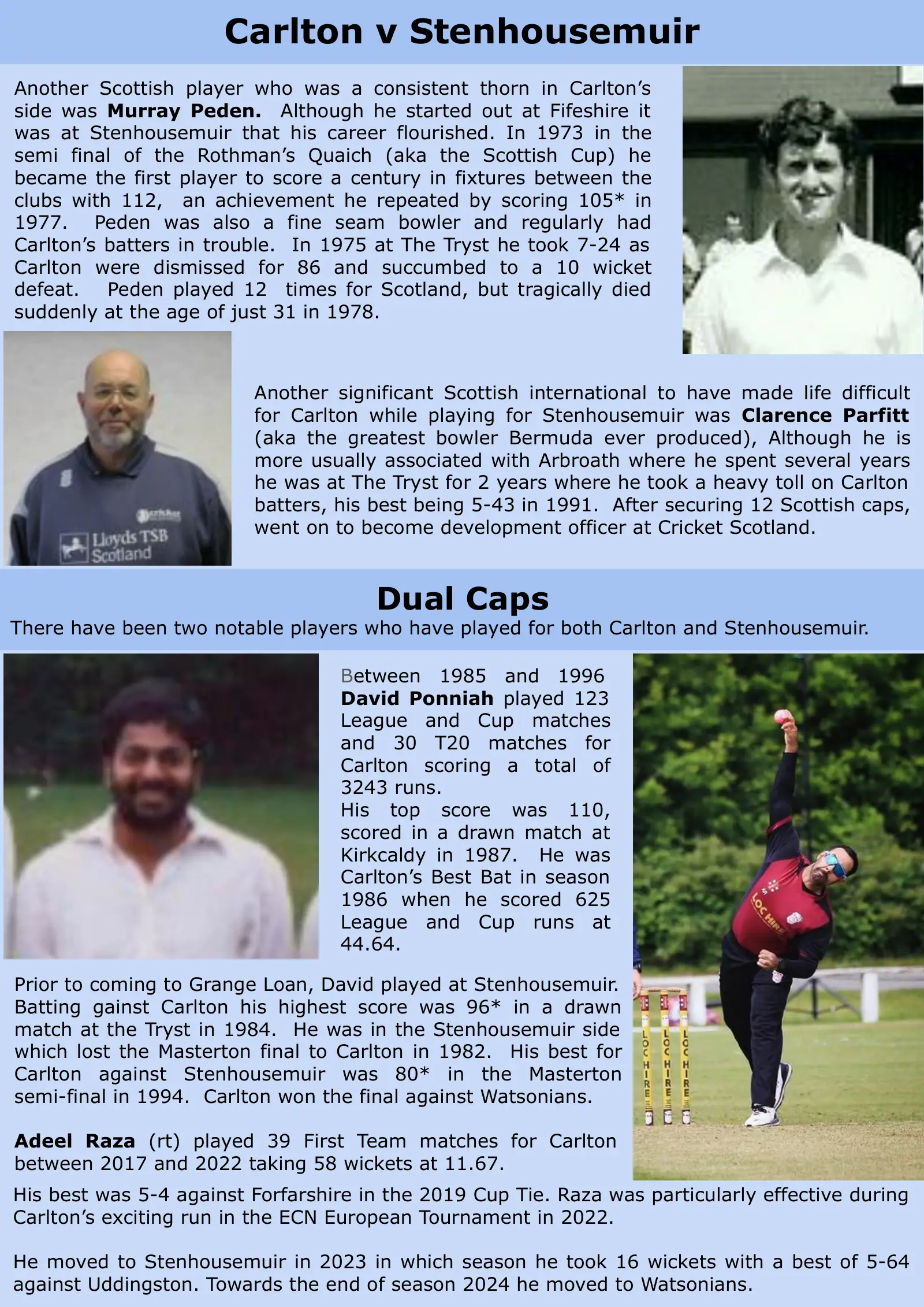
Stenhousemuir attracted a series of high
quality professionals. These included the
Pakistani leg spinner Abdul Qadir who played
67 Tests taking 236 wkts and 104 ODI with
132 wkts. In 1985 he scored 98* in victory
over Carlton, although his bowling was not so
effective he could only manage 1 for 110.
Another remembered with affection, and not a
little trepidation, as one of the faster bowlers
to have visited Scotland was New Zealand
pace bowler Derek Stirling, Stirling played at
the Tryst in 1983 and 84. He was particularly
threatening on the hard surfaces usually found
at the Tryst. He went on to play 6 Tests for
New Zealand but sadly died from cancer in
December 2023, at the age of 62.
Carlton v Stenhousemuir
Omar Henry won 62 Scottish caps, 14 as
skipper, between 1981 and 92 before going
on to become the first non-white player to
play Test cricket for S Africa following the end
of the apartheid ban in 1992. In 1988 he
scored 80* and took 3-75 in Stenhousemuir’s
winning draw against Carlton. In 1986 he
took 5 Carlton wickets for 56, but this was
not enough to prevent Carlton sneaking
victory by 1 wicket in a low scoring match
where George Innes’ 5-22 had reduced
Stenhousemuir to 130 ao.
Englishman
Tim
Selwood was pro at The
Tryst before pursuing a
career at Middlesex. In
1980 he scored 106* and
took
4-51
against
Carlton.
Australian Glenn
Rogers
was
Scotland’s
overseas
player
between
2005
and
2008
and
played
for
Stenhousemuir in
2006 and 2007.
He
gained
39
Scottish
caps.
His
108*
for
Stenhousemuir
against Carlton in
2006 remains the
highest
Stenhousemuir
score in matches
between
the
clubs.
Text of this page
Carlton v Stenhousemuir
Dual Caps
There have been two notable players who have played for both Carlton and Stenhousemuir.
Another Scottish player who was a consistent thorn in Carlton’s
side was Murray Peden. Although he started out at Fifeshire it
was at Stenhousemuir that his career flourished. In 1973 in the
semi final of the Rothman’s Quaich (aka the Scottish Cup) he
became the first player to score a century in fixtures between the
clubs with 112, an achievement he repeated by scoring 105* in
1977. Peden was also a fine seam bowler and regularly had
Carlton’s batters in trouble. In 1975 at The Tryst he took 7-24 as
Carlton were dismissed for 86 and succumbed to a 10 wicket
defeat. Peden played 12 times for Scotland, but tragically died
suddenly at the age of just 31 in 1978.
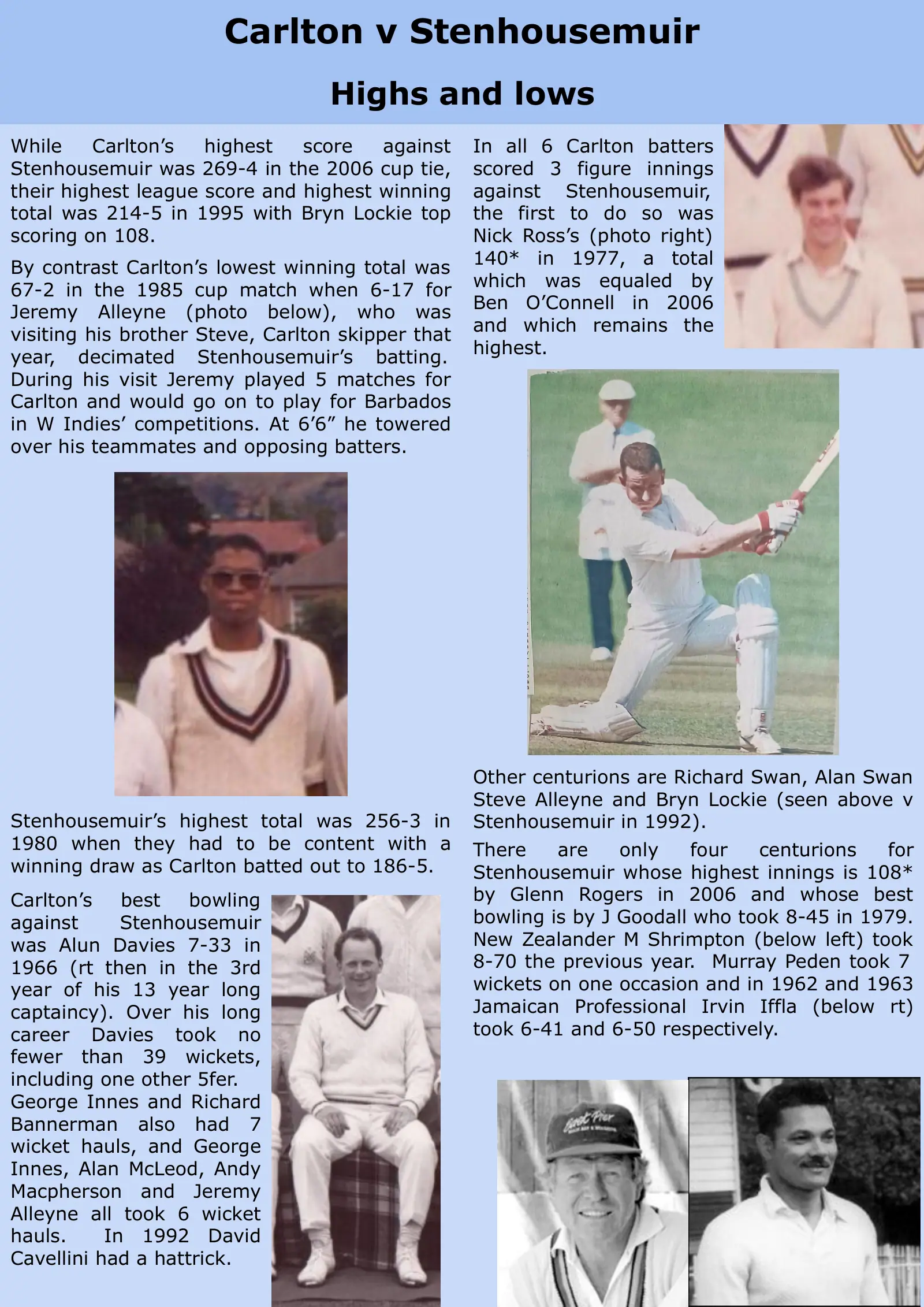
Between 1985 and 1996
David Ponniah played 123
League and Cup matches
and 30 T20 matches for
Carlton scoring a total of
3243 runs.
His top score was 110,
scored in a drawn match at
Kirkcaldy in 1987. He was
Carlton’s Best Bat in season
1986 when he scored 625
League and Cup runs at
44.64.
His best was 5-4 against Forfarshire in the 2019 Cup Tie. Raza was particularly effective during
Carlton’s exciting run in the ECN European Tournament in 2022.
He moved to Stenhousemuir in 2023 in which season he took 16 wickets with a best of 5-64
against Uddingston. Towards the end of season 2024 he moved to Watsonians.
Another significant Scottish international to have made life difficult
for Carlton while playing for Stenhousemuir was Clarence Parfitt
(aka the greatest bowler Bermuda ever produced), Although he is
more usually associated with Arbroath where he spent several years
he was at The Tryst for 2 years where he took a heavy toll on Carlton
batters, his best being 5-43 in 1991. After securing 12 Scottish caps,
went on to become development officer at Cricket Scotland.
Prior to coming to Grange Loan, David played at Stenhousemuir.
Batting gainst Carlton his highest score was 96* in a drawn
match at the Tryst in 1984. He was in the Stenhousemuir side
which lost the Masterton final to Carlton in 1982. His best for
Carlton against Stenhousemuir was 80* in the Masterton
semi-final in 1994. Carlton won the final against Watsonians.
Adeel Raza (rt) played 39 First Team matches for Carlton
between 2017 and 2022 taking 58 wickets at 11.67.
Text of this page
Carlton v Stenhousemuir
Highs and lows
While
Carlton’s
highest
score
against
Stenhousemuir was 269-4 in the 2006 cup tie,
their highest league score and highest winning
total was 214-5 in 1995 with Bryn Lockie top
scoring on 108.
By contrast Carlton’s lowest winning total was
67-2 in the 1985 cup match when 6-17 for
Jeremy Alleyne (photo below), who was
visiting his brother Steve, Carlton skipper that
year,
decimated
Stenhousemuir’s
batting.
During his visit Jeremy played 5 matches for
Carlton and would go on to play for Barbados
in W Indies’ competitions. At 6’6” he towered
over his teammates and opposing batters.
Stenhousemuir’s highest total was 256-3 in
1980 when they had to be content with a
winning draw as Carlton batted out to 186-5.
In all 6 Carlton batters
scored 3 figure innings
against
Stenhousemuir,
the first to do so was
Nick Ross’s (photo right)
140* in 1977, a total
which was equaled by
Ben O’Connell in 2006
and which remains the
highest.
Carlton’s
best
bowling
against
Stenhousemuir
was Alun Davies 7-33 in
1966 (rt then in the 3rd
year of his 13 year long
captaincy). Over his long
career
Davies
took
no
fewer than 39 wickets,
including one other 5fer.
George Innes and Richard
Bannerman also had 7
wicket hauls, and George
Innes, Alan McLeod, Andy
Macpherson and Jeremy
Alleyne all took 6 wicket
hauls. In 1992 David
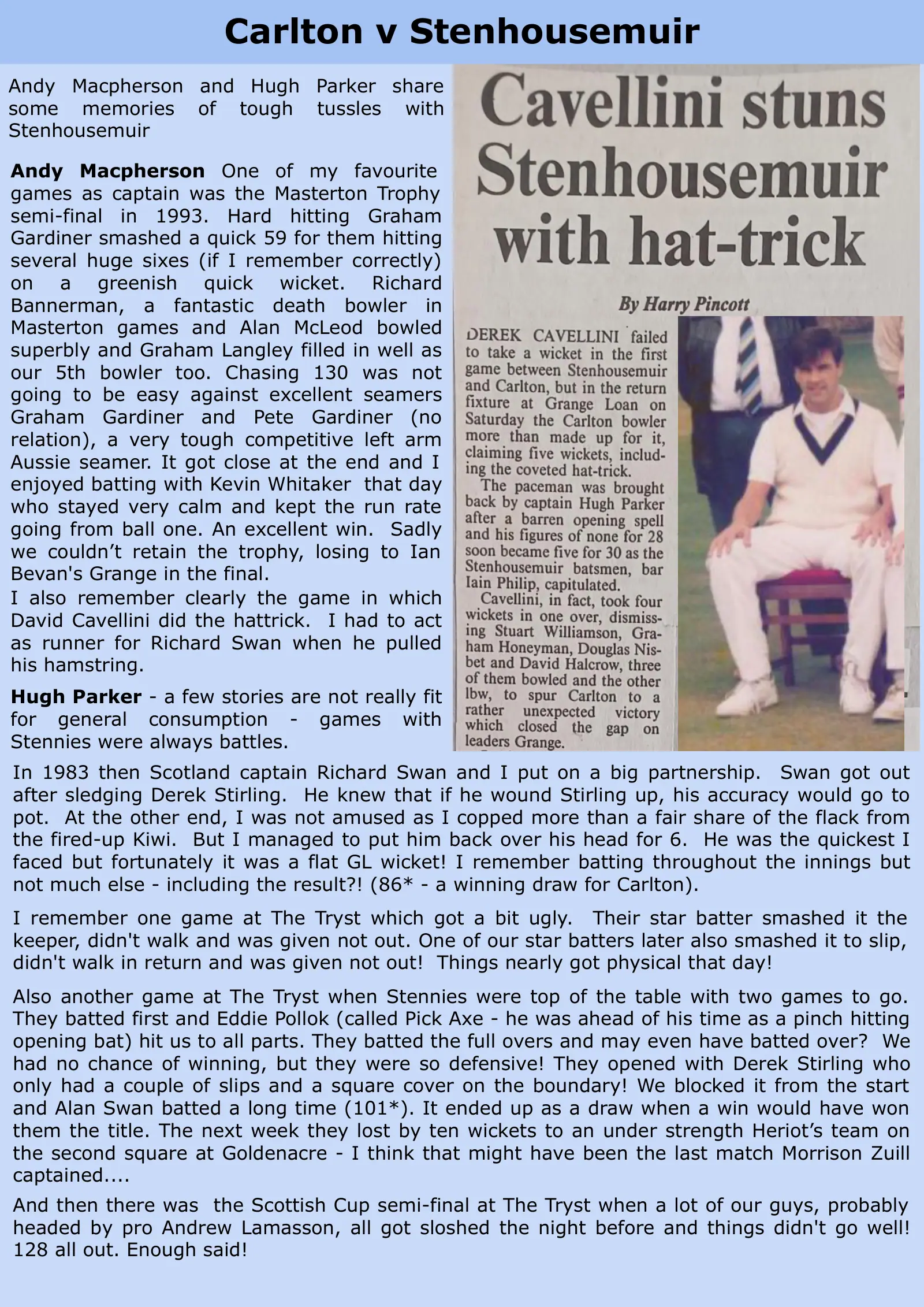
Cavellini had a hattrick.
Other centurions are Richard Swan, Alan Swan
Steve Alleyne and Bryn Lockie (seen above v
Stenhousemuir in 1992).
There
are
only
four
centurions
for
Stenhousemuir whose highest innings is 108*
by Glenn Rogers in 2006 and whose best
bowling is by J Goodall who took 8-45 in 1979.
New Zealander M Shrimpton (below left) took
8-70 the previous year. Murray Peden took 7
wickets on one occasion and in 1962 and 1963
Jamaican Professional Irvin Iffla (below rt)
took 6-41 and 6-50 respectively.
Text of this page
Andy Macpherson One of my favourite
games as captain was the Masterton Trophy
semi-final in 1993. Hard hitting Graham
Gardiner smashed a quick 59 for them hitting
several huge sixes (if I remember correctly)
on
a
greenish
quick
wicket.
Richard
Bannerman, a fantastic death bowler in
Masterton games and Alan McLeod bowled
superbly and Graham Langley filled in well as
our 5th bowler too. Chasing 130 was not
going to be easy against excellent seamers
Graham Gardiner and Pete Gardiner (no
relation), a very tough competitive left arm
Aussie seamer. It got close at the end and I
enjoyed batting with Kevin Whitaker that day
who stayed very calm and kept the run rate
going from ball one. An excellent win. Sadly
we couldn’t retain the trophy, losing to Ian
Bevan's Grange in the final.
I also remember clearly the game in which
David Cavellini did the hattrick. I had to act
as runner for Richard Swan when he pulled
his hamstring.
Hugh Parker - a few stories are not really fit
for general
consumption - games with
Stennies were always battles.
Carlton v Stenhousemuir
In 1983 then Scotland captain Richard Swan and I put on a big partnership. Swan got out
after sledging Derek Stirling. He knew that if he wound Stirling up, his accuracy would go to
pot. At the other end, I was not amused as I copped more than a fair share of the flack from
the fired-up Kiwi. But I managed to put him back over his head for 6. He was the quickest I
faced but fortunately it was a flat GL wicket! I remember batting throughout the innings but
not much else - including the result?! (86* - a winning draw for Carlton).
I remember one game at The Tryst which got a bit ugly. Their star batter smashed it the
keeper, didn't walk and was given not out. One of our star batters later also smashed it to slip,
didn't walk in return and was given not out! Things nearly got physical that day!
Also another game at The Tryst when Stennies were top of the table with two games to go.
They batted first and Eddie Pollok (called Pick Axe - he was ahead of his time as a pinch hitting
opening bat) hit us to all parts. They batted the full overs and may even have batted over? We
had no chance of winning, but they were so defensive! They opened with Derek Stirling who
only had a couple of slips and a square cover on the boundary! We blocked it from the start
and Alan Swan batted a long time (101*). It ended up as a draw when a win would have won
them the title. The next week they lost by ten wickets to an under strength Heriot’s team on
the second square at Goldenacre - I think that might have been the last match Morrison Zuill
captained....
And then there was the Scottish Cup semi-final at The Tryst when a lot of our guys, probably
headed by pro Andrew Lamasson, all got sloshed the night before and things didn't go well!
128 all out. Enough said!
Andy Macpherson and Hugh Parker share
some
memories
of
tough
tussles
with
Stenhousemuir

Text of this page
NEW FOR 2025
THE PITCHERO CLUB LOTTERY
BIG PRIZES EVERY MONTH
SUPPORTING CARLTON
LAUNCHING SOON
WATCH OUT FOR FULL DETAILS
Text of this page
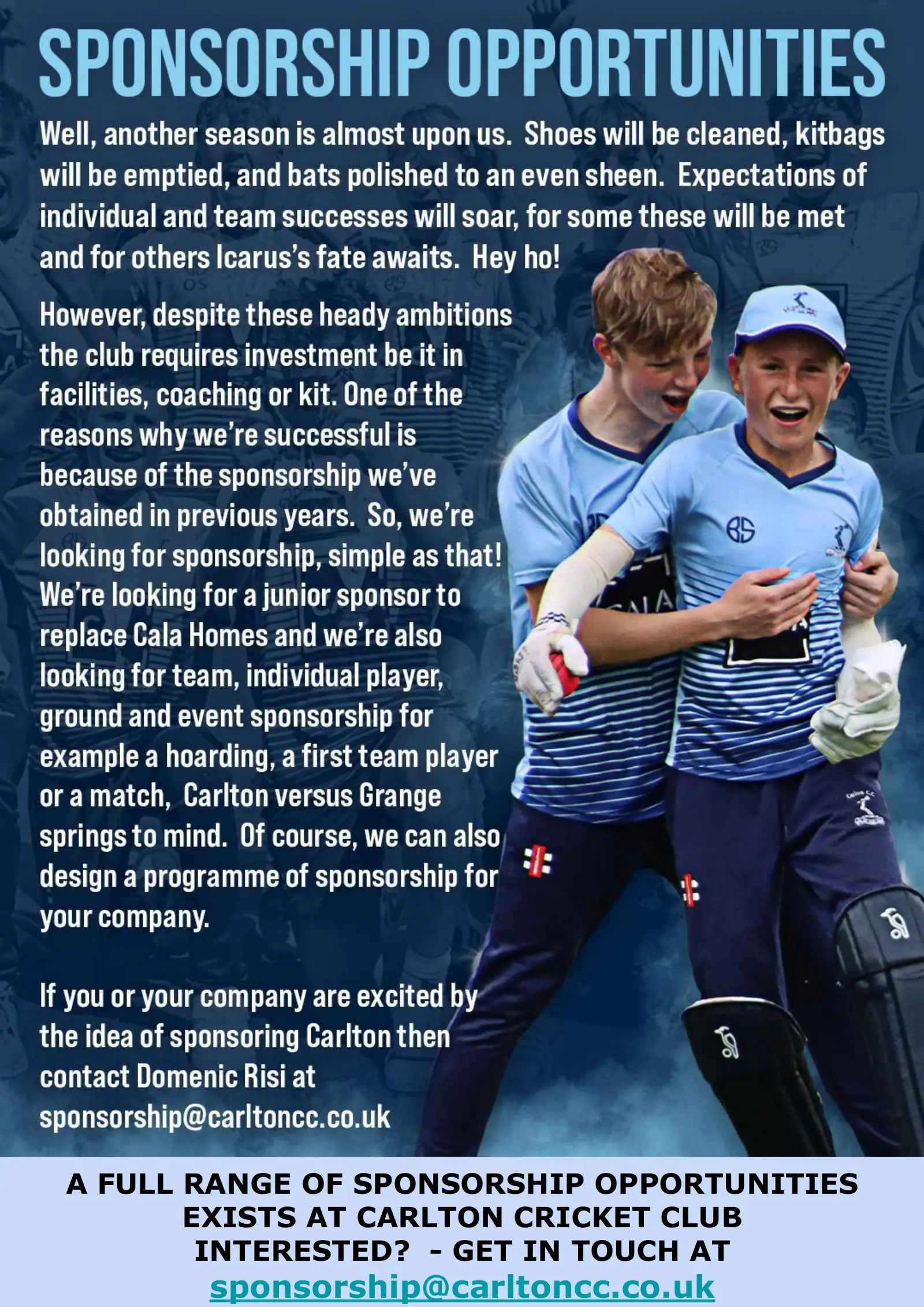
A FULL RANGE OF SPONSORSHIP OPPORTUNITIES
EXISTS AT CARLTON CRICKET CLUB
INTERESTED? - GET IN TOUCH AT
sponsorship@carltoncc.co.uk
Text of this page
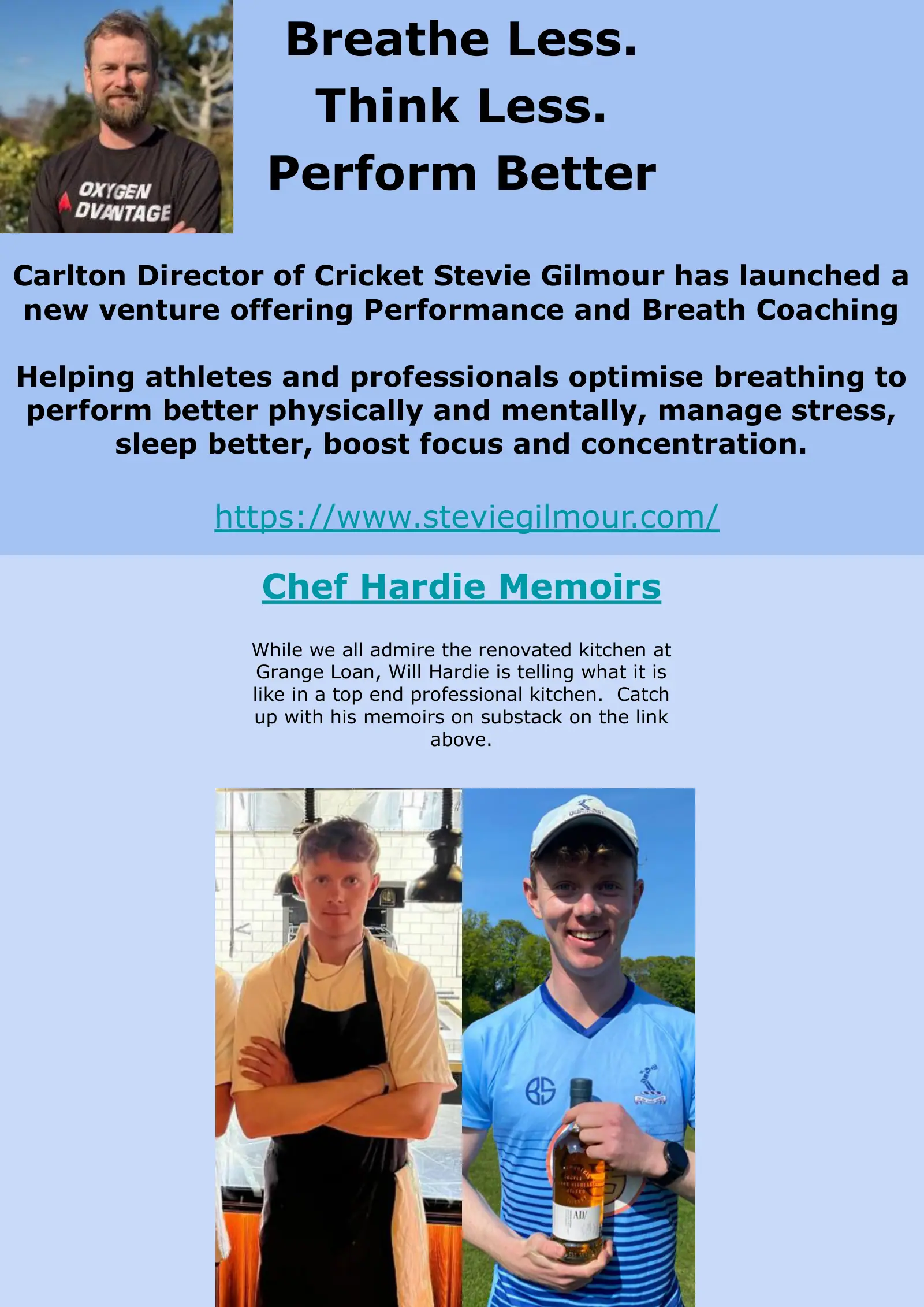
Chef Hardie Memoirs
While we all admire the renovated kitchen at
Grange Loan, Will Hardie is telling what it is
like in a top end professional kitchen. Catch
up with his memoirs on substack on the link
above.
Breathe Less.
Think Less.
Perform Better
Carlton Director of Cricket Stevie Gilmour has launched a
new venture offering Performance and Breath Coaching
Helping athletes and professionals optimise breathing to
perform better physically and mentally, manage stress,
sleep better, boost focus and concentration.
https://www.steviegilmour.com/
Text of this page
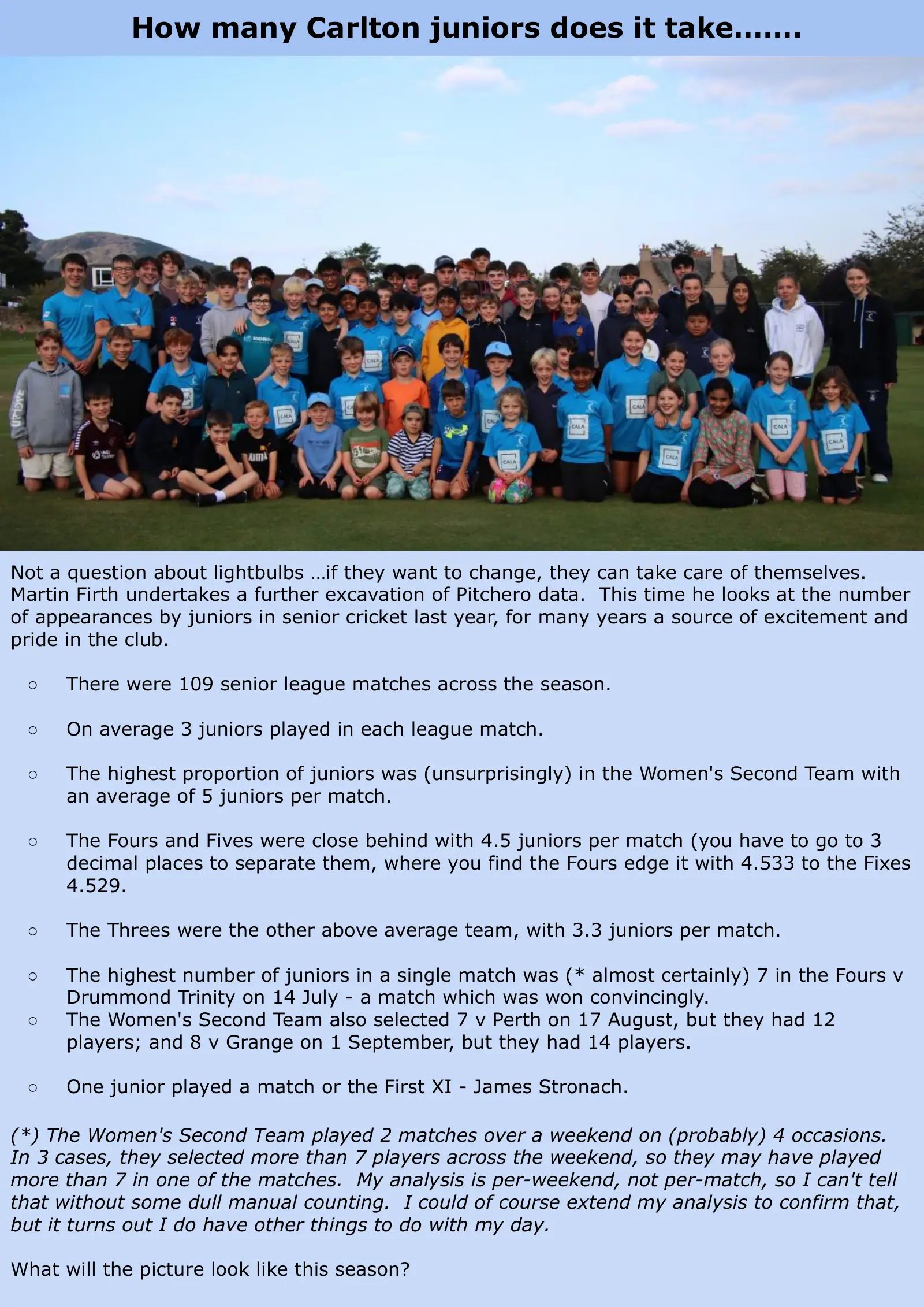
Not a question about lightbulbs …if they want to change, they can take care of themselves.
Martin Firth undertakes a further excavation of Pitchero data. This time he looks at the number
of appearances by juniors in senior cricket last year, for many years a source of excitement and
pride in the club.
○
There were 109 senior league matches across the season.
○
On average 3 juniors played in each league match.
○
The highest proportion of juniors was (unsurprisingly) in the Women's Second Team with
an average of 5 juniors per match.
○
The Fours and Fives were close behind with 4.5 juniors per match (you have to go to 3
decimal places to separate them, where you find the Fours edge it with 4.533 to the Fixes
4.529.
○
The Threes were the other above average team, with 3.3 juniors per match.
○
The highest number of juniors in a single match was (* almost certainly) 7 in the Fours v
Drummond Trinity on 14 July - a match which was won convincingly.
○
The Women's Second Team also selected 7 v Perth on 17 August, but they had 12
players; and 8 v Grange on 1 September, but they had 14 players.
○
One junior played a match or the First XI - James Stronach.
(*) The Women's Second Team played 2 matches over a weekend on (probably) 4 occasions.
In 3 cases, they selected more than 7 players across the weekend, so they may have played
more than 7 in one of the matches. My analysis is per-weekend, not per-match, so I can't tell
that without some dull manual counting. I could of course extend my analysis to confirm that,
but it turns out I do have other things to do with my day.
What will the picture look like this season?
How many Carlton juniors does it take…….
Text of this page
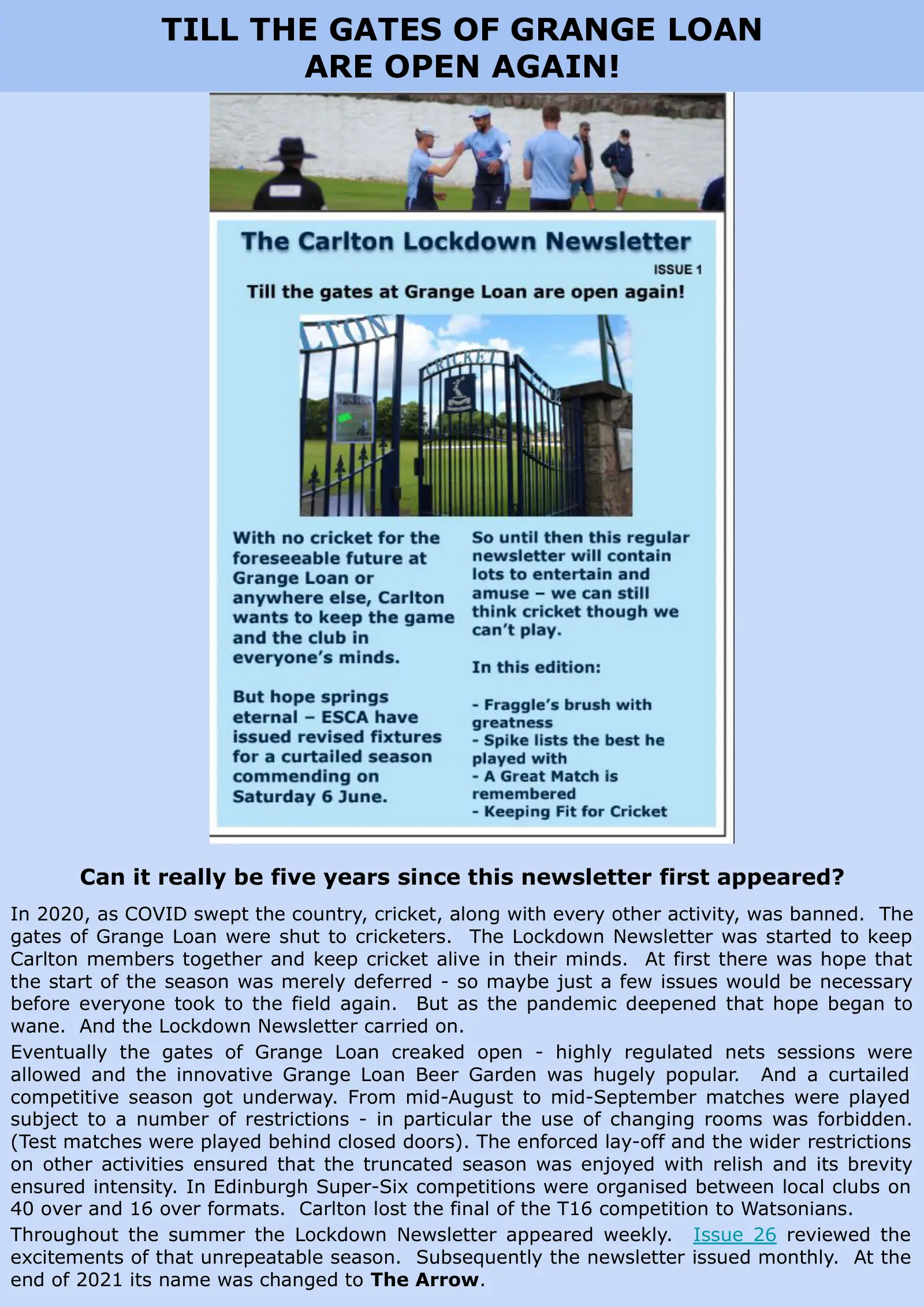
Can it really be five years since this newsletter first appeared?
In 2020, as COVID swept the country, cricket, along with every other activity, was banned. The
gates of Grange Loan were shut to cricketers. The Lockdown Newsletter was started to keep
Carlton members together and keep cricket alive in their minds. At first there was hope that
the start of the season was merely deferred - so maybe just a few issues would be necessary
before everyone took to the field again. But as the pandemic deepened that hope began to
wane. And the Lockdown Newsletter carried on.
Eventually the gates of Grange Loan creaked open - highly regulated nets sessions were
allowed and the innovative Grange Loan Beer Garden was hugely popular. And a curtailed
competitive season got underway. From mid-August to mid-September matches were played
subject to a number of restrictions - in particular the use of changing rooms was forbidden.
(Test matches were played behind closed doors). The enforced lay-off and the wider restrictions
on other activities ensured that the truncated season was enjoyed with relish and its brevity
ensured intensity. In Edinburgh Super-Six competitions were organised between local clubs on
40 over and 16 over formats. Carlton lost the final of the T16 competition to Watsonians.
Throughout the summer the Lockdown Newsletter appeared weekly. Issue 26 reviewed the
excitements of that unrepeatable season. Subsequently the newsletter issued monthly. At the
end of 2021 its name was changed to The Arrow.
TILL THE GATES OF GRANGE LOAN
ARE OPEN AGAIN!

Text of this page
Raise money for Carlton through
EASYFUNDRAISING
website or app
WHY NOT USE GRANGE LOAN FOR YOUR PARTY,
CORPORATE EVENT OR SPECIAL OCCASION?
Contact
Kerry_david_simpson@hotmail.com)