
Issue 53
· Coming home
As thoughts turn to the season ahead, Fantasy Bob has put together another action-packed edition of the Arrow. This month there is a feature on Finlay Thornton who is heading north for the summer. Also in this issue is a look at the history of groundskeeping at Grange Loan; a tribute to Amit Bij who very sadly passed away recently; Hayden Laing talks about his experiences in Scotland and South Africa and much, much more.

Text of this page
Carlton looks forward to welcoming
Finlay Thornton back to Grange Loan
this season. Finlay is seen here
striking out for Manly Warringah,
proudly wearing his Carlton helmet.
More about Finlay inside.
COMING HOME
The Newsletter of Carlton Cricket Club
6 February 2023 Issue 53
FOLLOW CARLTON
Text of this page
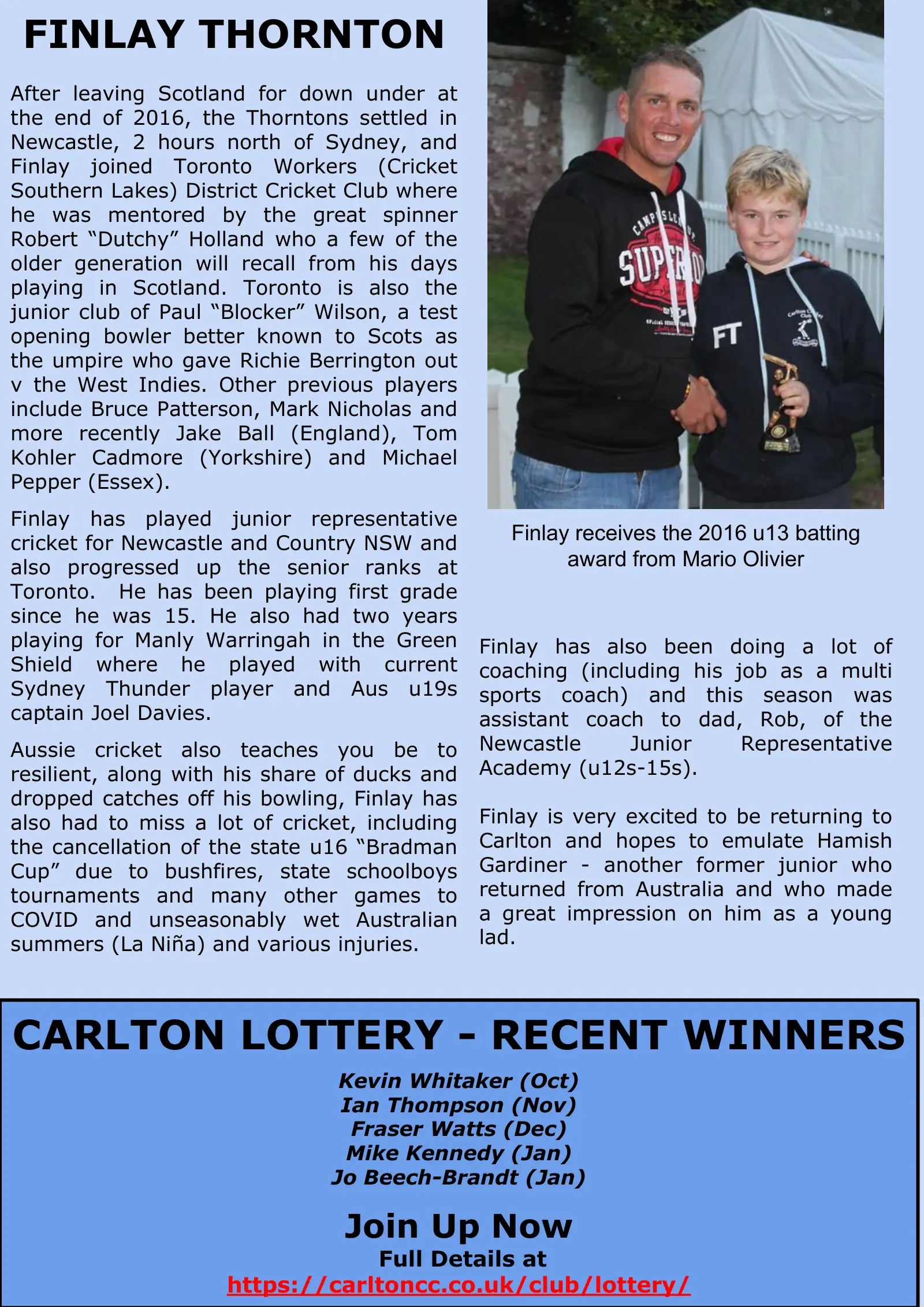
Finlay receives the 2016 u13 batting
award from Mario Olivier
FINLAY THORNTON
After leaving Scotland for down under at
the end of 2016, the Thorntons settled in
Newcastle, 2 hours north of Sydney, and
Finlay joined Toronto Workers (Cricket
Southern Lakes) District Cricket Club where
he was mentored by the great spinner
Robert “Dutchy” Holland who a few of the
older generation will recall from his days
playing in Scotland. Toronto is also the
junior club of Paul “Blocker” Wilson, a test
opening bowler better known to Scots as
the umpire who gave Richie Berrington out
v the West Indies. Other previous players
include Bruce Patterson, Mark Nicholas and
more recently Jake Ball (England), Tom
Kohler Cadmore (Yorkshire) and Michael
Pepper (Essex).
Finlay has played junior representative
cricket for Newcastle and Country NSW and
also progressed up the senior ranks at
Toronto. He has been playing first grade
since he was 15. He also had two years
playing for Manly Warringah in the Green
Shield where he played with current
Sydney Thunder player and Aus u19s
captain Joel Davies.
Aussie cricket also teaches you be to
resilient, along with his share of ducks and
dropped catches off his bowling, Finlay has
also had to miss a lot of cricket, including
the cancellation of the state u16 “Bradman
Cup” due to bushfires, state schoolboys
tournaments and many other games to
COVID and unseasonably wet Australian
summers (La Niña) and various injuries.
Finlay has also been doing a lot of
coaching (including his job as a multi
sports coach) and this season was
assistant coach to dad, Rob, of the
Newcastle
Junior
Representative
Academy (u12s-15s).
Finlay is very excited to be returning to
Carlton and hopes to emulate Hamish
Gardiner - another former junior who
returned from Australia and who made
a great impression on him as a young
lad.
CARLTON LOTTERY - RECENT WINNERS
Kevin Whitaker (Oct)
Ian Thompson (Nov)
Fraser Watts (Dec)
Mike Kennedy (Jan)
Jo Beech-Brandt (Jan)
Join Up Now
Full Details at
https://carltoncc.co.uk/club/lottery/
Text of this page
I've known Amit for about 13 years. I got to know him as his in-laws had a corner shop
opposite to where I lived. Amit was a great Husband, father, and Son: he was honourable, he
was kind, he was charismatic and most of all he was a great friend who was there for me
whenever I needed him. Whatever he put his mind to, he cared with a passion, whether it be
his work, his family or social life.
He worked hard at whatever he put his mind to and just left an impression on many. I
remember the times we worked on some DIY projects at his home; he walked behind me with
a brush and shovel to minimise any mess caused. We joked around about how he was clean
freak.
I miss him greatly; he was my best friend! I will remember him for all the times we spent
together whether it be whilst training at cricket, times spent out together and even whilst we
were both at work - the calls/constant texts/ random Gifs and songs we liked. And the weekly
meals we went out for, we spoke of all sorts - the room was never quiet, full of laughter and
relaxed ambience
Amit’s Daughter Ria and my two children attend the same primary school, and the kids see
each other daily at drop-offs and sometimes in the playground. My kids looked forward to
seeing Amit and Ria in the morning for a quick muck about. Even the kids are missing Amit, he
know how to always able to put a smile on anyone's face.
I know that we have already heard this many times before and we don't realise it until a loved
one passes - life is a lot shorter than any of us realise and you just don't know what you have
until it's gone.
I just wish I could just speak to him one last time and tell him he's been a fantastic friend and
how proud I am that he was a part of my life.
Who was to know he would be gone far too soon leaving behind a loving wife and two gorgeous
daughters?
Amit Bij will truly be missed for who he really was.
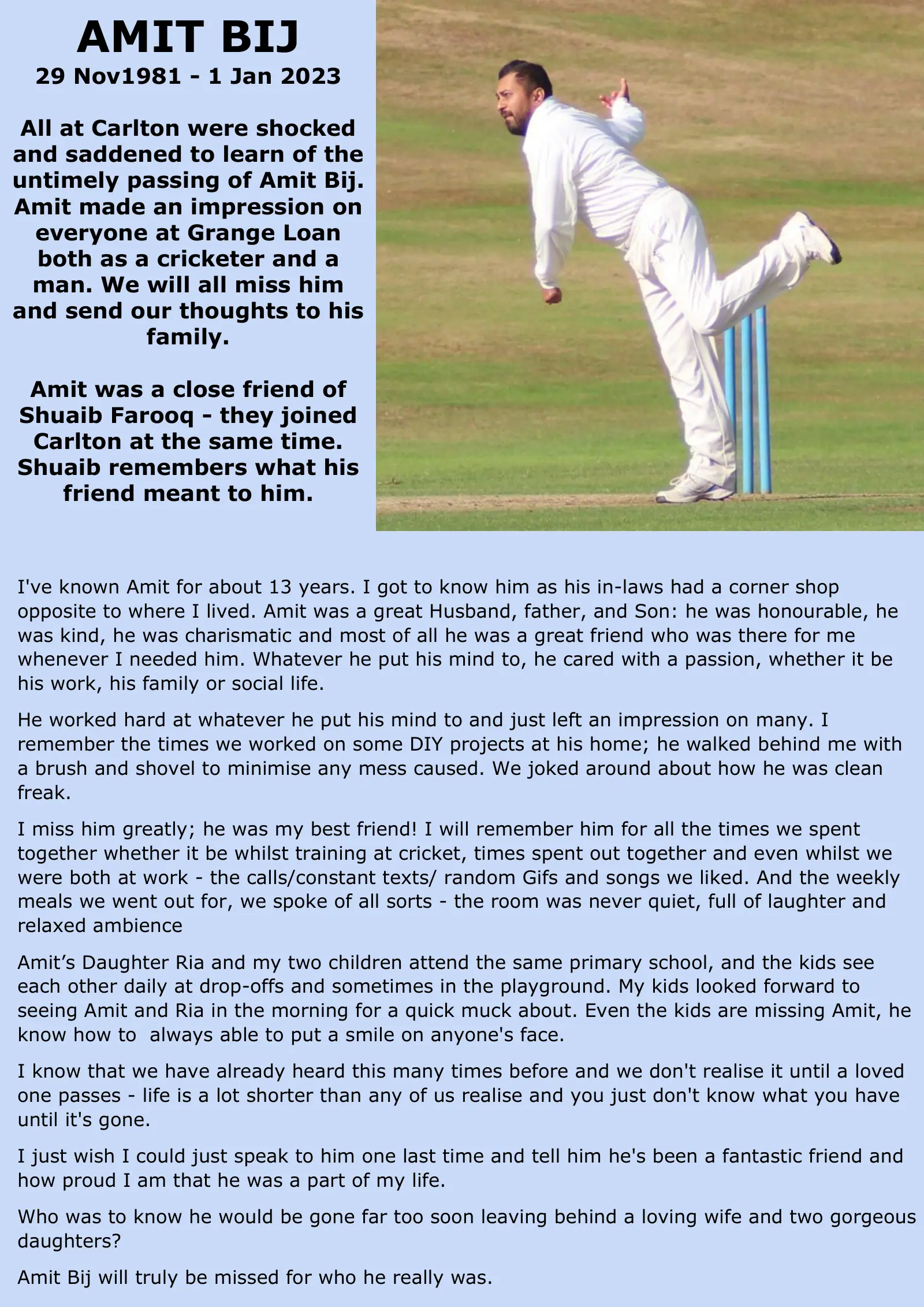
AMIT BIJ
29 Nov1981 - 1 Jan 2023
All at Carlton were shocked
and saddened to learn of the
untimely passing of Amit Bij.
Amit made an impression on
everyone at Grange Loan
both as a cricketer and a
man. We will all miss him
and send our thoughts to his
family.
Amit was a close friend of
Shuaib Farooq - they joined
Carlton at the same time.
Shuaib remembers what his
friend meant to him.

Text of this page
HOW CAN YOU
HELP?
Don’t let others do all the work.
Carlton’s success depends on the
voluntary efforts of its members.
Everyone can make a difference.
Do you have skills or experience which
the club could draw on from time to
time?
We would welcome additional advice and
help in the following areas particularly.
PR/Communications
IT
HR
Fund Raising
Facilities Management
DIY
Catering
Photography
Let us know at Carlton
Text of this page
INDOOR
PRACTICE?
●
Dewald Nel - Carlton
welcomes Dewald as Head
Coach for 2023 - more about
Dewald in the next issue of the
Arrow.
●
Subscriptions are now due
and are being collected through
Pitchero. Prompt payment
appreciated.
●
Pre-Season Quiz Night -
coming soon -details will follow
through social media channels.
●
AGM - a report of the AGM can
be found on the Club Website.
●
Congratulations to Omar
Ahmed, Head of Diversity,
who becomes Vice President
and Director of Carlton
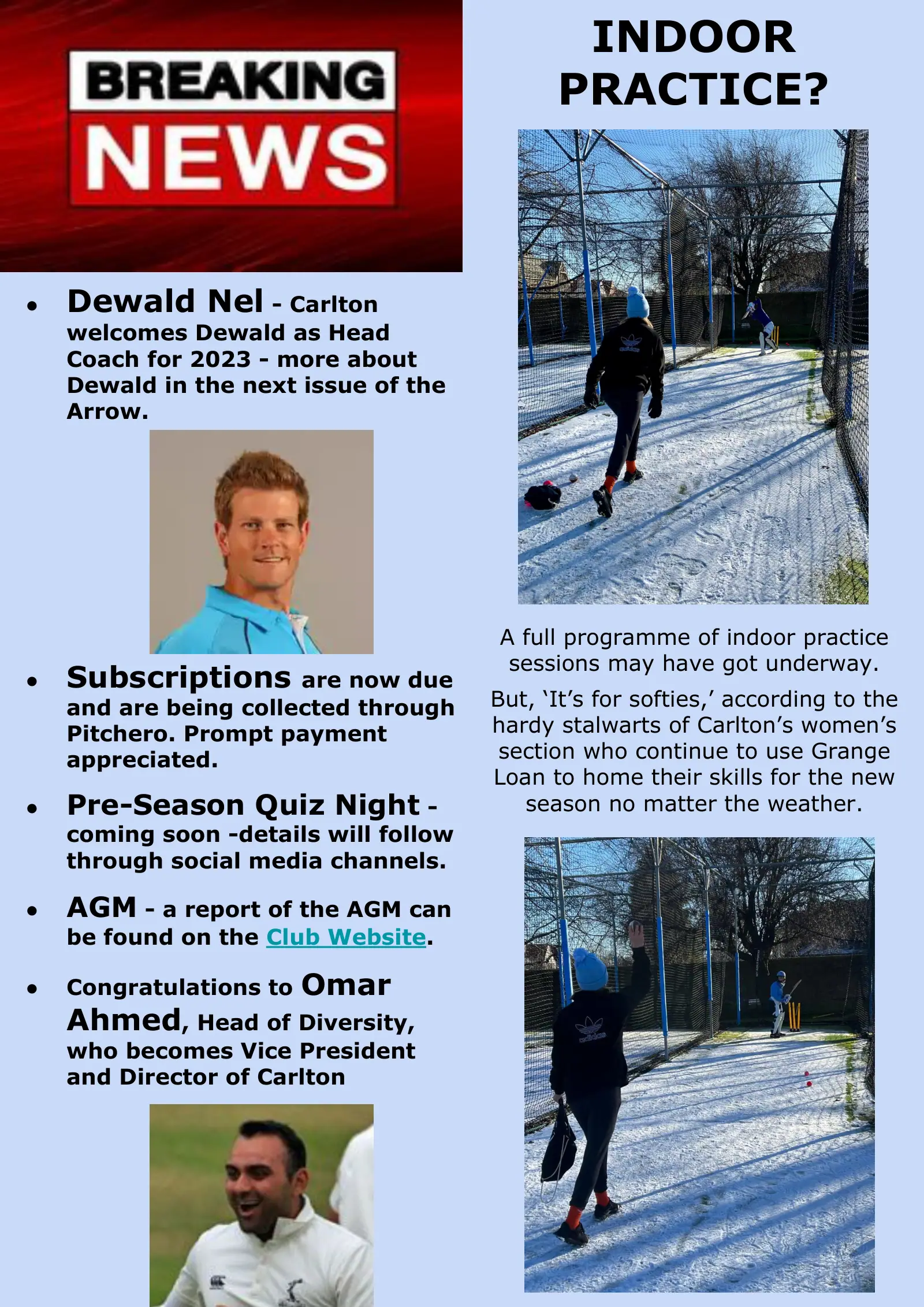
A full programme of indoor practice
sessions may have got underway.
But, ‘It’s for softies,’ according to the
hardy stalwarts of Carlton’s women’s
section who continue to use Grange
Loan to home their skills for the new
season no matter the weather.
Text of this page
Work has just underway to refurbish and improve the nets at Grange Loan.
Improved surfaces and extended run ups will ensure that the facilities
remain of the highest standard. The project is planned to be complete by
the time that outdoor practice commences in April. Also in hand are plans
to refurbish the artificial strip, which in addition to being available for
matches should also increase the range of practice facilities at Grange Loan.
Commenting on the projects, Director of Cricket Stevie Gilmour said,
'This is great news for all Carlton's members. The present nets were
installed in 2011 and have been a great asset to the club. They have been
very well used but began to show signs of wear and tear in the last couple
of years. We are determined to ensure that Carlton continues to have the
highest standard of practice facilities. This refurbishment is an essential
part of achieving this goal and all players can look forward to using them
this season.'
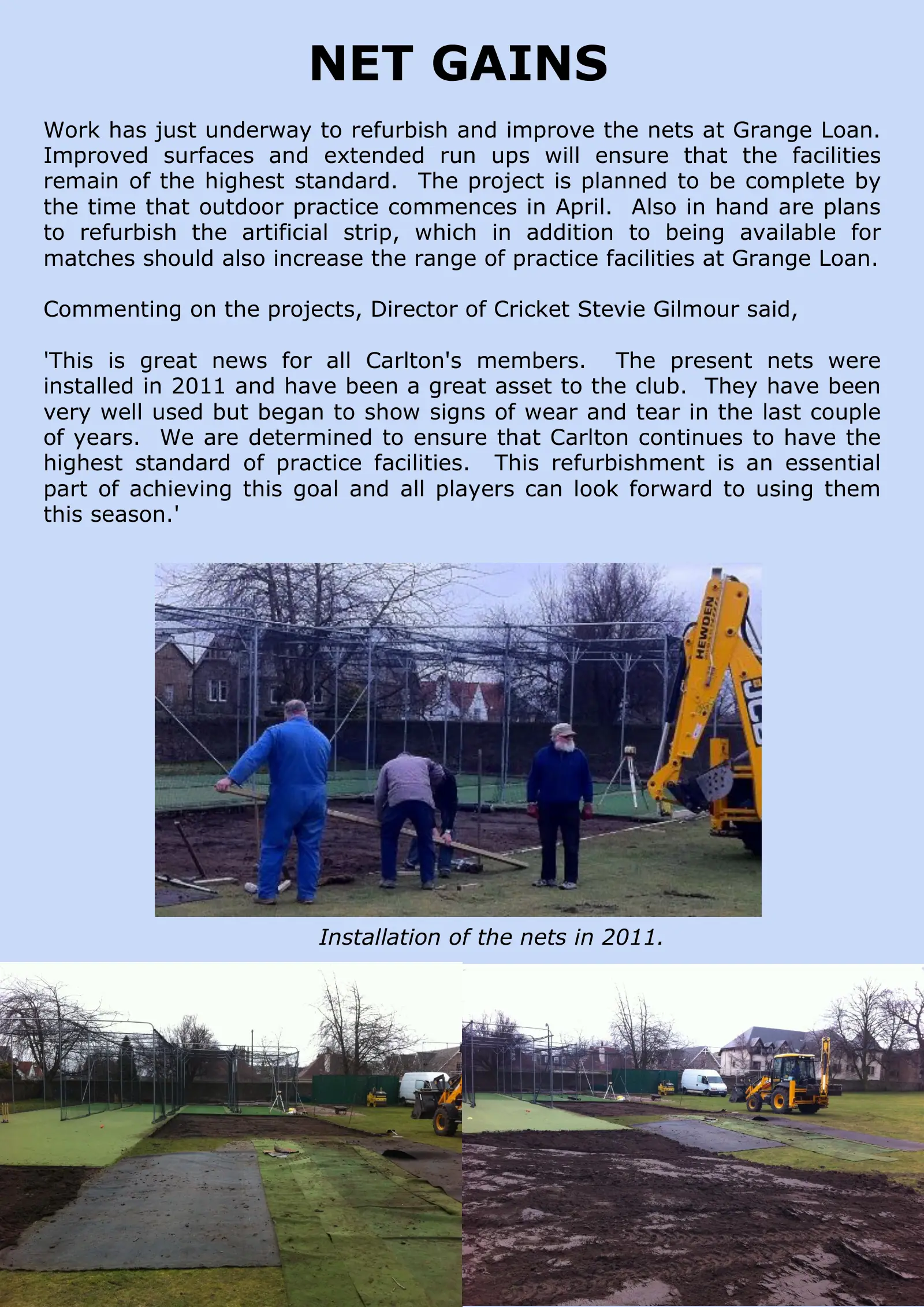
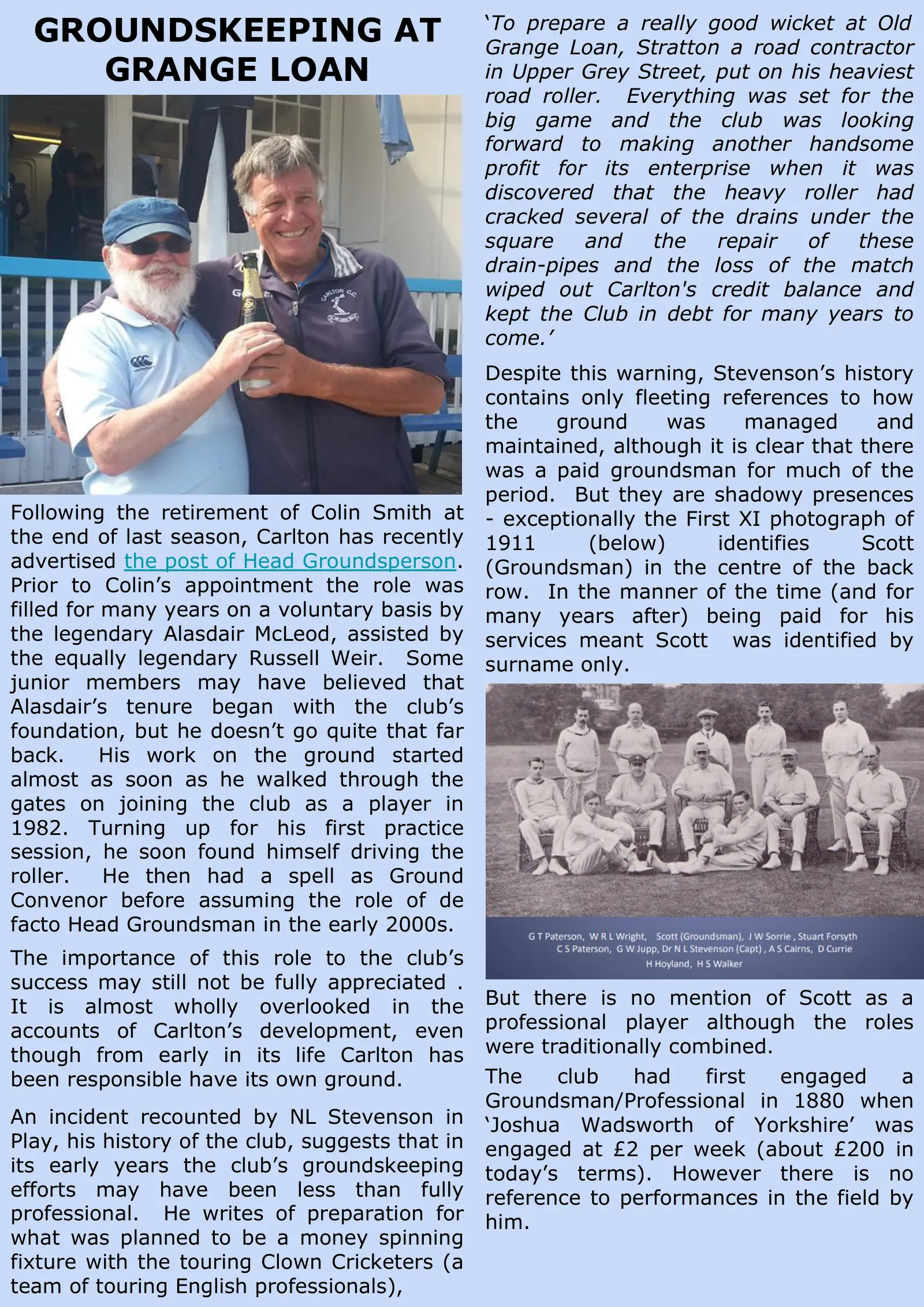
Installation of the nets in 2011.
NET GAINS
Text of this page
GROUNDSKEEPING AT
GRANGE LOAN
Following the retirement of Colin Smith at
the end of last season, Carlton has recently
advertised the post of Head Groundsperson.
Prior to Colin’s appointment the role was
filled for many years on a voluntary basis by
the legendary Alasdair McLeod, assisted by
the equally legendary Russell Weir. Some
junior members may have believed that
Alasdair’s tenure began with the club’s
foundation, but he doesn’t go quite that far
back. His work on the ground started
almost as soon as he walked through the
gates on joining the club as a player in
1982. Turning up for his first practice
session, he soon found himself driving the
roller. He then had a spell as Ground
Convenor before assuming the role of de
facto Head Groundsman in the early 2000s.
The importance of this role to the club’s
success may still not be fully appreciated .
It is almost wholly overlooked in the
accounts of Carlton’s development, even
though from early in its life Carlton has
been responsible have its own ground.
An incident recounted by NL Stevenson in
Play, his history of the club, suggests that in
its early years the club’s groundskeeping
efforts may have been less than fully
professional. He writes of preparation for
what was planned to be a money spinning
fixture with the touring Clown Cricketers (a
team of touring English professionals),
‘To prepare a really good wicket at Old
Grange Loan, Stratton a road contractor
in Upper Grey Street, put on his heaviest
road roller. Everything was set for the
big game and the club was looking
forward to making another handsome
profit for its enterprise when it was
discovered that the heavy roller had
cracked several of the drains under the
square
and
the
repair
of
these
drain-pipes and the loss of the match
wiped out Carlton's credit balance and
kept the Club in debt for many years to
come.’
Despite this warning, Stevenson’s history
contains only fleeting references to how
the
ground
was
managed
and
maintained, although it is clear that there
was a paid groundsman for much of the
period. But they are shadowy presences
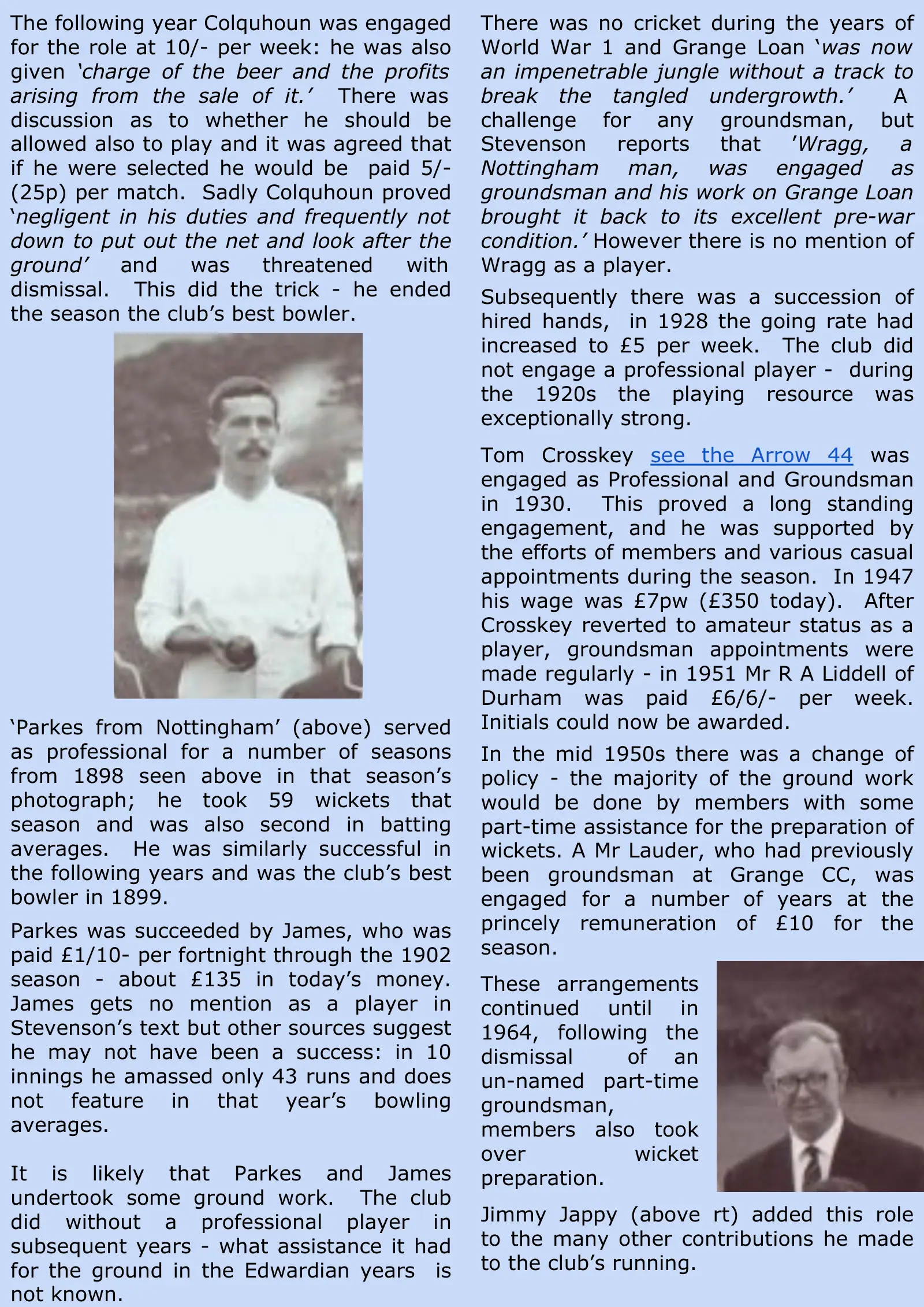
- exceptionally the First XI photograph of
1911
(below)
identifies
Scott
(Groundsman) in the centre of the back
row. In the manner of the time (and for
many years after) being paid for his
services meant Scott was identified by
surname only.
But there is no mention of Scott as a
professional player although the roles
were traditionally combined.
The
club
had
first
engaged
a
Groundsman/Professional in 1880 when
‘Joshua Wadsworth of Yorkshire’ was
engaged at £2 per week (about £200 in
today’s terms). However there is no
reference to performances in the field by
him.
Text of this page
The following year Colquhoun was engaged
for the role at 10/- per week: he was also
given ‘charge of the beer and the profits
arising from the sale of it.’ There was
discussion as to whether he should be
allowed also to play and it was agreed that
if he were selected he would be paid 5/-
(25p) per match. Sadly Colquhoun proved
‘negligent in his duties and frequently not
down to put out the net and look after the
ground’
and
was
threatened
with
dismissal. This did the trick - he ended
the season the club’s best bowler.
‘Parkes from Nottingham’ (above) served
as professional for a number of seasons
from 1898 seen above in that season’s
photograph; he took 59 wickets that
season and was also second in batting
averages. He was similarly successful in
the following years and was the club’s best
bowler in 1899.
Parkes was succeeded by James, who was
paid £1/10- per fortnight through the 1902
season - about £135 in today’s money.
James gets no mention as a player in
Stevenson’s text but other sources suggest
he may not have been a success: in 10
innings he amassed only 43 runs and does
not
feature
in
that
year’s
bowling
averages.
It
is
likely
that
Parkes
and
James
undertook some ground work. The club
did
without
a
professional
player
in
subsequent years - what assistance it had
for the ground in the Edwardian years is
not known.
There was no cricket during the years of
World War 1 and Grange Loan ‘was now
an impenetrable jungle without a track to
break the tangled undergrowth.’ A
challenge
for
any
groundsman,
but
Stevenson
reports
that
’Wragg,
a
Nottingham
man,
was
engaged
as
groundsman and his work on Grange Loan
brought it back to its excellent pre-war
condition.’ However there is no mention of
Wragg as a player.
Subsequently there was a succession of
hired hands, in 1928 the going rate had
increased to £5 per week. The club did
not engage a professional player - during
the 1920s the playing resource was
exceptionally strong.
Tom Crosskey see the Arrow 44 was
engaged as Professional and Groundsman
in 1930. This proved a long standing
engagement, and he was supported by
the efforts of members and various casual
appointments during the season. In 1947
his wage was £7pw (£350 today). After
Crosskey reverted to amateur status as a
player, groundsman appointments were
made regularly - in 1951 Mr R A Liddell of
Durham was paid £6/6/- per week.
Initials could now be awarded.
In the mid 1950s there was a change of
policy - the majority of the ground work
would be done by members with some
part-time assistance for the preparation of
wickets. A Mr Lauder, who had previously
been groundsman at Grange CC, was
engaged for a number of years at the
princely remuneration of £10 for the
season.
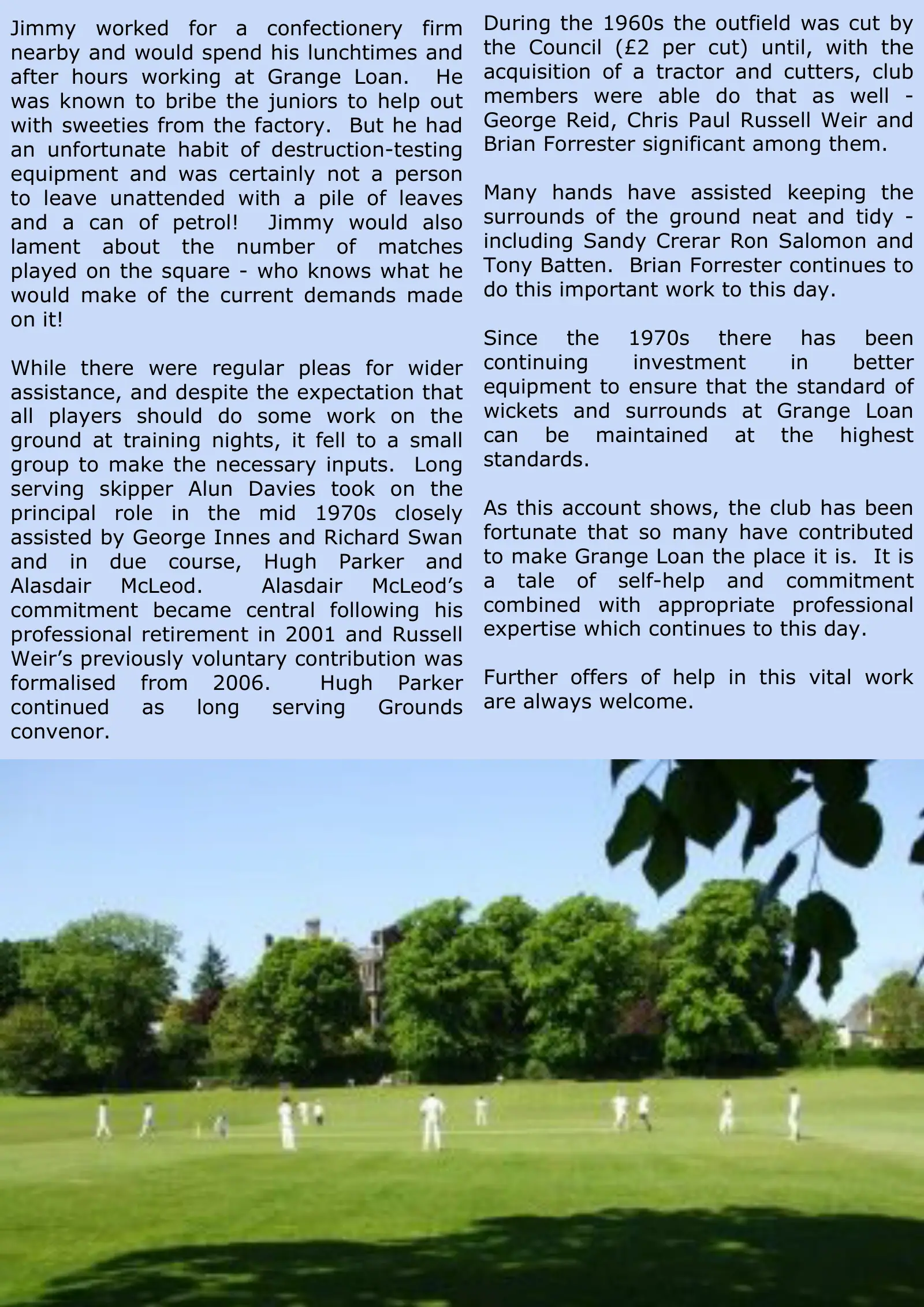
Jimmy Jappy (above rt) added this role
to the many other contributions he made
to the club’s running.
These arrangements
continued
until
in
1964, following the
dismissal
of
an
un-named part-time
groundsman,
members also took
over
wicket
preparation.
Text of this page
Jimmy worked for a confectionery firm
nearby and would spend his lunchtimes and
after hours working at Grange Loan. He
was known to bribe the juniors to help out
with sweeties from the factory. But he had
an unfortunate habit of destruction-testing
equipment and was certainly not a person
to leave unattended with a pile of leaves
and a can of petrol! Jimmy would also
lament about the number of matches
played on the square - who knows what he
would make of the current demands made
on it!
While there were regular pleas for wider
assistance, and despite the expectation that
all players should do some work on the
ground at training nights, it fell to a small
group to make the necessary inputs. Long
serving skipper Alun Davies took on the
principal role in the mid 1970s closely
assisted by George Innes and Richard Swan
and in due course, Hugh Parker and
Alasdair
McLeod.
Alasdair
McLeod’s
commitment became central following his
professional retirement in 2001 and Russell
Weir’s previously voluntary contribution was
formalised
from
2006.
Hugh
Parker
continued
as
long
serving
Grounds
convenor.
During the 1960s the outfield was cut by
the Council (£2 per cut) until, with the
acquisition of a tractor and cutters, club
members were able do that as well -
George Reid, Chris Paul Russell Weir and
Brian Forrester significant among them.
Many hands have assisted keeping the
surrounds of the ground neat and tidy -
including Sandy Crerar Ron Salomon and
Tony Batten. Brian Forrester continues to
do this important work to this day.
Since
the
1970s
there
has
been
continuing
investment
in
better
equipment to ensure that the standard of
wickets and surrounds at Grange Loan
can
be
maintained
at
the
highest
standards.
As this account shows, the club has been
fortunate that so many have contributed
to make Grange Loan the place it is. It is
a tale of self-help and commitment
combined with appropriate professional
expertise which continues to this day.
Further offers of help in this vital work
are always welcome.
Text of this page
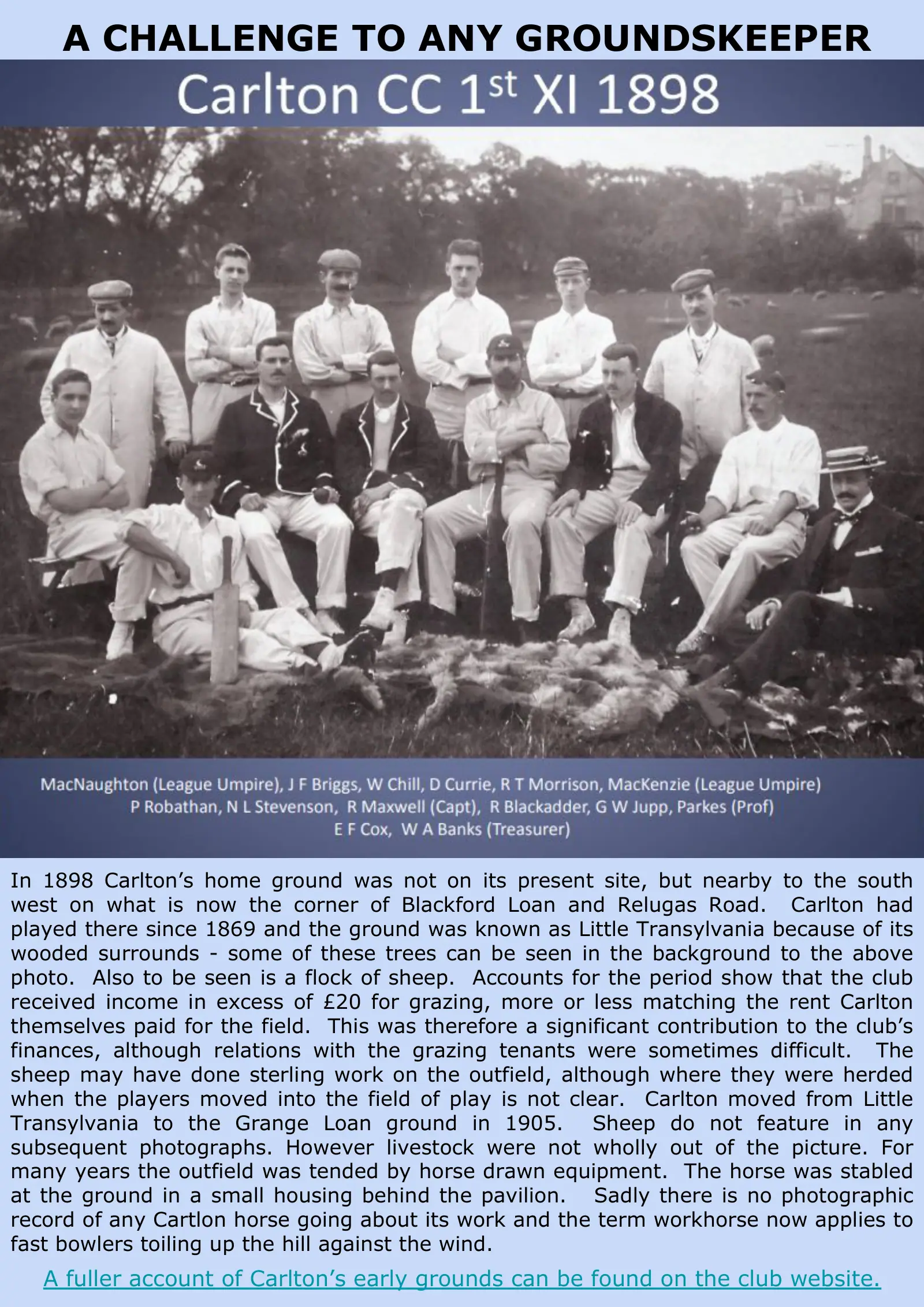
In 1898 Carlton’s home ground was not on its present site, but nearby to the south
west on what is now the corner of Blackford Loan and Relugas Road. Carlton had
played there since 1869 and the ground was known as Little Transylvania because of its
wooded surrounds - some of these trees can be seen in the background to the above
photo. Also to be seen is a flock of sheep. Accounts for the period show that the club
received income in excess of £20 for grazing, more or less matching the rent Carlton
themselves paid for the field. This was therefore a significant contribution to the club’s
finances, although relations with the grazing tenants were sometimes difficult. The
sheep may have done sterling work on the outfield, although where they were herded
when the players moved into the field of play is not clear. Carlton moved from Little
Transylvania to the Grange Loan ground in 1905. Sheep do not feature in any
subsequent photographs. However livestock were not wholly out of the picture. For
many years the outfield was tended by horse drawn equipment. The horse was stabled
at the ground in a small housing behind the pavilion. Sadly there is no photographic
record of any Cartlon horse going about its work and the term workhorse now applies to
fast bowlers toiling up the hill against the wind.
A fuller account of Carlton’s early grounds can be found on the club website.
A CHALLENGE TO ANY GROUNDSKEEPER
Text of this page
Fair fa’ your honest doughty face
Great chieftain o’ the groundsman race
In the middle tak your place
Mow, roll, repair
Your cheery greeting rings through
space
GET AFF THE SQUARE
To mak a wicket taks for ever
But who respects your great
endeavour?
These players should be mair clever
You can despair
You tell them oft but they never
GET AFF THE SQUARE
Ye tend the strip, ye gie it bounce
The players dinna help an ounce
But aifter play they preen and flounce
Fegs! Everywhere
Till ye maun doughtily pronounce
GET AFF THE SQUARE
Anyone unwise enough to wish to enjoy more of the Bard’s rediscovered cricket
poems can find them on this link.
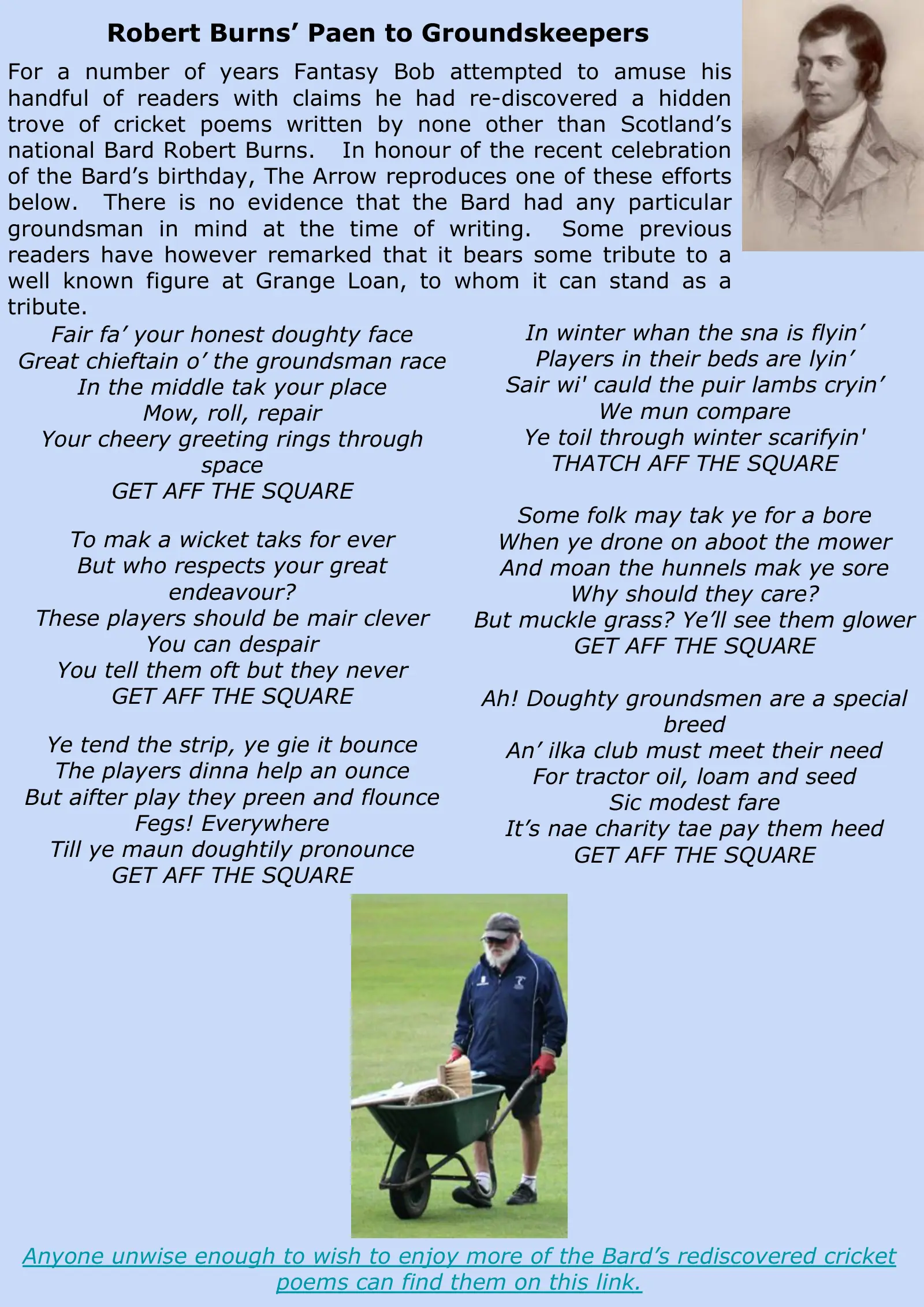
For a number of years Fantasy Bob attempted to amuse his
handful of readers with claims he had re-discovered a hidden
trove of cricket poems written by none other than Scotland’s
national Bard Robert Burns. In honour of the recent celebration
of the Bard’s birthday, The Arrow reproduces one of these efforts
below. There is no evidence that the Bard had any particular
groundsman in mind at the time of writing. Some previous
readers have however remarked that it bears some tribute to a
well known figure at Grange Loan, to whom it can stand as a
tribute.
In winter whan the sna is flyin’
Players in their beds are lyin’
Sair wi' cauld the puir lambs cryin’
We mun compare
Ye toil through winter scarifyin'
THATCH AFF THE SQUARE
Some folk may tak ye for a bore
When ye drone on aboot the mower
And moan the hunnels mak ye sore
Why should they care?
But muckle grass? Ye’ll see them glower
GET AFF THE SQUARE
Ah! Doughty groundsmen are a special
breed
An’ ilka club must meet their need
For tractor oil, loam and seed
Sic modest fare
It’s nae charity tae pay them heed
GET AFF THE SQUARE
Robert Burns’ Paen to Groundskeepers
Text of this page
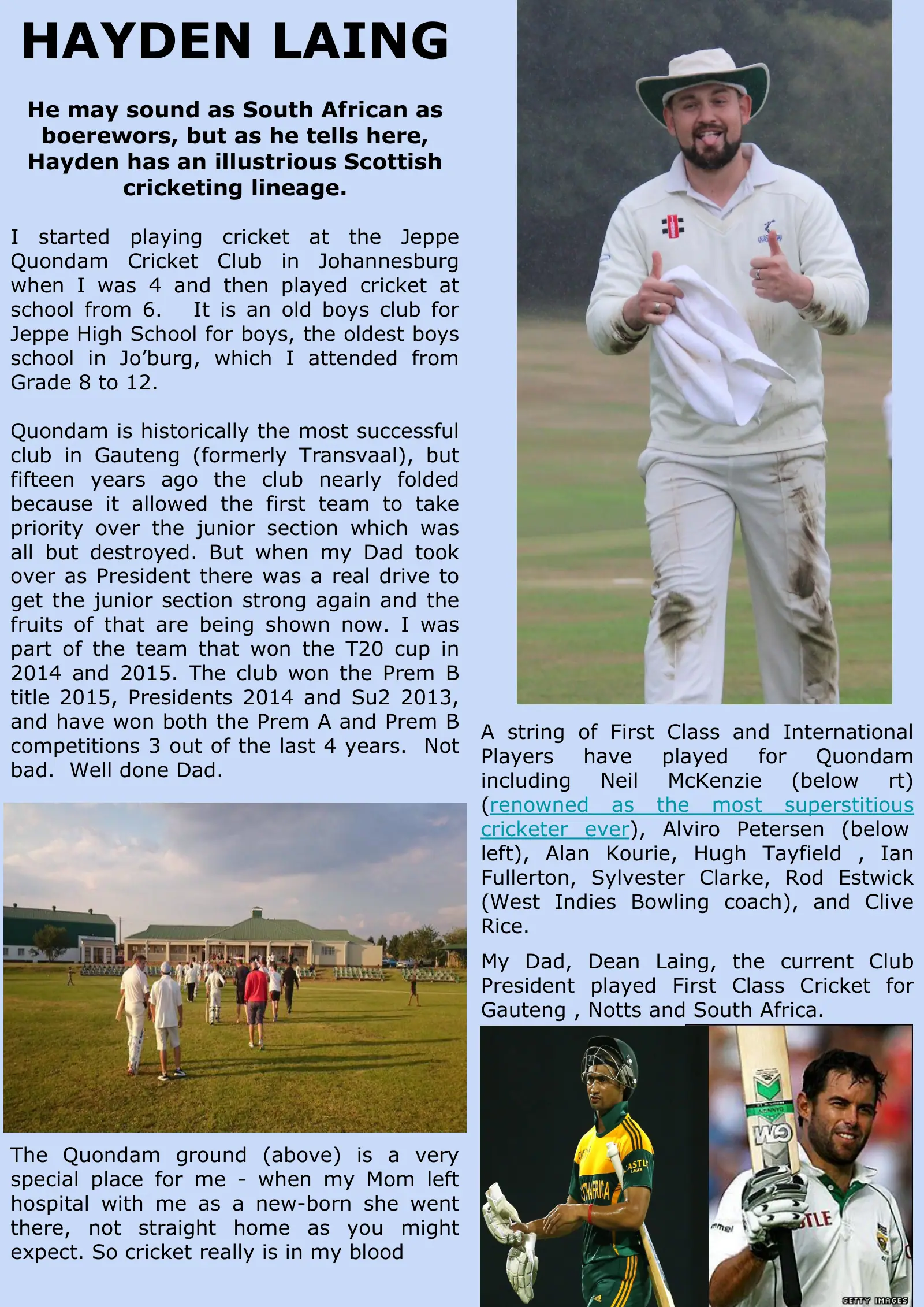
HAYDEN LAING
He may sound as South African as
boerewors, but as he tells here,
Hayden has an illustrious Scottish
cricketing lineage.
I started playing cricket at the Jeppe
Quondam Cricket Club in Johannesburg
when I was 4 and then played cricket at
school from 6. It is an old boys club for
Jeppe High School for boys, the oldest boys
school in Jo’burg, which I attended from
Grade 8 to 12.
Quondam is historically the most successful
club in Gauteng (formerly Transvaal), but
fifteen years ago the club nearly folded
because it allowed the first team to take
priority over the junior section which was
all but destroyed. But when my Dad took
over as President there was a real drive to
get the junior section strong again and the
fruits of that are being shown now. I was
part of the team that won the T20 cup in
2014 and 2015. The club won the Prem B
title 2015, Presidents 2014 and Su2 2013,
and have won both the Prem A and Prem B
competitions 3 out of the last 4 years. Not
bad. Well done Dad.
A string of First Class and International
Players
have
played
for
Quondam
including
Neil
McKenzie
(below
rt)
(renowned as the most superstitious
cricketer ever), Alviro Petersen (below
left), Alan Kourie, Hugh Tayfield , Ian
Fullerton, Sylvester Clarke, Rod Estwick
(West Indies Bowling coach), and Clive
Rice.
My Dad, Dean Laing, the current Club
President played First Class Cricket for
Gauteng , Notts and South Africa.
The Quondam ground (above) is a very
special place for me - when my Mom left
hospital with me as a new-born she went
there, not straight home as you might
expect. So cricket really is in my blood
Text of this page
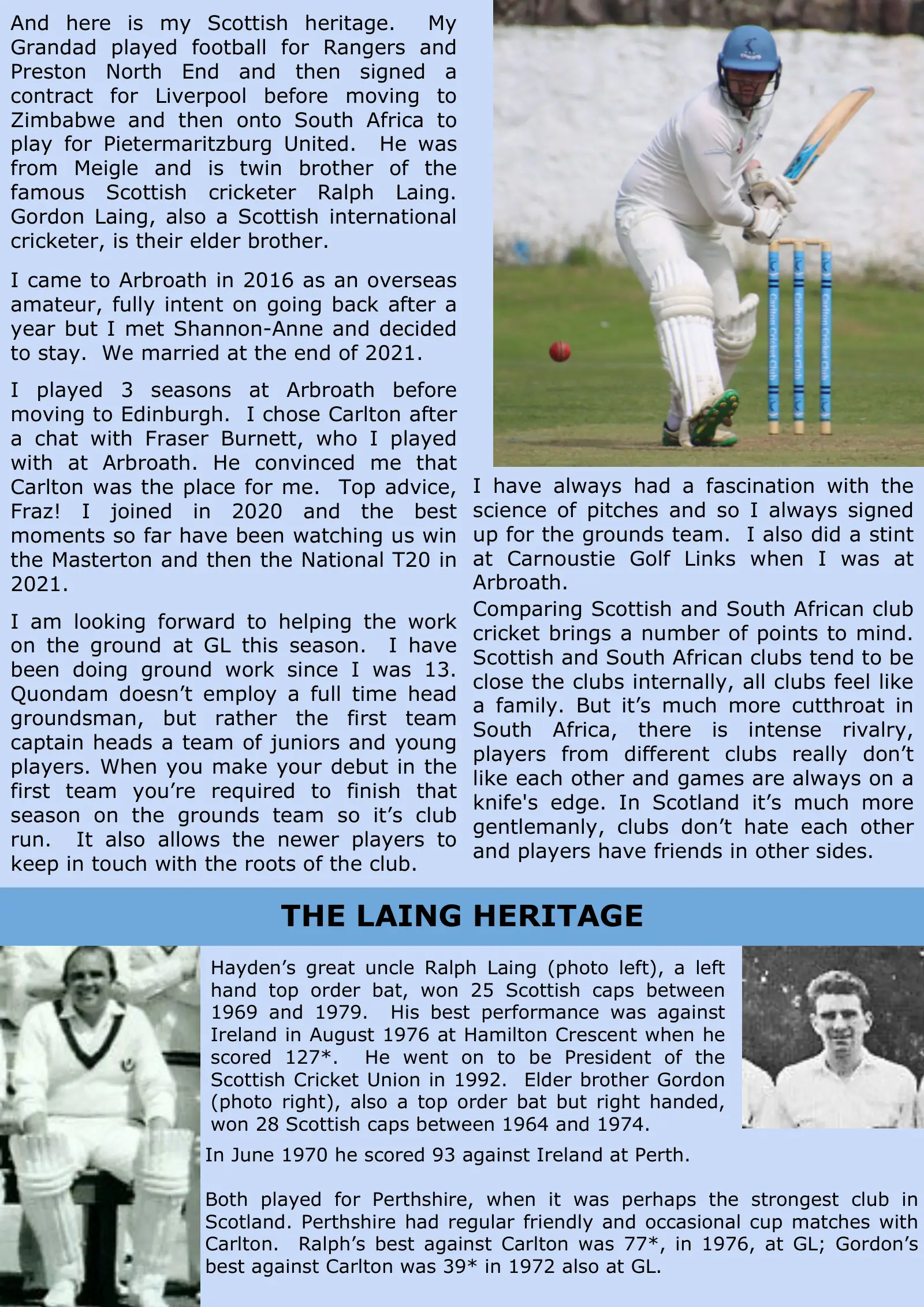
I have always had a fascination with the
science of pitches and so I always signed
up for the grounds team. I also did a stint
at Carnoustie Golf Links when I was at
Arbroath.
Comparing Scottish and South African club
cricket brings a number of points to mind.
Scottish and South African clubs tend to be
close the clubs internally, all clubs feel like
a family. But it’s much more cutthroat in
South Africa, there is intense rivalry,
players from different clubs really don’t
like each other and games are always on a
knife's edge. In Scotland it’s much more
gentlemanly, clubs don’t hate each other
and players have friends in other sides.
Hayden’s great uncle Ralph Laing (photo left), a left
hand top order bat, won 25 Scottish caps between
1969 and 1979. His best performance was against
Ireland in August 1976 at Hamilton Crescent when he
scored 127*. He went on to be President of the
Scottish Cricket Union in 1992. Elder brother Gordon
(photo right), also a top order bat but right handed,
won 28 Scottish caps between 1964 and 1974.
And here is my Scottish heritage. My
Grandad played football for Rangers and
Preston North End and then signed a
contract for Liverpool before moving to
Zimbabwe and then onto South Africa to
play for Pietermaritzburg United. He was
from Meigle and is twin brother of the
famous Scottish cricketer Ralph Laing.
Gordon Laing, also a Scottish international
cricketer, is their elder brother.
I came to Arbroath in 2016 as an overseas
amateur, fully intent on going back after a
year but I met Shannon-Anne and decided
to stay. We married at the end of 2021.
I played 3 seasons at Arbroath before
moving to Edinburgh. I chose Carlton after
a chat with Fraser Burnett, who I played
with at Arbroath. He convinced me that
Carlton was the place for me. Top advice,
Fraz! I joined in 2020 and the best
moments so far have been watching us win
the Masterton and then the National T20 in
2021.
I am looking forward to helping the work
on the ground at GL this season. I have
been doing ground work since I was 13.
Quondam doesn’t employ a full time head
groundsman, but rather the first team
captain heads a team of juniors and young
players. When you make your debut in the
first team you’re required to finish that
season on the grounds team so it’s club
run. It also allows the newer players to
keep in touch with the roots of the club.
THE LAING HERITAGE
In June 1970 he scored 93 against Ireland at Perth.
Both played for Perthshire, when it was perhaps the strongest club in
Scotland. Perthshire had regular friendly and occasional cup matches with
Carlton. Ralph’s best against Carlton was 77*, in 1976, at GL; Gordon’s
best against Carlton was 39* in 1972 also at GL.

Text of this page
CAN YOU HELP CARLTON CONTINUE TO
IMPROVE?
Know a potential sponsor?
Got an idea for a fund raiser?
Got an idea for a social event?
Got a suggestion for how the club can improve?
Want to do a little to help now and then?
JUST DROP A NOTE TO
Carlton
It couldn’t be easier
to make a
contribution to
Carlton with all your
on-line purchasing
SIGN UP TODAY
Easy Fundraising
No matter who you
shop with, you can
turn your weekly
grocery shopping into
big donations for
Carlton.
Click here to find out
more