
Issue 51
· A flying visit – Robin Singh
As the nights draw in Fantasy Bob has put together another bumper edition of the Arrow. In this issue there is an extended feature on Indian ODI legend Robin Singh who talks about his time at Grange Loan and there are also recollections from many who played alongside him. Elsewhere in this edition Omar Ahmad talks about his Carlton playing career and his new role as head of the Diversity Committee, John Beattie reports on the results of the recent players survey as well as outgoing head groundsman Colin Smith talking cracks and much, much more.

Text of this page
The Newsletter of Carlton Cricket Club
14 November 2022 Issue 51
A FLYING VISIT
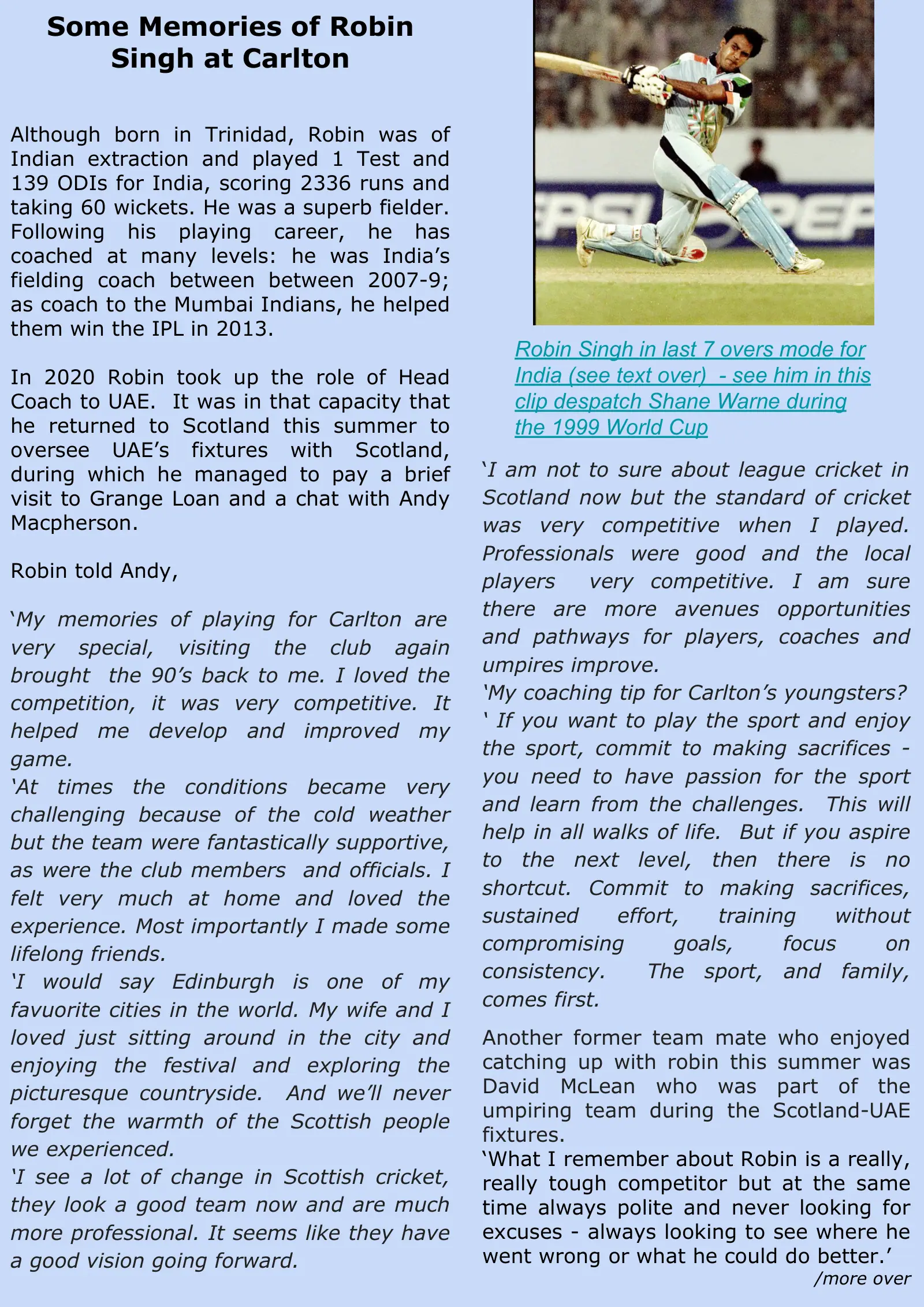
Robin Singh
For many older Carlton members, the best player ever to don Carlton colours is
Robin Singh, who played as professional at Grange Loan in 1995 and 1996. In
44 First Team matches, he scored 1445 runs at an average of 48.17, including 2
centuries and a top score of 114. He also took 90 wkts, at 18.36, with a best
return of 6-43.
Robin paid a short visit to Grange Loan this summer - see more inside.
Text of this page
Some Memories of Robin
Singh at Carlton
Although born in Trinidad, Robin was of
Indian extraction and played 1 Test and
139 ODIs for India, scoring 2336 runs and
taking 60 wickets. He was a superb fielder.
Following his playing career, he has
coached at many levels: he was India’s
fielding coach between between 2007-9;
as coach to the Mumbai Indians, he helped
them win the IPL in 2013.
In 2020 Robin took up the role of Head
Coach to UAE. It was in that capacity that
he returned to Scotland this summer to
oversee UAE’s fixtures with Scotland,
during which he managed to pay a brief
visit to Grange Loan and a chat with Andy
Macpherson.
Robin told Andy,
‘My memories of playing for Carlton are
very
special,
visiting
the
club
again
brought the 90’s back to me. I loved the
competition, it was very competitive. It
helped me develop and improved my
game.
‘At times the conditions became very
challenging because of the cold weather
but the team were fantastically supportive,
as were the club members and officials. I
felt very much at home and loved the
experience. Most importantly I made some
lifelong friends.
‘I would say Edinburgh is one of my
favuorite cities in the world. My wife and I
loved just sitting around in the city and
enjoying the festival and exploring the
picturesque countryside. And we’ll never
forget the warmth of the Scottish people
we experienced.
‘I see a lot of change in Scottish cricket,
they look a good team now and are much
more professional. It seems like they have
a good vision going forward.
‘I am not to sure about league cricket in
Scotland now but the standard of cricket
was very competitive when I played.
Professionals were good and the local
players very competitive. I am sure
there are more avenues opportunities
and pathways for players, coaches and
umpires improve.
‘My coaching tip for Carlton’s youngsters?
‘ If you want to play the sport and enjoy
the sport, commit to making sacrifices -
you need to have passion for the sport
and learn from the challenges. This will
help in all walks of life. But if you aspire
to the next level, then there is no
shortcut. Commit to making sacrifices,
sustained
effort,
training
without
compromising
goals,
focus
on
consistency. The sport, and family,
comes first.
Another former team mate who enjoyed
catching up with robin this summer was
David McLean who was part of the
umpiring team during the Scotland-UAE
fixtures.
‘What I remember about Robin is a really,
really tough competitor but at the same
time always polite and never looking for
excuses - always looking to see where he
went wrong or what he could do better.’
/more over
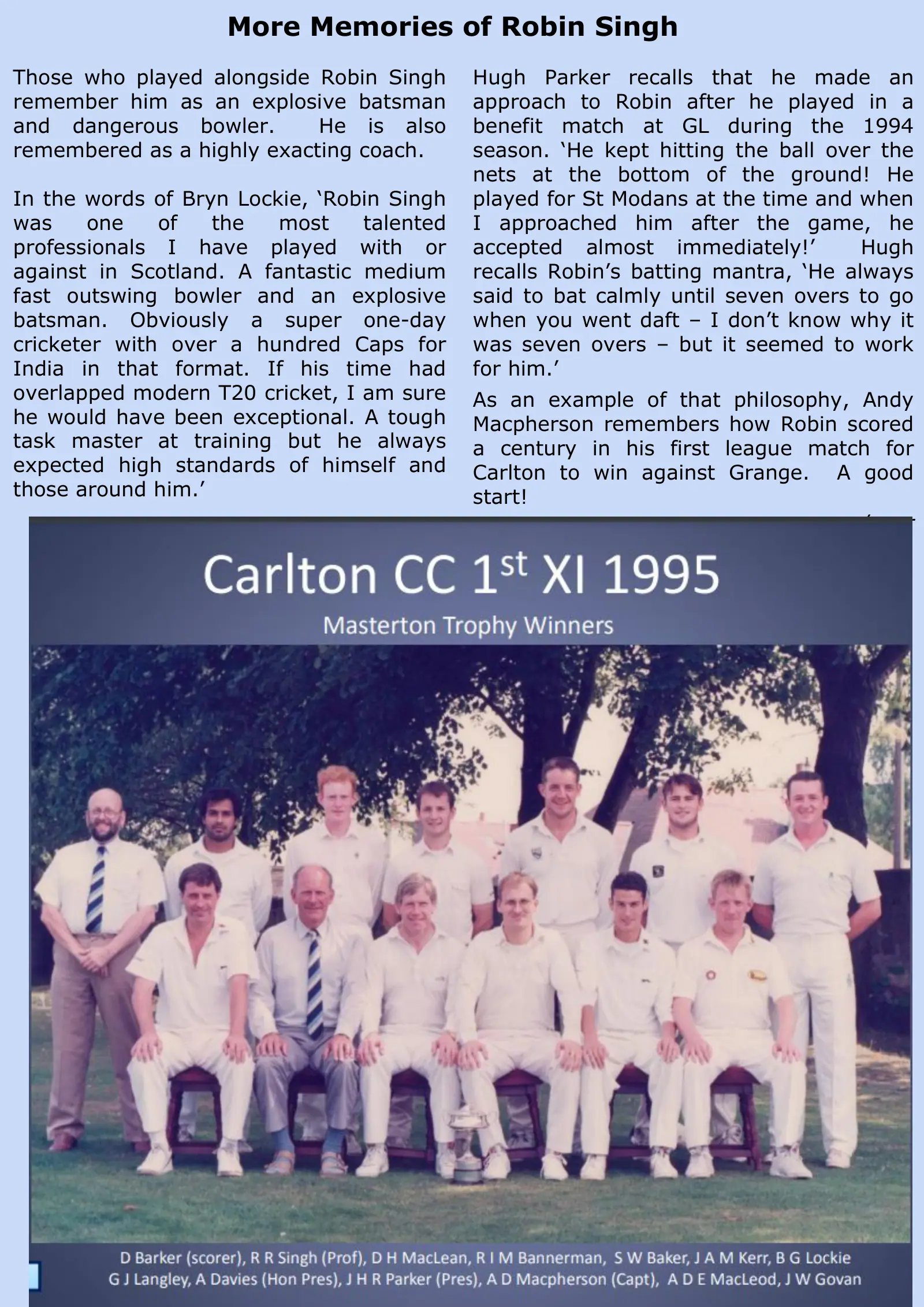
Robin Singh in last 7 overs mode for
India (see text over) - see him in this
clip despatch Shane Warne during
the 1999 World Cup
Text of this page
Hugh Parker recalls that he made an
approach to Robin after he played in a
benefit match at GL during the 1994
season. ‘He kept hitting the ball over the
nets at the bottom of the ground! He
played for St Modans at the time and when
I approached him after the game, he
accepted almost immediately!’ Hugh
recalls Robin’s batting mantra, ‘He always
said to bat calmly until seven overs to go
when you went daft – I don’t know why it
was seven overs – but it seemed to work
for him.’
As an example of that philosophy, Andy
Macpherson remembers how Robin scored
a century in his first league match for
Carlton to win against Grange. A good
start!
/over
More Memories of Robin Singh
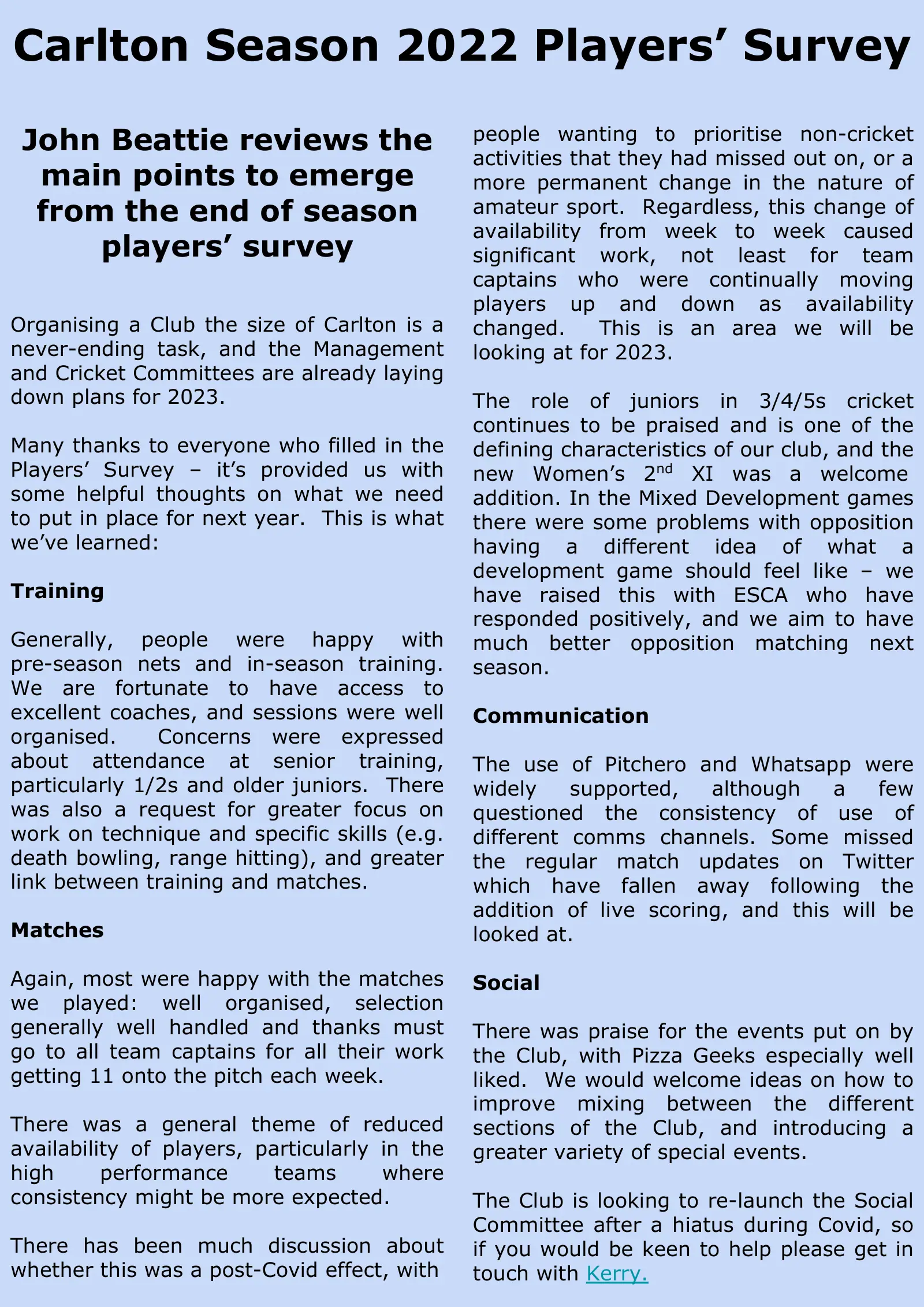
Those who played alongside Robin Singh
remember him as an explosive batsman
and dangerous bowler. He is also
remembered as a highly exacting coach.
In the words of Bryn Lockie, ‘Robin Singh
was
one
of
the
most
talented
professionals I have played with or
against in Scotland. A fantastic medium
fast outswing bowler and an explosive
batsman. Obviously a super one-day
cricketer with over a hundred Caps for
India in that format. If his time had
overlapped modern T20 cricket, I am sure
he would have been exceptional. A tough
task master at training but he always
expected high standards of himself and
those around him.’
Text of this page
Robin
is
also
remembered
as
an
exceptional fielder, he once took five
catches in a match against Freuchie. As
Andy says, ‘It was no surprise when he
was appointed India fielding coach after
his playing days were over.’
Alan McLeod also recalls him as a bowler,
‘Robin’s
time
at
Carlton
was
before
reverse-swing
was
as
common
a
phenomenon as it is these days, but Robin
was ahead of the game and understood
how to do this. It was quite funny when he
was bowling as he would not allow anyone
else in the team to touch the ball.
‘The wicket-keeper had to just throw the
ball straight back to him to avoid any idiot
in the team getting moisture on the wrong
side of the ball!’
David McLean kept to Robin and also
remembers his early mastery of reverse
swing, ‘We would quite often go out to the
middle and he would bowl while I kept. It
was very interesting speaking to him to
learn where he was looking to bowl
particular deliveries and to see the control
he had of the ball.’
David also remembers during practice
once being with him at the top of his
run-up and demonstrating his change in
grip - whereas his previous inswinger had
crashed into the batter’s pads, his next
ball was a huge outswinger which the
batter ‘missed by 4 feet!’
But, Alan recalls, Robin’s competitiveness
could also get the better of him. ‘Ian
Beven
was
professional
at
West
of
Scotland (and subsequently Grange) in
those days, a highly competitive Aussie
and fine cricketer. I remember that he
managed to wind-up Robin during a match
against West of Scotland at Grange Loan.
Bev just kept talking to Robin, tempting
him to hit it out of the ground. In the end
Robin fell for it and was caught out at cow
corner to the delight of Bev!
‘Happy Days!’
/cont’d
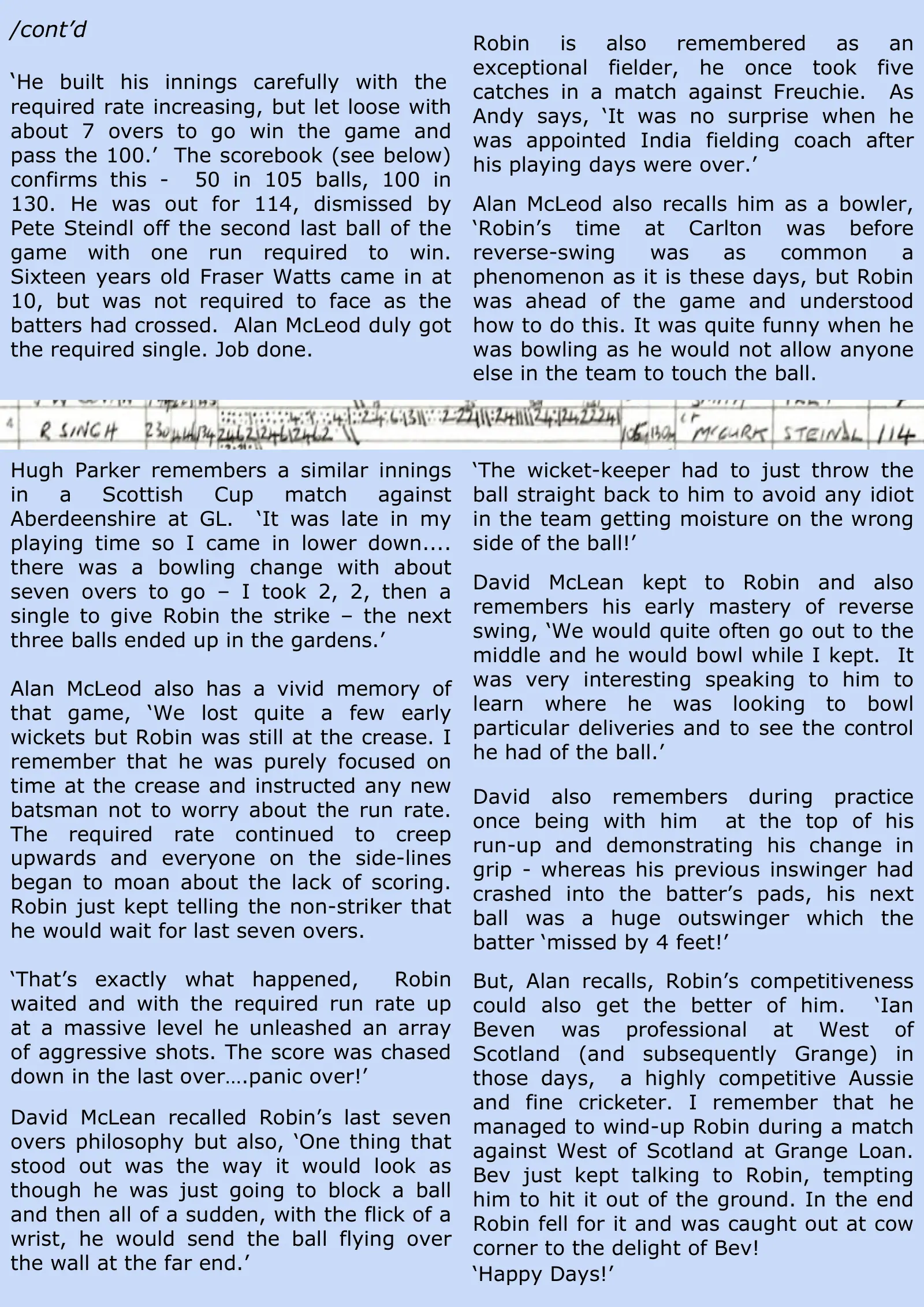
‘He built his innings carefully with the
required rate increasing, but let loose with
about 7 overs to go win the game and
pass the 100.’ The scorebook (see below)
confirms this - 50 in 105 balls, 100 in
130. He was out for 114, dismissed by
Pete Steindl off the second last ball of the
game with one run required to win.
Sixteen years old Fraser Watts came in at
10, but was not required to face as the
batters had crossed. Alan McLeod duly got
the required single. Job done.
Hugh Parker remembers a similar innings
in
a
Scottish
Cup
match
against
Aberdeenshire at GL. ‘It was late in my
playing time so I came in lower down....
there was a bowling change with about
seven overs to go – I took 2, 2, then a
single to give Robin the strike – the next
three balls ended up in the gardens.’
Alan McLeod also has a vivid memory of
that game, ‘We lost quite a few early
wickets but Robin was still at the crease. I
remember that he was purely focused on
time at the crease and instructed any new
batsman not to worry about the run rate.
The required rate continued to creep
upwards and everyone on the side-lines
began to moan about the lack of scoring.
Robin just kept telling the non-striker that
he would wait for last seven overs.
‘That’s exactly what happened, Robin
waited and with the required run rate up
at a massive level he unleashed an array
of aggressive shots. The score was chased
down in the last over….panic over!’
David McLean recalled Robin’s last seven
overs philosophy but also, ‘One thing that
stood out was the way it would look as
though he was just going to block a ball
and then all of a sudden, with the flick of a
wrist, he would send the ball flying over
the wall at the far end.’

Text of this page
I joined Carlton from Edinburgh CC half
way through season 2006. My main
reason for moving was that the level of
cricket played in Edinburgh wasn’t high
enough for what I wanted going forward
playing for East of Scotland and Scotland
respectively.
The main reason for picking Carlton was
that I knew some players already (Charles
Legget, Ali Evans, Steven Elder Craig
Marshall) who I had played with in
representative games.
Just about my first game for the 1s was
against Grange away - when I got my first
wicket against them (Jonny ‘biscuits’ Gray
- stumped by Jamie Kerr) in a brilliant win
for us!
I’ve had many great games for Carlton,
but I think my best games were home
games against Heriots and Dunfermline
getting 13 wickets in total (6 against
Heriots and 7 for against Dunfermline ).
Another to note was against Ayr in a
Scottish Cup match in 2011. They had
New Zealand test cap Michael Papps who
got a ton. I bowled 10 overs for a measly
11 runs and took 1 wicket - not bad - but
sadly it was in a losing cause.
Omar Ahmad
188 wickets including seven
5 wkt hauls in 155 First
Team matches. His best
return was 7-20 against
Forfarshire in 2014 at GL.
The Carlton green-top legend
talks about his career at
Carlton and his new role as
Head of Carlton’s Diversity
Committee.
Cedric English was probably the best
coach I played under. He corrected my
bowling action and introduced me to
bowling
my
‘famous’
stock
ball
outswinger.
Who
have
been
the
most
difficult
opponents? As I have played for over 13
years there have been a lot of tough
opponents, Grange in their prime were a
good side and Heriot’s now are probably
the best team I’ve seen.
5-23 at Myreside, May 2021
On the way to 7-20 in 2014

Text of this page
The Club’s Culture Statement sets out the importance which Carlton places on
inclusivity – Carlton is a Club for everyone. We not only respect differences,
but view diversity as a key element for our long-term success.
I am therefore very pleased to head Carlton’s new Diversity Committee -
which we have started for everyone - from different social and economical
backgrounds, different ethnicities, women, LGBT community. All are part of,
and welcome at, Carlton. We must continue to ensure that is the case.
Many can feel as if they have no voice. No one to approach. No one in the
management committee to hear their issues.
We want to make sure that Carlton is a fair and fun place to play and be a
part of, which is why we created the diversity committee. We saw all the bad
news from Yorkshire and Cricket Scotland last year and are determined to
make sure this wasn’t happening or won’t happen in the future at Carlton.
The main issue we face after speaking with many different players within
Carlton is the treatment they feel they get. Unfortunately some players feel
as if they get overlooked; picked on; forgotten about. And not coached
enough due to being in one of the categories above. We will ensure that all
these issues are addressed.
We want to ensure that women to feel more involved within the club. People
from different backgrounds to feel like they are no different from anyone else.
And most importantly have a place where people can come to for advice or to
have their voices heard.
So far Umair, Kerry, Fraggle, Anish and Siobhan have joined the discussion -
but we would be pleased to hear from anyone else who wishes to play a part.
Watch out also for news of a special email address through which anyone with
any concerns can raise issues in confidence.
Carlton welcomes the recent appointment of Anjan Luthra as Chair of Cricket
Scotland and looks forward to working with him to ensure that cricket is a
fully inclusive activity.
Omar on the Diversity Committee
‘Carlton Cricket Club believes that all people,
regardless of age, culture, disability, gender,
language, race, socio-economic status, religious
belief and/or sexual orientation have the right to
participate in cricket and to receive protection
from abuse.’
Carlton CC Equality Statement

Text of this page
Raise funds for
Carlton Cricket
Club whenever
you shop online
All you have to do is click on
this link and that will take
you
to
Carlton's
Easy
Fundraising page to register.
Then either use the website
or mobile app every time you
shop. It’s that easy.
CHRISTMAS RAPIDLY
APPROACHES
A PRESENT OF CARLTON KIT
OR LEISURE WEAR IS
ALWAYS WELCOME
THE FULL RANGE IS
AVAILABLE THROUGH
BRUNTSFIELD SPORTS.
SWEATER NEWS
Martin Robertson says he has one
Carlton Heritage Sweater available -
Sleeveless - size XL - £65.
Martin is also happy to put together
another order with the manufacturers
if there is wider interest. An order
early in the next couple of months
should ensure that the sweaters are
available by the start of next season.
Interested?
Get in touch with Martin direct.
Text of this page
John Beattie reviews the
main points to emerge
from the end of season
players’ survey
Organising a Club the size of Carlton is a
never-ending task, and the Management
and Cricket Committees are already laying
down plans for 2023.
Many thanks to everyone who filled in the
Players’ Survey – it’s provided us with
some helpful thoughts on what we need
to put in place for next year. This is what
we’ve learned:
Training
Generally,
people
were
happy
with
pre-season nets and in-season training.
We are fortunate to have access to
excellent coaches, and sessions were well
organised. Concerns were expressed
about
attendance
at
senior
training,
particularly 1/2s and older juniors. There
was also a request for greater focus on
work on technique and specific skills (e.g.
death bowling, range hitting), and greater
link between training and matches.
Matches
Again, most were happy with the matches
we
played:
well
organised,
selection
generally well handled and thanks must
go to all team captains for all their work
getting 11 onto the pitch each week.
There was a general theme of reduced
availability of players, particularly in the
high
performance
teams
where
consistency might be more expected.
There has been much discussion about
whether this was a post-Covid effect, with
people wanting to prioritise non-cricket
activities that they had missed out on, or a
more permanent change in the nature of
amateur sport. Regardless, this change of
availability from week to week caused
significant
work,
not
least
for
team
captains who were continually moving
players
up
and
down
as
availability
changed. This is an area we will be
looking at for 2023.
The role of juniors in 3/4/5s cricket
continues to be praised and is one of the
defining characteristics of our club, and the
new Women’s 2nd XI was a welcome
addition. In the Mixed Development games
there were some problems with opposition
having
a
different
idea
of
what
a
development game should feel like – we
have raised this with ESCA who have
responded positively, and we aim to have
much better opposition matching next
season.
Communication
The use of Pitchero and Whatsapp were
widely
supported,
although
a
few
questioned the consistency of use of
different comms channels. Some missed
the regular match updates on Twitter
which have fallen away following the
addition of live scoring, and this will be
looked at.
Social
There was praise for the events put on by
the Club, with Pizza Geeks especially well
liked. We would welcome ideas on how to
improve mixing between the different
sections of the Club, and introducing a
greater variety of special events.
The Club is looking to re-launch the Social
Committee after a hiatus during Covid, so
if you would be keen to help please get in
touch with Kerry.
Carlton Season 2022 Players’ Survey
Text of this page
We are all familiar with the wrong kind of
things. The wrong kind of leaves or snow
frequently disrupt our transport system. In
sport generally and cricket in particular, we
often hear about the wrong kind of bounce,
the wrong colour of pitch and commentators
who are paid to know about these things talk
about cracks. But is it justified?
Either side of the millennium, the ECB
commissioned
a
study
into
First
Class
pitches. It took into account not only
Captains’ and Umpires’ pitch reports, but
weather data and soil samples from the
pitches. It presented a picture of runs per
wicket (rpw) for each feature. Some results
tended
to
confirm
existing
opinions/prejudices.
For
example,
cloudy
days and green pitches tended to result in a
lower rpw - a loose correlation.
However, when it came to cracks, there was
no correlation. Extreme examples had a
match with a rpw figure of less than 10
(fancy
a
bowl
anyone),
whilst
another
produced a figure of over 150 (fancy a bat
anyone). Both pitches had cracks, so what
was going on?
If you ask cricketers what produces a good
cricket pitch, many will say rolling, some will
say watering, and others mowing. Very few
will say soil type or grass root system.
The soil type we use is loam and the
constituent that we are interested in is clay.
Loam used for cricket in the UK has a clay
content of 24 – 40%. Carlton has >30% clay.
The Oval tops the UK with 40% and the
WACA in Perth tops the world with 70%.
Clay has four features that interest us:
●
Each clay particle is small <0.002mm
●
It is flat - plate like
●
Each particle carries a small covalent
electric charge
●
Clay shrinks when it dries.
When compressed, the electrical charges
attract covalently and although each charge is
small, the millions of particles bond to form a
solid and hard area.
Uncompressed, the soil will break up when it
dries due to shrinking. However, compressed
the soil will stick together much better, but
two competing forces are at work: shrinking
and the covalent bonding. As the clay shrinks,
the distance between particles increase and
the bonds weaken. What holds it together is
the
root
system,
but
it
has
to
break
somewhere and that is when cracks develop.
There will be a weak point in the soil or root
system somewhere and the cracks will develop
from that point.
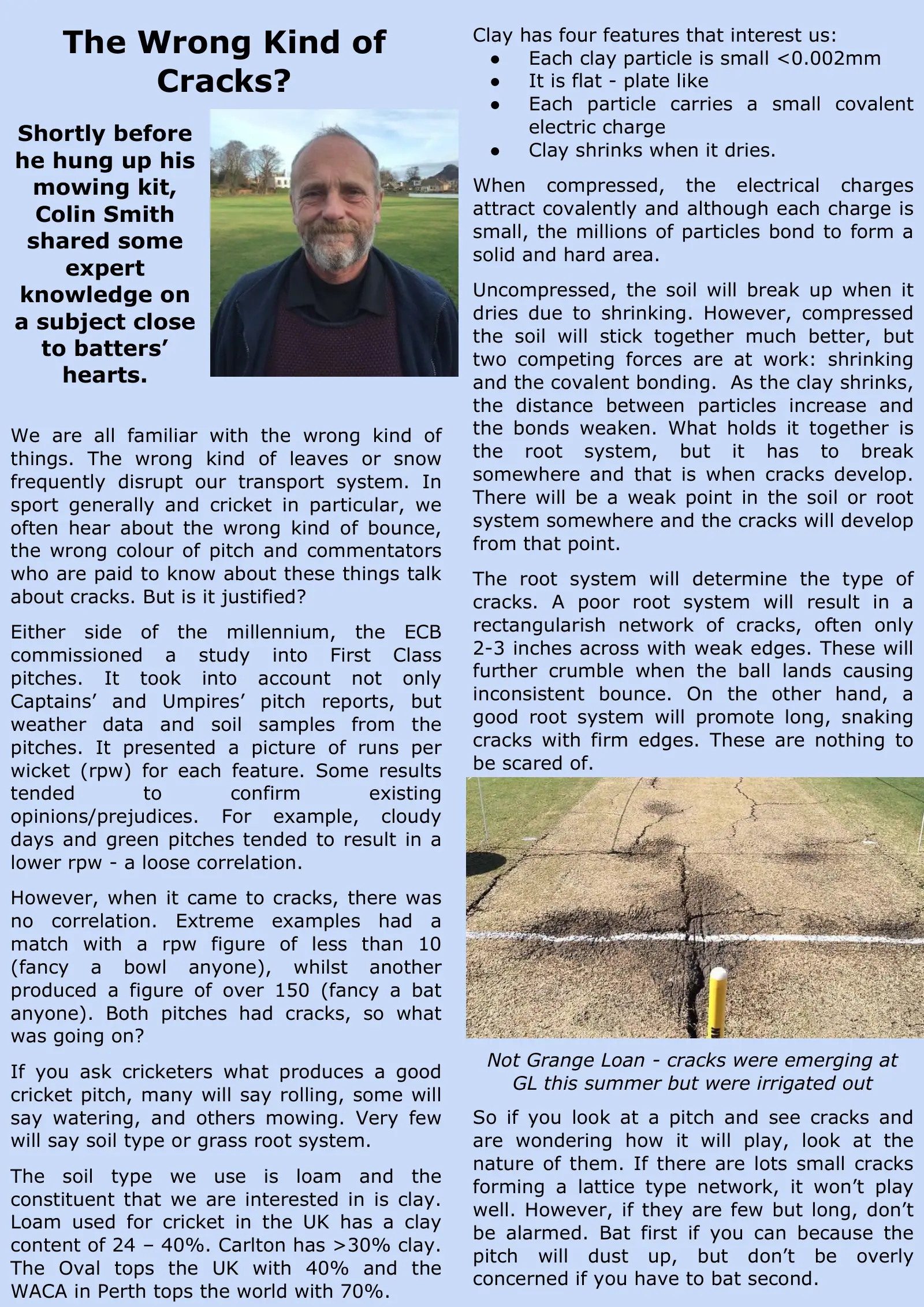
The root system will determine the type of
cracks. A poor root system will result in a
rectangularish network of cracks, often only
2-3 inches across with weak edges. These will
further crumble when the ball lands causing
inconsistent bounce. On the other hand, a
good root system will promote long, snaking
cracks with firm edges. These are nothing to
be scared of.
So if you look at a pitch and see cracks and
are wondering how it will play, look at the
nature of them. If there are lots small cracks
forming a lattice type network, it won’t play
well. However, if they are few but long, don’t
be alarmed. Bat first if you can because the
pitch will dust up, but don’t be overly
concerned if you have to bat second.
Not Grange Loan - cracks were emerging at
GL this summer but were irrigated out
Shortly before
he hung up his
mowing kit,
Colin Smith
shared some
expert
knowledge on
a subject close
to batters’
hearts.
The Wrong Kind of
Cracks?
Text of this page
Hi everyone! I was asked to write a wee
article after the conclusion of my first
Women’s Premier season with Carlton. It
was a summer of mostly highs, a few lows
and a lot cricket played; my first ever 50 is
a standout high (in a preseason friendly)
along with a high score of 33* in the
league, taking a couple of wickets and
bowling many, many wides!
My love of cricket started much like my
love of most sports; my older brother
started playing and I was determined to be
better than him! Luckily Sam wanted to be
a bowler which meant I got hours of
batting practice, which I loved, and we
avoided the two footed challenges of our
football tussles! With cricket my goal was
always to hit him as far over the fence as
possible. Sometimes it worked out, often
my bails went flying and more than a
couple of times it resulted in the breaking
of windows. A love of batting was born
and my want to swing hard (often against
my better judgement) has never left, the
only difference now is the result of often
getting out LBW, (as my wife has kindly
reminded my whilst writing this article).
People are regularly surprised to hear that
this was my first full season playing club
cricket, despite playing for most of my
childhood. Unfortunately, due to a lack of a
girls’ team at our local club and a busy
sporting schedule of tennis, football and
athletics it never quite worked out for me
to join a club. Most of my school friends
played though, so I spent much of my
summer holidays in the nets at the boy’s
school.
With one of Kent’s CC grounds in our town
we often went down to T20 games and
even managed the odd test match at the
Oval or Lords. We also played a lot (and I
mean a lot) of Brian Lara International
Cricket on PS2!
In my later teens, I played more and more
football and tennis and ultimately I turned
this into a career, moving out to New
Zealand to work as a full-time tennis
coach. My coaching career was short lived
though due to sustaining a series of stress
fractures in my back, which resulted in me
not being able to play any sports for a
couple of years, until last summer when I
was able to have a small procedure which
resulted in being relatively pain free for
the first time in years.
It was post lockdown(s) and being new to
Edinburgh, I decided the time was right to
start playing cricket again, even with a
rather stiff spine. The fast (ish) bowling of
my youth is no more, I have to be
cautious of not getting carried away with
the bat and my fielding is… how to say
this…
not
very
graceful!
But
I
am
absolutely loving playing again!
It’s fair to say; I don’t like cricket, I love
it!
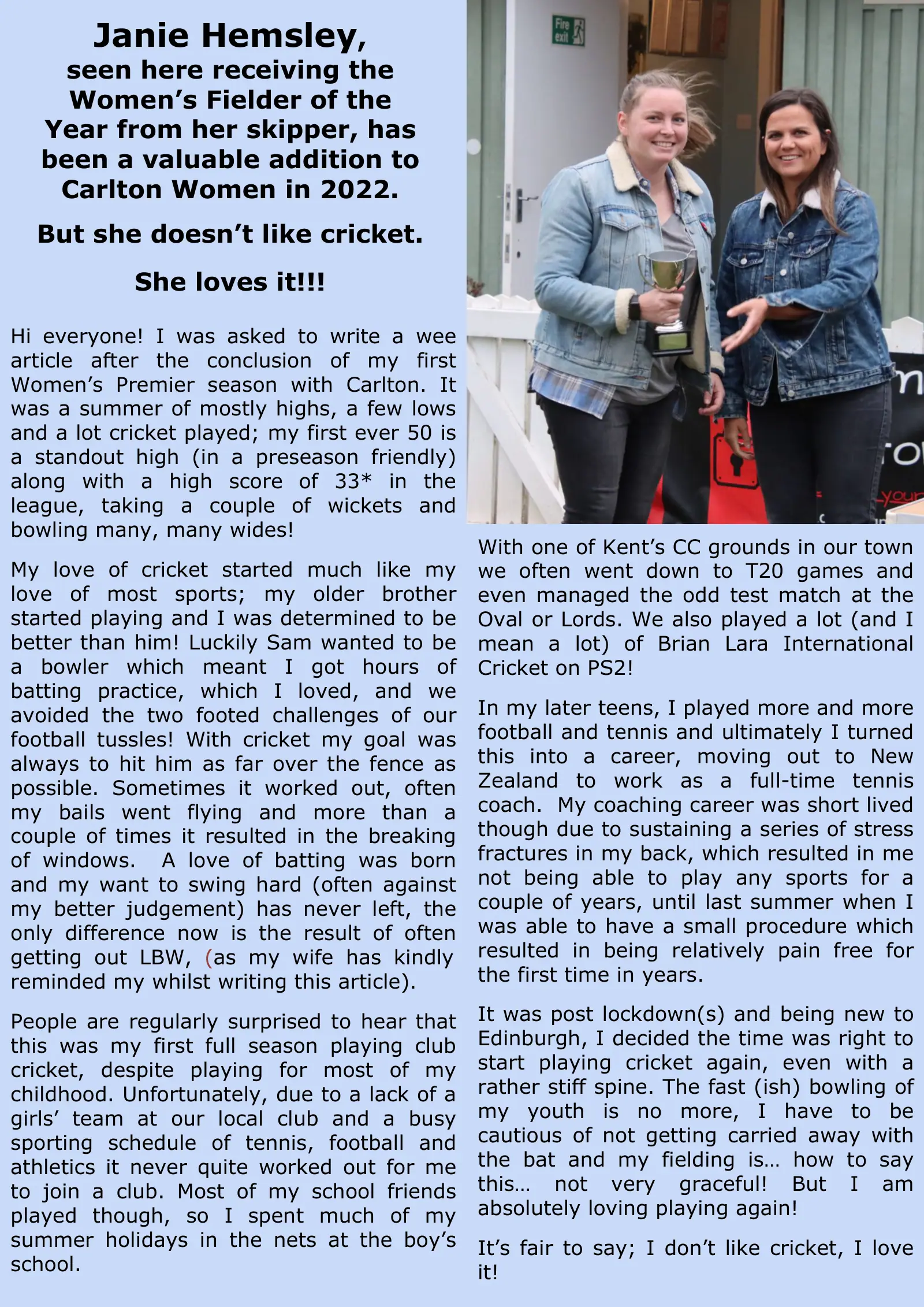
Janie Hemsley,
seen here receiving the
Women’s Fielder of the
Year from her skipper, has
been a valuable addition to
Carlton Women in 2022.
But she doesn’t like cricket.
She loves it!!!
Text of this page
Most years I find myself wondering at
some point or other, usually after a low
score, whether I really want to spend my
weekends during the best part of the year
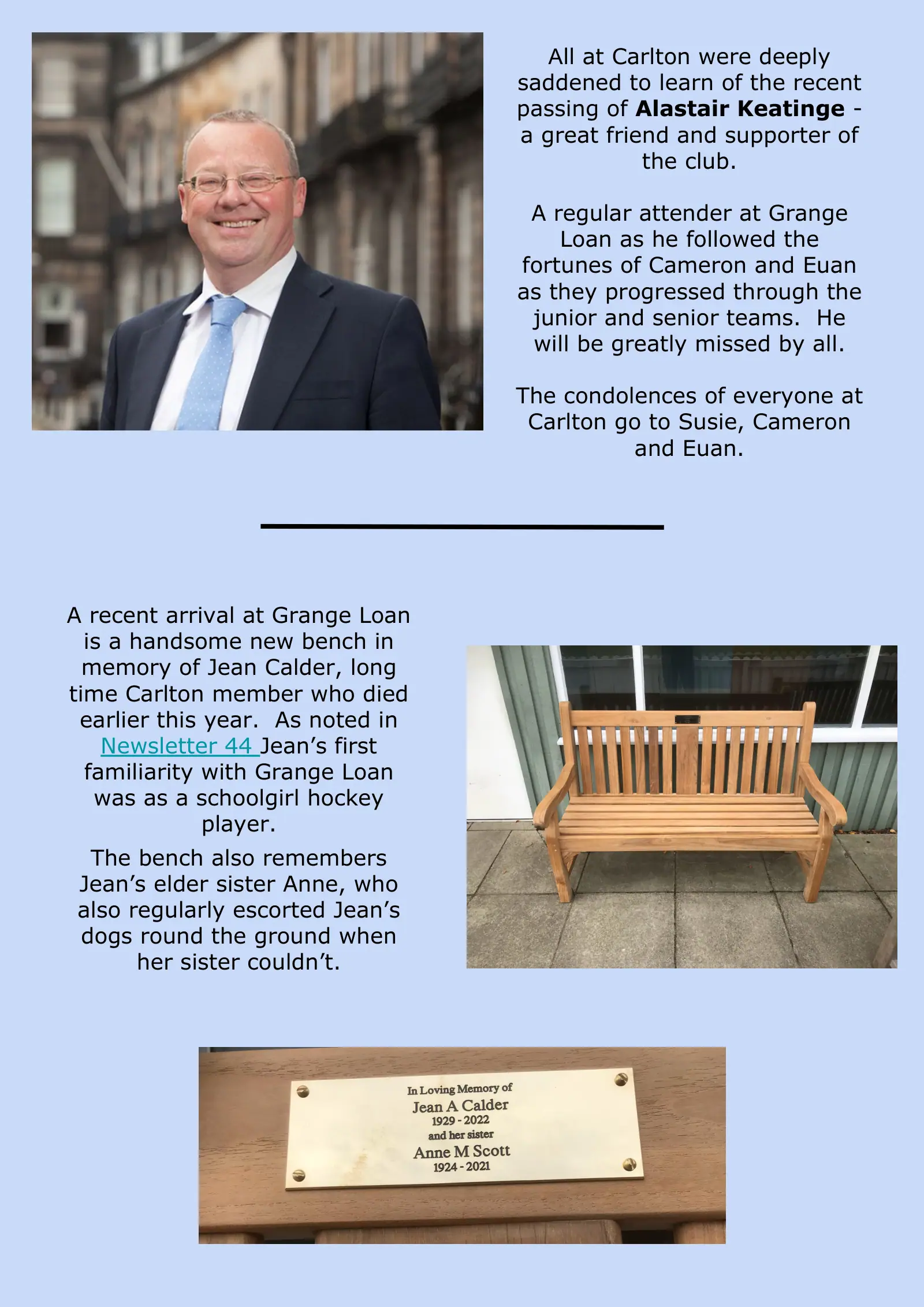
at Peffermill, when I might otherwise be in
a tent in the mountains (see photo below)
or spending long days on the bike. So I’ll
leave the “why cricket” part for now, and
focus on Carlton.
I arrived at Grange Loan in 2014 and was
welcomed into a 2nd XI side that escaped
relegation by the barest of margins (ask
Brad about that one - or see Newsletter
19). A glance at Brian’s stats page tells me
that I played 54 games for the 2nd team;
and then, since 2018, when I was
overtaken by a whole load of younger,
more talented players coming up through
the club, another 30-odd for the 3’s.
While lots of things have changed in that
time, playing cricket at Carlton has been a
constant part of my life since I moved
back to Edinburgh.
But it’s still hard to sum up what I’ve got
from the club over the years, and why I
keep coming back each season; and so I
found myself thinking about the game I
played this year before an enforced
mid-season break.
It was at Barnton, and I’d spent the last
15 overs at point watching a pair of
“Carlton juniors” absolutely tear through
the opposition top order, reducing them to
40 for 6. Earlier in the day, a few of the
“Carlton seniors” had batted us to a decent
total of 200 or so. And now we were stood
around in the evening sunshine: a team
spanning
a
range
of
ages
that
–
notwithstanding the select few excitedly
shouting “cricket!” at seemingly random
intervals – genuinely enjoy each other’s
company and success (so much so that I
even got to come onto bowl at the number
11 at the end of the innings).
That moment seemed to encapsulate what
it is that I love about playing at the club,
and in my experience it’s a dynamic that’s
quite unique. So, for now, the answer to
“why cricket?” is probably, “Carlton”. And
as long as there are still juniors shouting,
“you’re still in your prime”, as I pick
myself up from diving to stop a ball, I
reckon I’ll be back next season too.
Ben was awarded the 3rd XI Batting Award
this season.
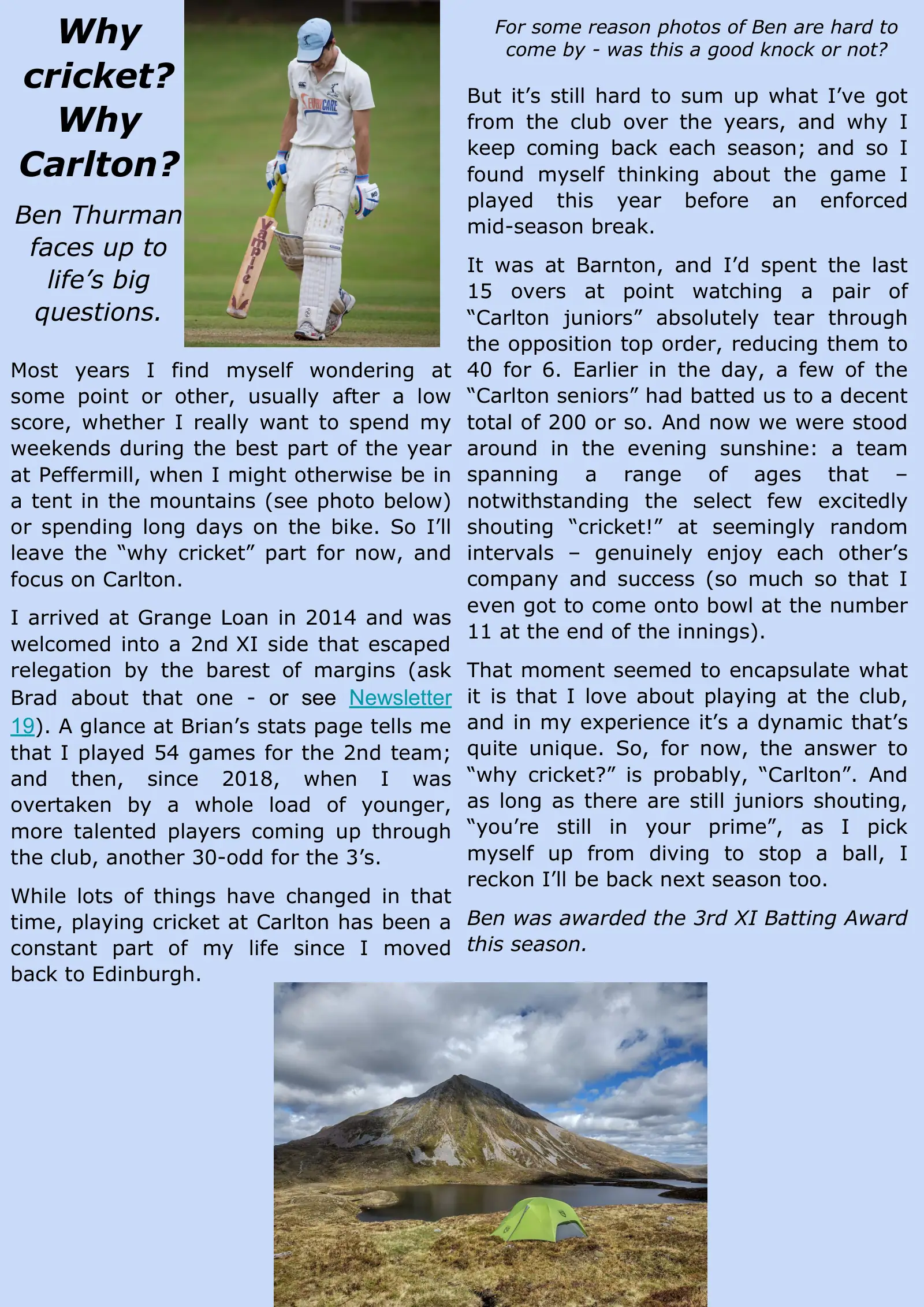
For some reason photos of Ben are hard to
come by - was this a good knock or not?
Why
cricket?
Why
Carlton?
Ben Thurman
faces up to
life’s big
questions.
Text of this page
All at Carlton were deeply
saddened to learn of the recent
passing of Alastair Keatinge -
a great friend and supporter of
the club.
A regular attender at Grange
Loan as he followed the
fortunes of Cameron and Euan
as they progressed through the
junior and senior teams. He
will be greatly missed by all.
The condolences of everyone at
Carlton go to Susie, Cameron
and Euan.
A recent arrival at Grange Loan
is a handsome new bench in
memory of Jean Calder, long
time Carlton member who died
earlier this year. As noted in
Newsletter 44 Jean’s first
familiarity with Grange Loan
was as a schoolgirl hockey
player.
The bench also remembers
Jean’s elder sister Anne, who
also regularly escorted Jean’s
dogs round the ground when
her sister couldn’t.
Text of this page
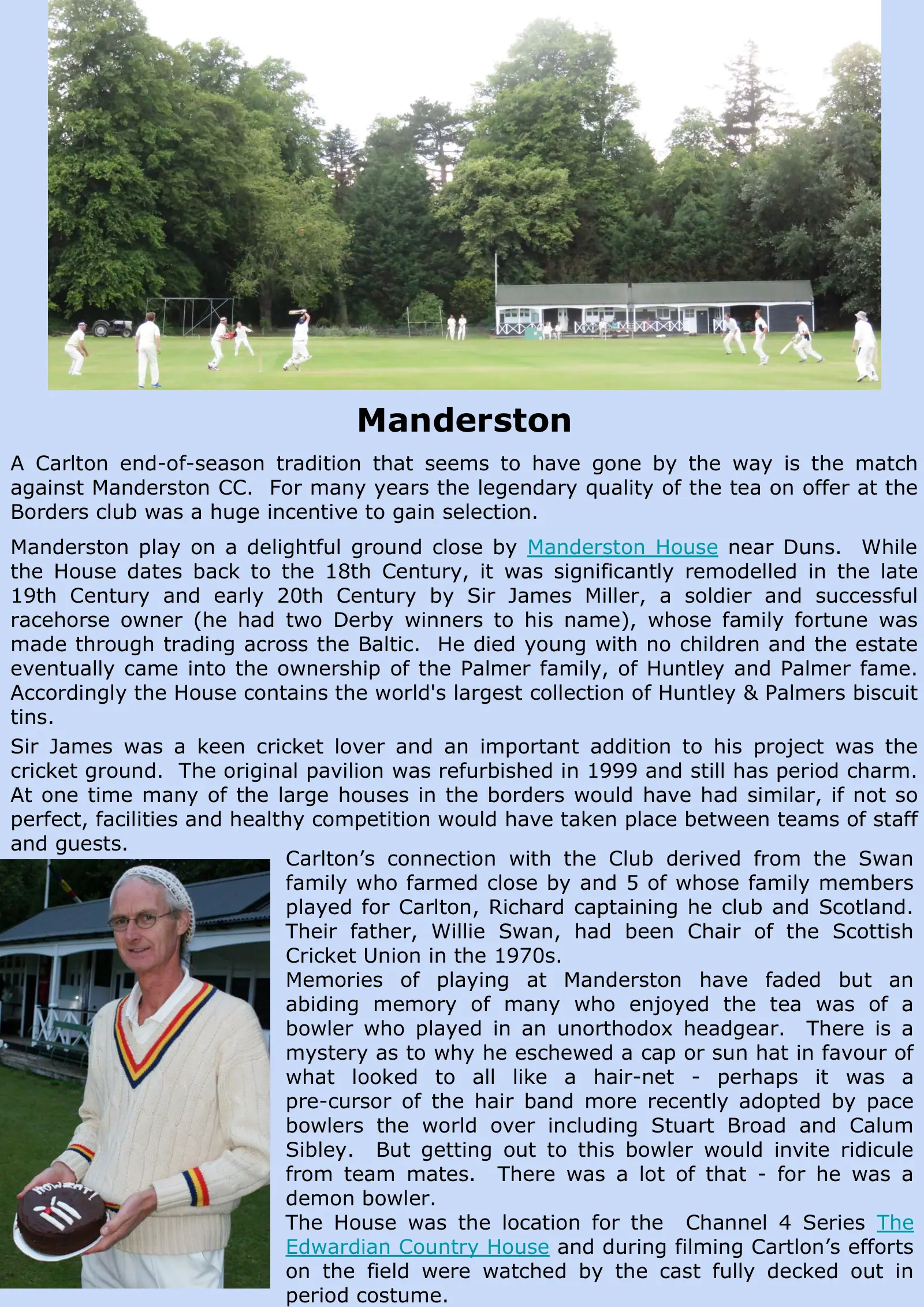
Manderston
A Carlton end-of-season tradition that seems to have gone by the way is the match
against Manderston CC. For many years the legendary quality of the tea on offer at the
Borders club was a huge incentive to gain selection.
Manderston play on a delightful ground close by Manderston House near Duns. While
the House dates back to the 18th Century, it was significantly remodelled in the late
19th Century and early 20th Century by Sir James Miller, a soldier and successful
racehorse owner (he had two Derby winners to his name), whose family fortune was
made through trading across the Baltic. He died young with no children and the estate
eventually came into the ownership of the Palmer family, of Huntley and Palmer fame.
Accordingly the House contains the world's largest collection of Huntley & Palmers biscuit
tins.
Sir James was a keen cricket lover and an important addition to his project was the
cricket ground. The original pavilion was refurbished in 1999 and still has period charm.
At one time many of the large houses in the borders would have had similar, if not so
perfect, facilities and healthy competition would have taken place between teams of staff
and guests.
Carlton’s connection with the Club derived from the Swan
family who farmed close by and 5 of whose family members
played for Carlton, Richard captaining he club and Scotland.
Their father, Willie Swan, had been Chair of the Scottish
Cricket Union in the 1970s.
Memories of playing at Manderston have faded but an
abiding memory of many who enjoyed the tea was of a
bowler who played in an unorthodox headgear. There is a
mystery as to why he eschewed a cap or sun hat in favour of
what looked to all like a hair-net - perhaps it was a
pre-cursor of the hair band more recently adopted by pace
bowlers the world over including Stuart Broad and Calum
Sibley. But getting out to this bowler would invite ridicule
from team mates. There was a lot of that - for he was a
demon bowler.
The House was the location for the Channel 4 Series The
Edwardian Country House and during filming Cartlon’s efforts
on the field were watched by the cast fully decked out in
period costume.